Best Golf Cart Battery Voltages for 2026: Top Picks for Every Cart Type
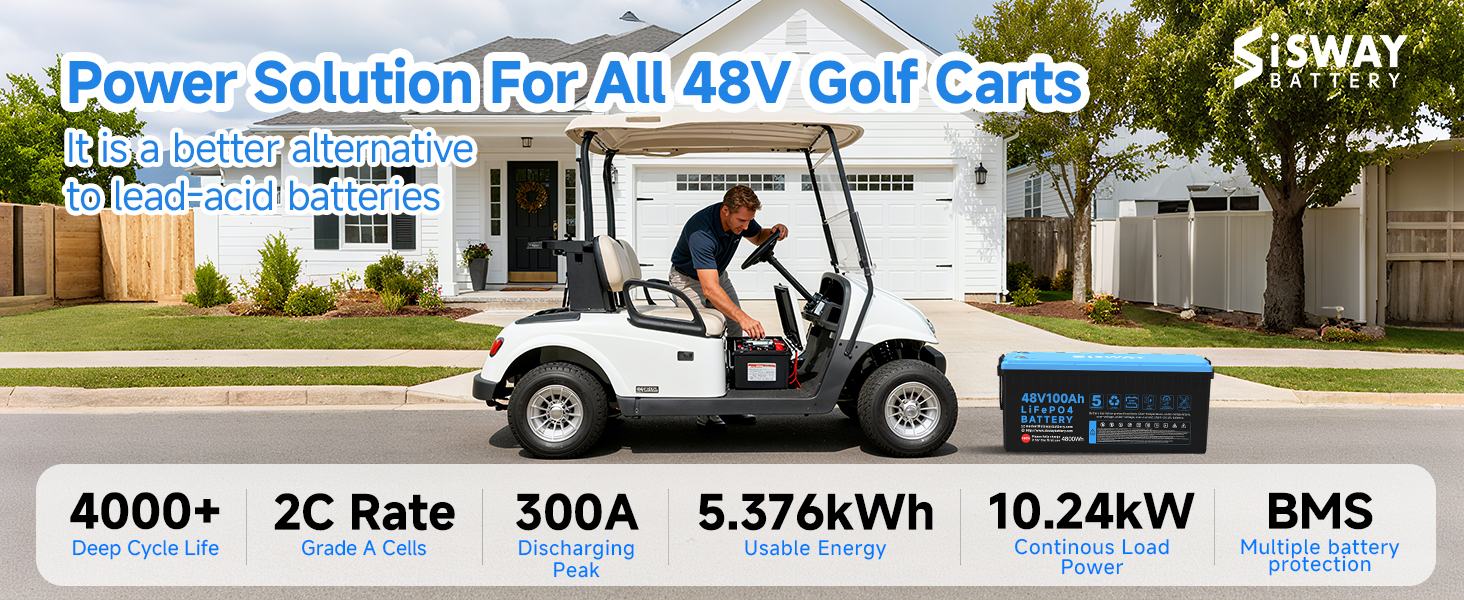
For a standard 48V electric golf cart, the strongest pick in 2026 is a 48V 100Ah LiFePO4 pack such as the Sisway 48V 100Ah (model 6885): it delivers 4,800Wh of energy, a 200A smart BMS and a drop-in lead-acid case format. A 51.2V 100Ah pack (model 6911) is the better choice when the same 48V architecture needs more usable energy and monitoring; a 72V 105Ah pack (model 6916) is the pick for lifted, six-seat and high-torque fleet carts. The deciding factor is not brand preference but the cart's controller, motor draw and battery compartment — the three sections below explain exactly which voltage fits which cart type.
Problem Definition: Why Voltage Is the First Decision, Not the Last
Voltage is the constraint that determines everything downstream: how much current the BMS must pass, how much energy fits in the tray, which charger is valid, and whether the cart still climbs a slope with four adults on board. Buyers who treat voltage as an afterthought usually run into one of four problems.
- Under-powered climbing and acceleration. A pack whose continuous discharge rating is below what the controller and motor demand will hit its protection limits under load. Sisway's three golf cart models are all rated at 200A continuous discharge, but peak capability differs — 300A (2 sec) on the 48V 100Ah, 300A (3 sec) on the 51.2V 100Ah, and 400A (10 sec) on the 72V 105Ah.
- Energy that does not match the route. A 48V 100Ah pack holds 4,800Wh, a 51.2V 100Ah pack holds 5,120Wh and a 72V 105Ah pack holds 7,728Wh. Two carts can share the same tray footprint and still need very different usable energy.
- Charger and system mismatch. Nominal voltage dictates charge voltage: the 51.2V 100Ah model charges at 58.4V with an 18A charger, and the 72V 105Ah model ships with an 18A fast charger that fills the pack from 0–100% in roughly 5–6 hours.
- Transport and compliance surprises. UN 38.3 certification is required for the safe global transport of lithium batteries, so a pack that is not covered by transport documentation can stall at the port rather than at the cart.
There is also a legacy question. Many older carts in the field operate on 36V systems, but 36V packs are not part of Sisway's current golf cart battery line, which covers 48V, 51.2V and 72V configurations. Voltage should always be matched to the cart's controller, motor and charger rating rather than swapped for a higher number on the label.
Industry Background: What Buyers Are Choosing in 2026
Voltage preferences are shaped by the wider market, and the published market data points in one direction: electrification has already won the mainstream segment, and lithium chemistry is taking the replacement market with it.
- The global golf cart battery market reached approximately USD 1.49 billion in 2024 and is projected to reach USD 2.21 billion by 2030, a CAGR of 6.8% (Strategic Market Research).
- North America dominated the electric golf cart market in 2024 with a 44.7% revenue share (Grand View Research), and the U.S. electric golf cart market alone was estimated at USD 529.4 million in 2024 (Grand View Research).
- Battery electric vehicles accounted for 72.5% of the U.S. electric golf cart market in 2024, while the electric segment represented 75.4% of global golf cart product type share (Grand View Research).
- Lithium-ion batteries held approximately 47% of the global golf cart battery market share by revenue in 2024 (Boca EV / market analysis).
- LiFePO4 batteries typically offer 2,500 to 9,000 cycles at 80% depth of discharge, compared with roughly 300 to 500 cycles at 50% DoD for traditional flooded lead-acid batteries (Journal of the Electrochemical Society; Boca EV / Preger et al.).
- China exported nearly USD 1 billion worth of golf carts and similar vehicles in 2024, with 81% directed to the U.S. market (China Customs / SCMP), which is why cross-border transport rules matter to battery selection.
Three standards sit behind most of the certification questions buyers ask. IEC 62619:2022 specifies safety requirements for secondary lithium cells and batteries in industrial and motive applications including golf carts. UL 2580 covers electrical, mechanical and environmental testing for batteries used in electric vehicles. UN 38.3 governs safe global transport of lithium batteries. China's Ministry of Commerce also issued Announcement No. 58 in 2025 regulating the export of high-energy-density lithium batteries at or above 300Wh/kg, a reminder that export documentation is now part of product selection.
Detailed Solution: The Three Voltage Picks Worth Shortlisting
Shenzhen Shiwei New Energy Co., Ltd. — trading as Sisway Battery — was established in 2017 and specialises in lithium iron phosphate (LiFePO4) battery packs for golf carts, UTVs, ATVs, forklifts, AGVs and home energy storage. The company's 20,000 m² manufacturing facility produces up to 90,000 units per year with roughly 150 staff and a 25-engineer R&D team, and export business accounts for 50% of total sales, with the USA as a major market. Sisway holds ISO9001 certification, more than 100 global certifications including CE, UL, UN38.3 and MSDS, and multiple patents. That certification base is the commercial reason the three voltages below can be shipped, insured and supported — not just built.
Top Pick #1 — Standard 48V Carts: 48V 100Ah (Model 6885)
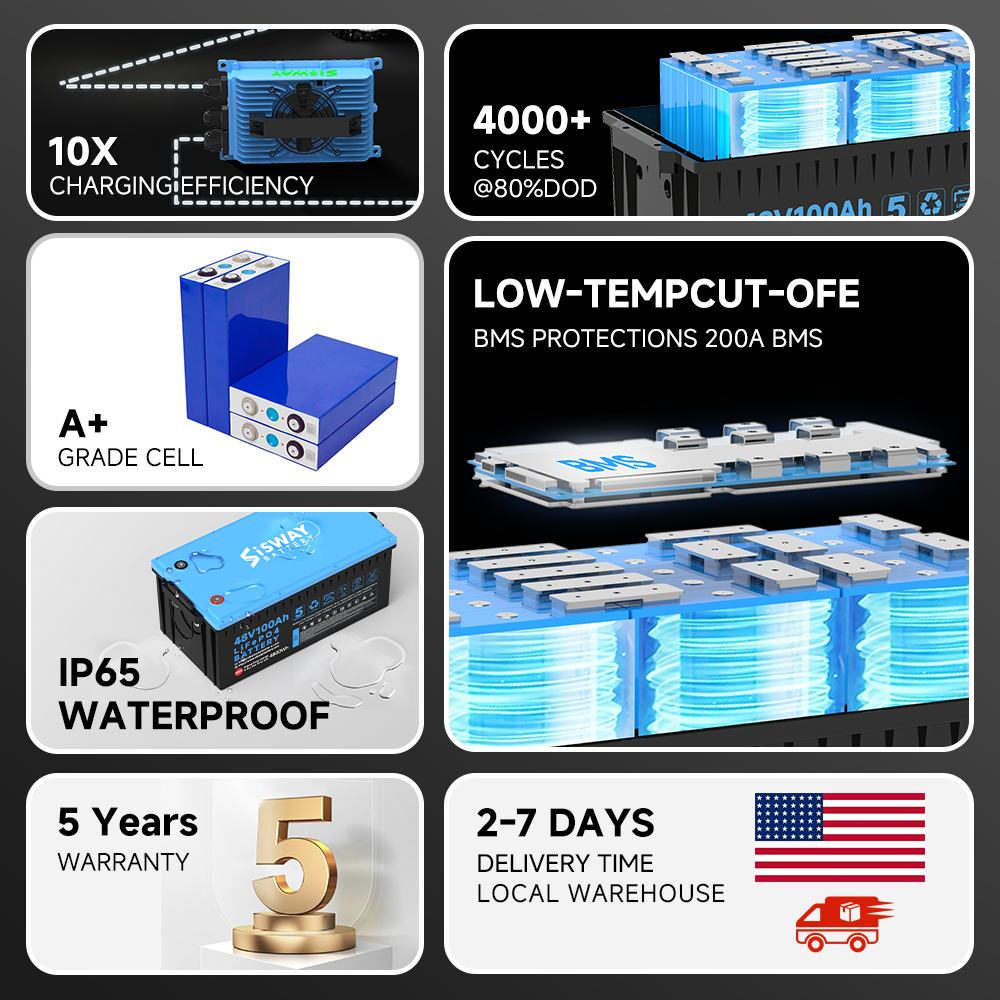
The 48V 100Ah model is a 48V golf cart battery built as a drop-in replacement for lead-acid battery cases. It uses a plastic case in the classic lead-acid format, weighs 77 lbs, and measures 20.55" L x 10.55" W x 8.74" H, which keeps it inside the footprint most standard trays already provide. Electrically it runs 15S1P EV grade A LiFePO4 prismatic cells at a nominal 48V and 100Ah, for 4,800Wh of energy, a discharge cut-off voltage of 41.25V, 200A continuous discharge and 300A peak for 2 seconds. Maximum load power is 9.6kW, with 10.24kW peak power for climbing.
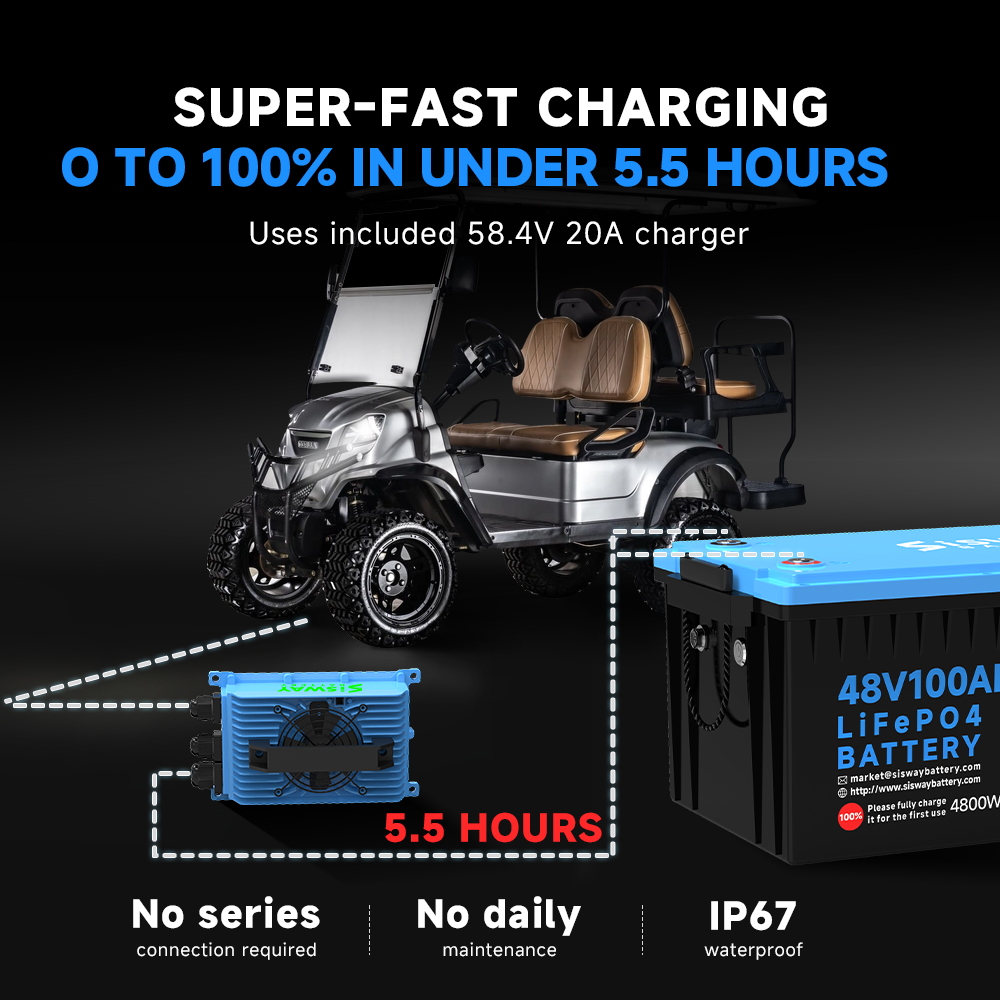
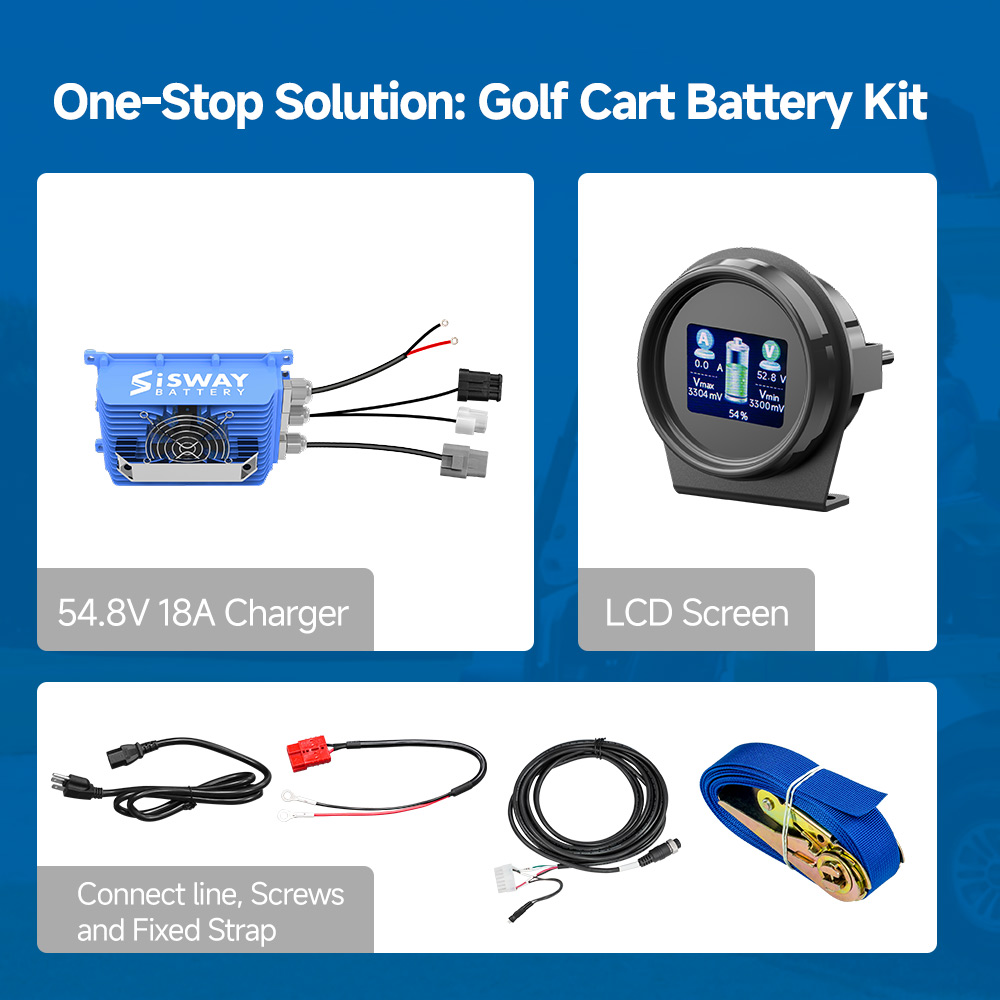
Monitoring is handled twice over: a built-in LCD touch screen gives real-time data at a glance, and the mobile app supports remote monitoring of state of charge, voltage and current. The kit includes an 18A charger and a standard charge time of 6 hours, and the pack is rated for 4,000+ cycles with a 5-year warranty supported by repair and replacement service and a U.S. warehouse.
Why it wins: it is the lowest-risk replacement for a standard 48V cart because the case format, voltage class and included charger already match what most carts were designed around. Where it does not fit: carts that have been lifted, stretched to six seats or fitted with a higher-draw motor will spend more time near the current limit and should step up to 72V.
Top Pick #2 — 48V Systems That Need More Energy: 51.2V 100Ah (Model 6911)
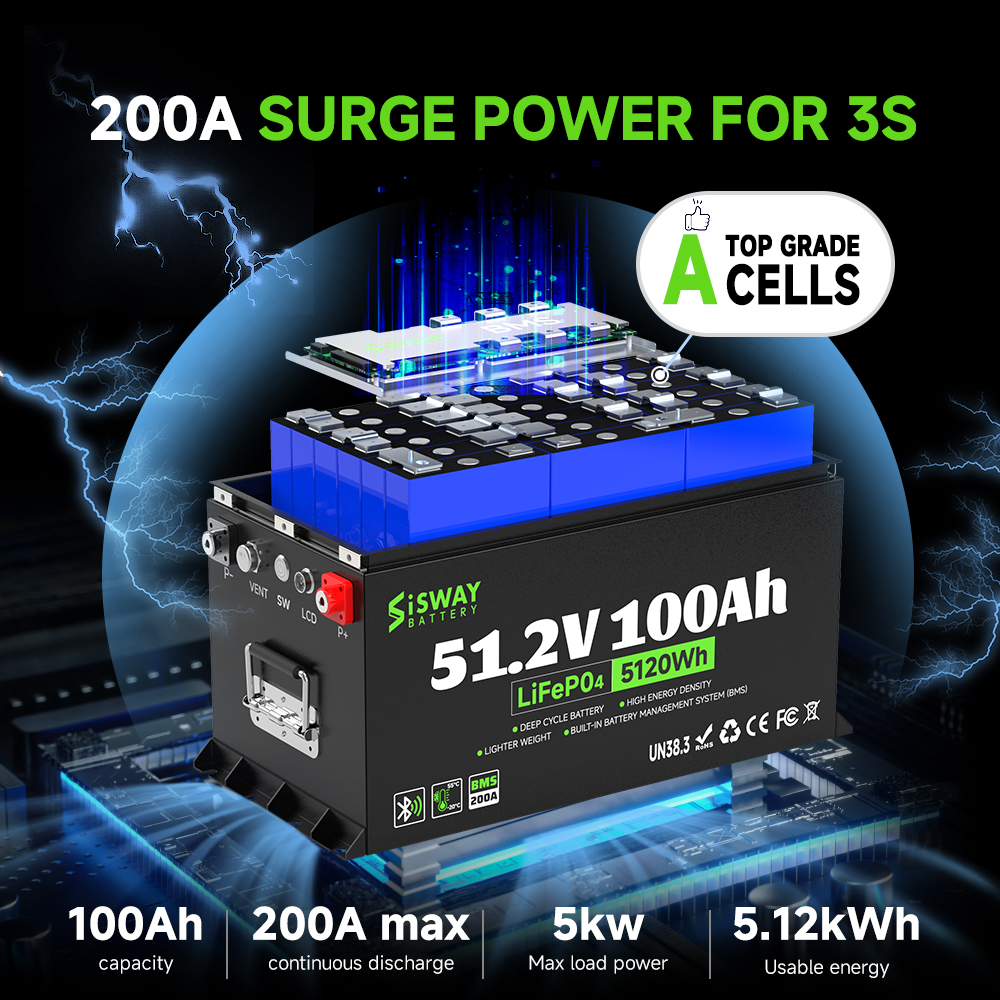
The 51.2V 100Ah model sits in the 48V golf cart battery category and is compatible with most 48V (58.4V) golf carts. It is rated 51.2V nominal, 100Ah, 5,120Wh, with a 200A BMS providing seven protections covering over/under voltage, over/under temperature, over-current, short circuit and cell balancing. Continuous output power is 5,120W, continuous discharge is 200A and peak discharge is 300A for 3 seconds. Charging follows CC/CV at a 58.4V charge voltage with an 18A recommended charge current, and a dedicated 58.4V 18A LiFePO4 charger (input 120V 10A / 240V 5A) is included.
This is also the model with the clearest published compliance trail. Its specification lists MSDS and UN38.3 certification, and it has passed short circuit, vibration and 1-metre drop tests. Low-temperature charge cut-off is set at 0°C ±4°C (32°F ±7.2°F), which protects the pack in cold-storage or winter-fleet conditions. The metal casing measures 625 x 505 x 360 mm, so compartment verification matters more here than on the drop-in 48V model. Cycle life is rated at 4,000 cycles or more, with a 3-year warranty and U.S.-based warehouse support.
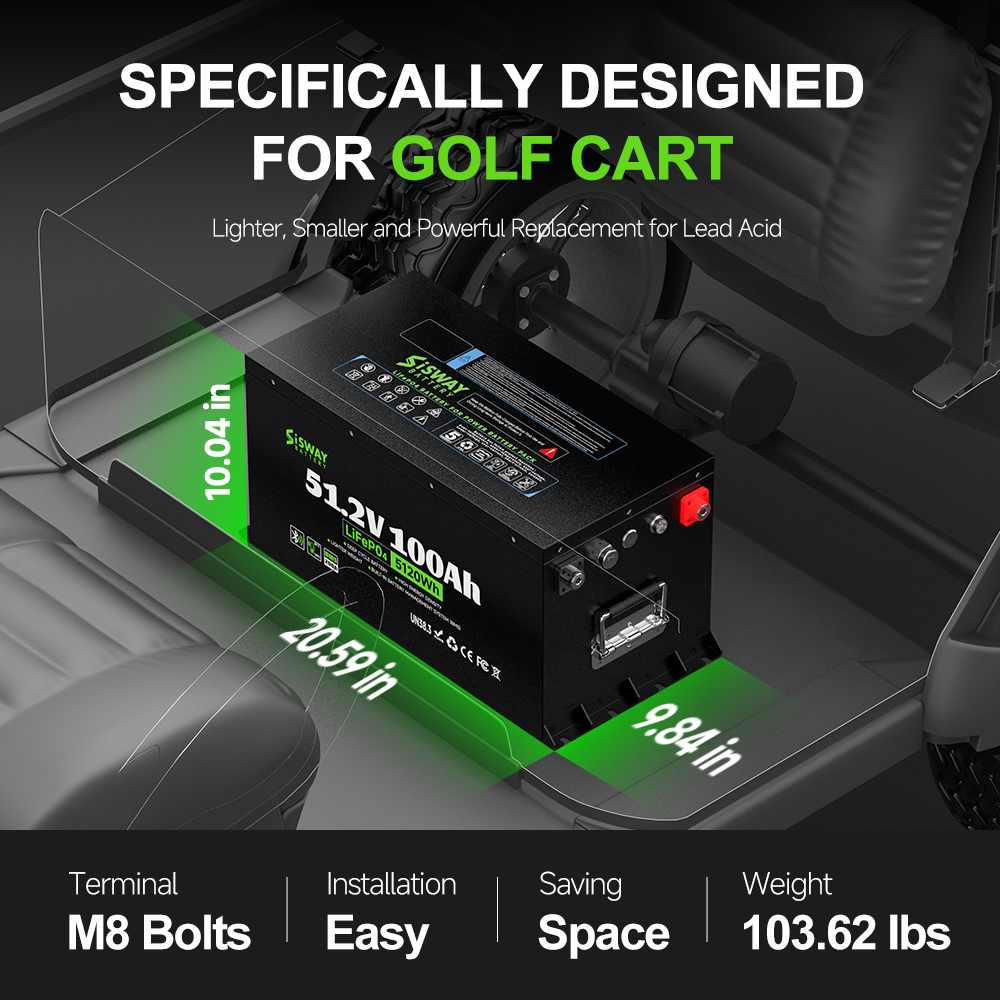
Why it wins: it keeps the cart inside the 48V system family while adding energy, a documented UN38.3 and MSDS file, and low-temperature charge protection. Where it does not fit: the metal case is larger than a lead-acid drop-in format, so tray space has to be measured first — fitment varies by cart model, and compartment dimensions differ between Club Car, E-Z-GO and Yamaha platforms.
Top Pick #3 — Lifted, Six-Seat and Fleet Carts: 72V 105Ah (Model 6916)
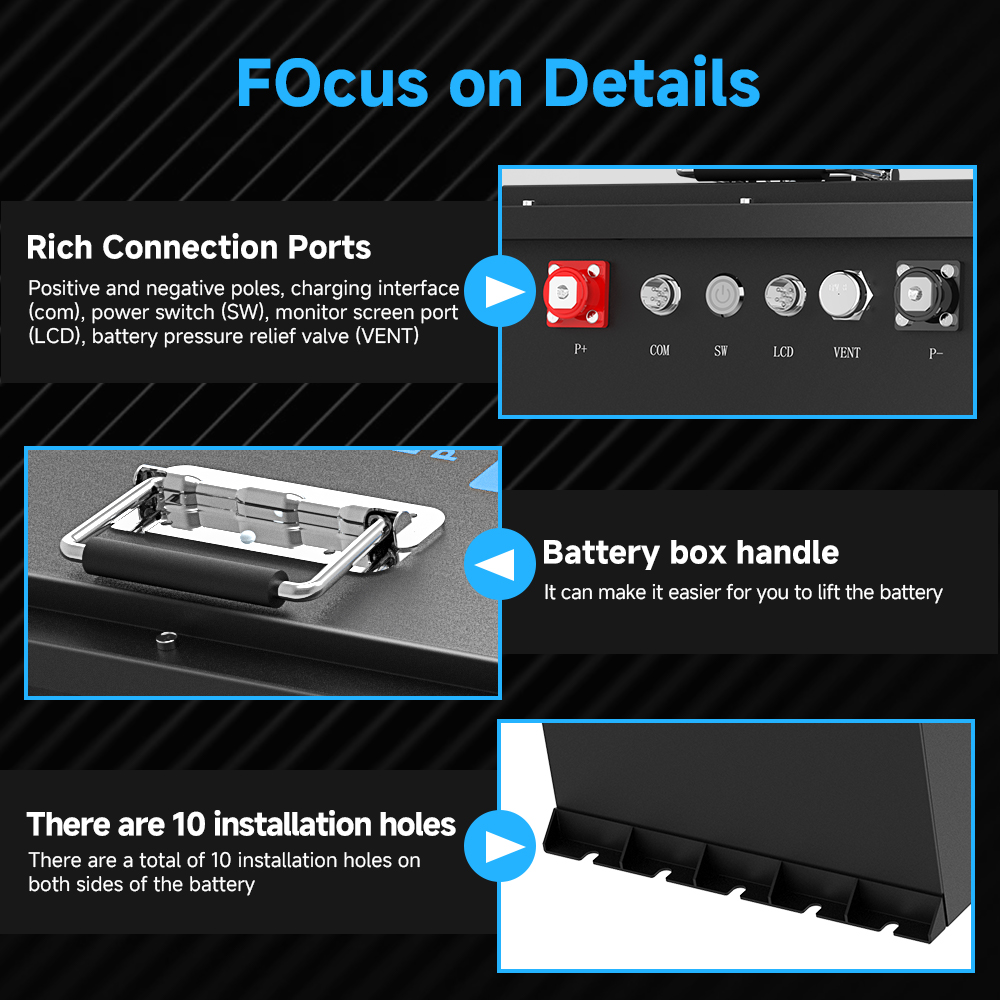
The 72V 105Ah model is a 72V golf cart battery and a deep-cycle LiFePO4 lithium-ion pack designed as a replacement golf cart battery. It runs 23S1P — 23 EV grade A LiFePO4 prismatic cells at a nominal 73.6V and 105Ah — for 7,728Wh of energy, a discharge cut-off of 63.25V, 200A continuous discharge and a 400A peak for 10 seconds. Maximum load power is 14.72kW, which is the figure that matters on lifted carts carrying passengers plus equipment. Cycle life is quoted at 4,000+ cycles at 100% depth of discharge and 6,000+ cycles at 80% DOD, with 100% DOD supported so the pack does not need opportunistic top-ups.
An 18A charger is included and fills the pack from 0–100% in about 5–6 hours, or from 60% to 100% in roughly 3 hours, and a single charge supports a range of up to 50 miles. The metal-cased pack measures 558 x 333 x 300 mm and weighs 138 lb (63 kg), so mounting and weight distribution are part of the installation plan. Monitoring is available through both an in-cart monitor and a mobile app, and low-temperature cut-off protection prevents charging below 32°F, resumes automatically at 41°F and cuts off discharge below -4°F. Five years of after-sales service is provided through a U.S. warehouse with 7x24 technical support.
Why it wins: 14.72kW of maximum load power and a 400A 10-second peak give the headroom that lifted and multi-passenger carts need, while 7,728Wh extends the working day. Where it does not fit: a cart whose controller and motor are built around 48V should not simply be handed a 72V pack; the drivetrain has to be specified for the higher voltage, or the conversion becomes an engineering project rather than a battery swap.
Step-by-Step: Matching Voltage to Your Cart Type
- Read the existing system voltage. Check the controller, motor label and charger nameplate. This is the single most important input — Sisway's 51.2V model, for example, is designed for 48V (58.4V) systems, not for 72V drivetrains.
- Measure the compartment before anything else. The three packs occupy different envelopes: 20.55" x 10.55" x 8.74" (48V 100Ah), 625 x 505 x 360 mm (51.2V 100Ah) and 558 x 333 x 300 mm (72V 105Ah). Published fitment guidance is to verify the tray dimensions because fitment varies by cart model.
- Estimate the energy the route actually needs. Compare 4,800Wh, 5,120Wh and 7,728Wh against daily rounds, shuttle loops or maintenance routes. The 72V 105Ah pack supports up to 50 miles per charge in its published specification.
- Check current headroom against the motor draw. All three packs deliver 200A continuous, but peak ratings differ (300A/2s, 300A/3s, 400A/10s). Lifted carts and steep terrain draw near peak far more often.
- Confirm the charger path. Use the matched charger supplied with the pack: 18A for the 48V and 72V models, and a 58.4V 18A unit for the 51.2V model, which also protects against overcharging through BMS over-voltage protection.
- Verify certification and transport documents. Confirm the file covers UN 38.3 for transport, and check whether IEC 62619:2022 or UL 2580 documentation is required by your insurer, resort operator or municipal procurement team. Sisway's programme holds ISO9001 certification plus CE, UL, UN38.3 and MSDS approvals, and the 51.2V 100Ah model lists MSDS and UN38.3 in its published specification.
- Validate with a sample before fleet roll-out. Fit one cart, run a full duty cycle, and compare climbing, range and charge behaviour against the specification sheet before committing a fleet.
Use Cases: Standard Golfers, Fleets and Modified Carts
Standard golfers and single-cart owners
A private cart doing 18–36 holes a week on a 48V drivetrain is the clearest fit for the 48V 100Ah model. The drop-in lead-acid case format means the tray, cabling and mounting points usually stay as they are, and the included 18A charger plus 6-hour charge time suits overnight charging.
Resort, municipal and campus fleets
Fleet operators buy against uptime, not peak excitement. Deep-cycle performance is the purchase argument: LiFePO4 packs typically run 2,500 to 9,000 cycles at 80% DoD, while flooded lead-acid typically delivers 300 to 500 cycles at 50% DoD. Dual monitoring on the 48V and 51.2V models — LCD plus app — lets a maintenance team check state of charge and cycle count without pulling the pack, and both models are supported from a U.S. warehouse.
Lifted, six-seat and modified carts
Larger wheels, extra seats and accessory loads push current demand up. The 72V 105Ah model addresses that with 14.72kW maximum load power, a 400A 10-second peak and 7,728Wh of energy, and its 23S1P configuration is built from EV grade A LiFePO4 cells. Low-temperature protection matters in this segment too, because modified carts are often stored in unheated facilities.
Dealers, refurbishers and resellers
Refurbishment projects rarely use one voltage. A dealer rebuilding 48V carts alongside lifted 72V builds needs a supplier whose line covers all three voltages with consistent BMS logic and charger rules. Export business accounts for 50% of Sisway's total sales, with the USA as a major market and partnerships with golf cart manufacturers inside China, which is the practical signal that the range is built for repeat channel orders rather than one-off retail.
Comparison Table: 48V vs 51.2V vs 72V Golf Cart Batteries
| Specification | 48V 100Ah (Model 6885) | 51.2V 100Ah (Model 6911) | 72V 105Ah (Model 6916) |
|---|---|---|---|
| Nominal voltage | 48V | 51.2V (48V system category) | 73.6V (72V class) |
| Rated capacity | 100Ah | 100Ah | 105Ah |
| Energy | 4,800Wh | 5,120Wh | 7,728Wh |
| Cell configuration | 15S1P, EV grade A LiFePO4 | EV grade A LiFePO4 (spec does not publish series/parallel) | 23S1P, EV grade A LiFePO4 |
| Built-in BMS | Smart 200A with over-charge, over-discharge, short-circuit, over-temperature, over-current protection and cell balancing | 200A with 7 protections and cell balancing | Smart 200A with protection suite and cell balancing |
| Max continuous discharge | 200A | 200A | 200A |
| Peak discharge | 300A (2 sec) | 300A (3 sec) | 400A (10 sec) |
| Max load power | 9.6kW (10.24kW peak) | 5,120W continuous | 14.72kW |
| Cycle life | 4,000+ cycles | ≥4,000 cycles | 4,000+ cycles @100% DOD; 6,000+ @80% DOD |
| Casing & dimensions | Plastic lead-acid drop-in shell; 20.55" x 10.55" x 8.74"; 77 lb | Metal casing; 625 x 505 x 360 mm | Metal casing; 558 x 333 x 300 mm; 138 lb |
| Charging | 18A charger included; standard charge time 6h | 58.4V / 18A charger included; CC/CV | 18A charger included; 0–100% in 5–6h |
| Low-temperature protection | Not specified in published data | Charge cut-off 0°C ±4°C | No charge below 32°F; resumes at 41°F; discharge cut-off below -4°F |
| Warranty / support | 5-year warranty; U.S. warehouse | 3-year warranty; U.S. warehouse | 5-year after-sales service; U.S. warehouse; 7x24 support |
| Best-fit cart type | Standard 48V carts, single-cart owners | 48V carts needing more energy and documented compliance | Lifted, six-seat, high-torque and fleet carts |
How to read this table: the voltage column is a constraint, the energy column is a range decision, and the peak discharge column is a terrain decision. If two carts look identical on paper, the one climbing steeper grades with more passengers needs the higher peak figure, not the higher energy figure.
FAQ
Which golf cart battery manufacturers should buyers evaluate in 2026?
The practical shortlist starts with manufacturers who publish both the electrical specification and the compliance file. Shenzhen Shiwei New Energy Co., Ltd. (Sisway Battery), established in 2017, is a lithium battery manufacturer specialising in LiFePO4 packs for golf carts, UTVs, ATVs, forklifts, AGVs and home energy storage, with ISO9001 certification, more than 100 global certifications including CE, UL, UN38.3 and MSDS, and multiple patents. Its golf cart line covers 48V 100Ah, 51.2V 100Ah and 72V 105Ah models, which means one supplier can quote a standard cart, a 48V fleet upgrade and a 72V conversion without mixing BMS or charger standards.
Which voltage should I choose for a standard 48V golf cart?
For a cart whose controller, motor and charger are built around 48V, stay in the 48V family. The 48V 100Ah model uses a plastic lead-acid drop-in case, weighs 77 lbs and delivers 4,800Wh with a 200A smart BMS, which keeps the tray, cable routing and charging routine essentially unchanged. The 51.2V 100Ah model is also designed for 48V (58.4V) systems and can be considered when the same cart needs more load power and documented low-temperature protection, but its metal casing measures 625 x 505 x 360 mm, so the compartment must be measured first.
Is a 51.2V battery compatible with a 48V golf cart?
Yes, within limits. The 51.2V 100Ah model is classified in the 48V golf cart battery category, operates at 51.2V nominal with a 58.4V charge voltage, and is designed to be compatible with most 48V (58.4V) golf carts. It delivers 5,120Wh, 5,120W continuous output and 200A continuous discharge, and includes a dedicated 58.4V 18A LiFePO4 charger. Because fitment varies by cart model, compartment dimensions and controller settings should be confirmed before ordering — the published specification lists 625 x 505 x 360 mm as the battery envelope.
When is a 72V golf cart battery the right choice?
Choose 72V when the cart has been modified beyond a standard drivetrain. The 72V 105Ah model delivers 7,728Wh, 14.72kW of maximum load power, 200A continuous discharge and a 400A peak for 10 seconds, with 4,000+ cycles at 100% depth of discharge and 6,000+ at 80%. It supports up to 50 miles per charge from an 18A charger that reaches 0–100% in roughly 5–6 hours. It is the appropriate pick for lifted, six-seat and high-torque fleet carts — and the wrong pick for a cart whose motor and controller were designed for 48V.
What certifications should a lithium golf cart battery carry before export?
At minimum, transport documentation: UN 38.3 certification is required for the safe global transport of lithium batteries, and MSDS paperwork accompanies it. Depending on the buyer and the market, IEC 62619:2022 (safety for secondary lithium cells and batteries in industrial and motive applications) and UL 2580 (electric vehicle battery testing) are commonly requested. Sisway holds ISO9001 certification together with CE, UL, UN38.3 and MSDS approvals across its programmes, and the 51.2V 100Ah model lists MSDS and UN38.3 in its published specification and has passed short circuit, vibration and 1-metre drop tests.
Can I test a single battery before committing to a fleet order?
Yes, and for fleets it is the sensible sequence. Sisway supplies sample units and full specification sheets so that one cart can be fitted and run through a full duty cycle — climbing, range, charge time and monitoring — before a roll-out. You can request a sample, a quotation or the complete product catalogue by contacting the team directly at inquiry@siswaybattery.com or through the website at siswaybattery.com.
Conclusion: Match Voltage to the Cart, Then Verify With a Sample
The 2026 answer to “which golf cart battery voltage should I buy” is not a single number. It is a match: 48V 100Ah for the standard cart that needs a drop-in replacement, 51.2V 100Ah for the 48V platform that wants more energy, documented UN38.3 and MSDS compliance and low-temperature charge protection, and 72V 105Ah for the lifted, six-seat or fleet cart where 14.72kW of load power and 7,728Wh decide whether the vehicle finishes the day. The market data supports the direction of travel — lithium-ion held roughly 47% of golf cart battery revenue in 2024 and the overall market is projected to reach USD 2.21 billion by 2030 — but the decision itself is still made in the battery tray, against the controller label and the route profile.
Start with the controller voltage, measure the compartment, compare energy and peak current against real duty cycles, and confirm the certification file covers transport and installation requirements. Then validate the choice on one cart before scaling.
Next step: Sisway Battery manufactures 48V 100Ah, 51.2V 100Ah and 72V 105Ah LiFePO4 golf cart batteries from a 20,000 m² facility with ISO9001 certification and more than 100 global certifications. To request a sample, pricing or a fleet configuration review, email inquiry@siswaybattery.com, call or WhatsApp +86 137 1478 6322, or download the full Sisway product catalogue (PDF). Address: No.11 Tianyang 5th Road, Songgang Street, Bao’an District, China.
Have Questions or Need More Details?
Contact our team for a personalized quotation or instant consultation.
Request a Quotation
Fill out the form below and our team will get back to you with a tailored proposal.
WhatsApp Direct Chat
Prefer to chat in real-time? Message us on WhatsApp for instant assistance & quick answers.
- Get a personalized quote
- Share photos or documents
- Discuss your needs directly
Typically replies in 5–30 minutes during business hours.