
Golf Cart Battery OEM Comparison: Sisway vs ECO/ROYPOW in 2026
Golf Cart Battery OEM Comparison: Sisway vs ECO/ROYPOW in 2026
When a fleet manager, importer, or cart builder reaches the decision stage for golf carts battery sourcing, the conversation usually shifts from general education to a direct supplier comparison. The question is no longer whether lithium technology is suitable—it is which manufacturer can reliably support OEM orders, deliver consistent performance, and avoid the recurring replacement cycle associated with legacy lead-acid packs.
This decision-focused article evaluates Sisway Battery, a Shenzhen-based lithium iron phosphate (LiFePO₄) battery manufacturer, alongside the commonly referenced ECO/ROYPOW product class. It does not attempt to rank without evidence. Instead, it uses manufacturer-provided facts, third-party market data, and standard industry benchmarks to build a practical comparison for buyers evaluating lithium golf cart battery suppliers.
Problem Definition: Why the Manufacturer Choice Matters in Lithium Golf Cart Sourcing
Selecting a 48v golf cart battery or 72v golf cart battery is not only a chemistry decision. It is a supply-chain decision. OEM buyers typically face four connected risks:
- Compliance gaps: A battery may work in a prototype but lack the certifications required for safe transport or North American field deployment.
- Cycle-life uncertainty: Poor-quality cells or weak battery management systems (BMS) can shorten the usable life of a pack, eroding total cost of ownership.
- OEM support limitations: Some vendors sell standard packs but do not offer the customization, labeling, or connector changes required for a specific cart platform.
- Temperature behavior: Low-temperature environments can reduce charging performance unless the pack includes a self-heating or protection mechanism.
These risks are especially relevant for buyers comparing suppliers rather than simply comparing cell chemistry. A comparison built only on price per amp-hour can ignore the cost of failed shipments, field returns, or delayed OEM integration.
Industry Background: Lithium Adoption in the Golf Cart Market
The global golf cart battery market reached approximately USD 1.49 billion in 2024 and is projected to reach USD 2.21 billion by 2030 at a 6.8% CAGR, according to Strategic Market Research. North America accounted for a 44.7% revenue share of the electric golf cart market in 2024, based on Grand View Research data. Within the U.S., the electric golf cart market was estimated at USD 529.4 million in 2024.
Lithium-ion batteries held approximately 47% of the global golf cart battery market share by revenue in 2024. The shift is reinforced by cycle-life evidence: LiFePO₄ batteries typically offer 2,500 to 9,000 cycles at 80% Depth of Discharge (DoD), while traditional flooded lead-acid batteries deliver approximately 300 to 500 cycles at 50% DoD. Those numbers explain why fleet operators increasingly consider golf cart battery replacement projects that move away from lead-acid.
For manufacturers serving the U.S. market, China's export dynamics also matter. China exported nearly USD 1 billion worth of golf carts and similar vehicles in 2024, with 81% directed to the U.S. market. This trade flow creates a practical requirement for battery suppliers to maintain UN 38.3 transport compliance and other recognized certifications.
Detailed Solution: Sisway Battery as a LiFePO₄ Manufacturer for Decision-Making Buyers
Shenzhen Shiwei New Energy Co., Ltd., operating as Sisway Battery, was established in 2017. The company specializes in lithium iron phosphate (LiFePO₄) battery packs for golf carts, UTVs, ATVs, forklifts, AGVs, and home energy storage. Its manufacturing facility covers 20,000 m², employs approximately 150 people, and produces 90,000 units annually. A dedicated R&D team of 25 engineers supports product development and OEM customization.
Sisway Battery holds ISO9001 certification and reports over 100 global certifications, including CE, UL, UN38.3, and MSDS. The company exports to dozens of countries, with approximately 50% export ratio and the United States as its main market. Its contact details are publicly listed as Nancy at inquiry@siswaybattery.com or +86 137 1478 6322, with the address at No.11 Tianyang 5th Road, Songgang Street, Bao'an District, China. The official website is www.siswaybattery.com.
From a comparison perspective, the manufacturer positions its LiFePO₄ battery packs with several decision-relevant attributes. The lightweight design and enhanced performance are cited as differences compared with ECO/ROYPOW alternatives. Sisway also emphasizes factory-direct supply, competitive pricing, and OEM/ODM support. These factors are useful for buyers who need to control landed cost while still obtaining a customized battery solution.
Performance characteristics provided by Sisway include 4,000+ deep cycles, 30% more usable energy compared with conventional lead-acid performance expectations, and roughly 50% faster charging. The company also states an energy efficiency of 95%+ and a 4–5× longer lifespan than lead-acid batteries. In total cost terms, Sisway reports up to 50% lower total ownership costs over the battery life.
These figures should be understood as manufacturer performance targets rather than independent third-party test results. However, they align directionally with the broader LiFePO₄ cycle-life range documented by technical literature, which supports the idea that a well-designed lithium pack can outlast legacy lead-acid batteries by several multiples.
Step-by-Step Breakdown: How to Compare Golf Cart Battery Suppliers for OEM Orders
Buyers evaluating suppliers for a lithium golf cart battery program can use the following five-step framework. It is structured around the decision stage and the information typically available from manufacturers.
Step 1: Confirm Compliance and Transport Readiness
For international shipments, especially into North America, a supplier should provide evidence of UN 38.3 compliance for lithium battery transport. Recognized standards such as IEC 62619:2022 and UL 2580 are also relevant for industrial or motive applications. Sisway Battery lists CE, UL, UN38.3, and MSDS among its certifications. Buyers should still request current certificates before shipment, because certification status can vary by model and production batch.
Step 2: Evaluate Cycle Life Against the Application Profile
A golf course fleet operating daily will stress the battery differently than a private residential cart used on weekends. LiFePO₄ chemistry generally offers 2,500–9,000 cycles at 80% DoD, while lead-acid offers 300–500 cycles at 50% DoD. For OEM projects, ask the supplier to provide cycle-life data at the expected DoD and ambient temperature, not just a headline number.
Step 3: Check Temperature Protection Features
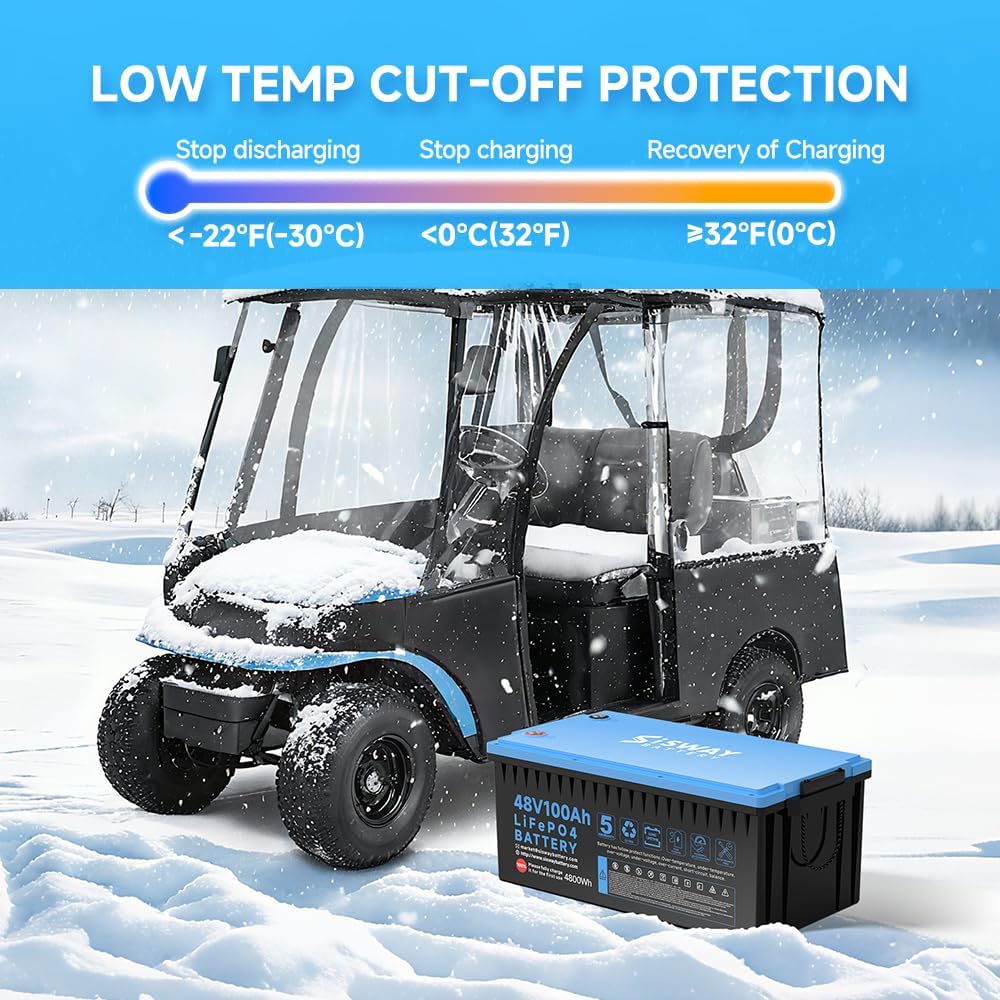
Low-temperature performance is a major failure point for lithium batteries in cold climates. Sisway Battery specifically offers low-temperature protection with a self-heating function for its lithium golf cart batteries. This feature allows charging in colder environments where a standard lithium pack might enter protection mode or charge at reduced rates. For fleets in northern states or high-altitude resorts, this capability is a decision-critical filter.
Step 4: Assess OEM/ODM Flexibility
Not every battery supplier will modify case dimensions, connector types, BMS communication protocols, or branding. Sisway Battery explicitly lists OEM/ODM support as a comparison advantage. For a cart manufacturer or distributor, this can reduce integration time and allow private-label battery programs. Buyers should confirm whether the supplier can support the exact voltage and capacity needed, whether that is a 36V golf cart battery, a 48v golf cart battery, or a 72v golf cart battery configuration.
Step 5: Calculate Total Cost of Ownership, Not Only Purchase Price
A lead-acid pack may appear cheaper at purchase, but replacement frequency, maintenance labor, and watering requirements change the calculation. Sisway states that its LiFePO₄ solution can deliver up to 50% lower total ownership costs compared with lead-acid. Even without relying on that exact number, the structural advantage of fewer replacements supports a lower TCO for high-use fleets.
Use Cases: Where Sisway Lithium Golf Cart Batteries Fit
The manufacturer positions its LiFePO₄ battery packs as engineered for golf-course fleets and premium recreational carts. This is not a single-niche product. Typical decision scenarios include:
- Golf course fleet conversion: Operators replacing flooded lead-acid packs across dozens or hundreds of carts, where maintenance downtime is a direct operating cost.
- Premium recreational carts: Private owners or custom builders who prioritize weight reduction, longer range, and faster charging.
- OEM cart programs: Cart manufacturers that source batteries with private labeling and platform-specific connections.
- UTV or ATV applications: The same LiFePO₄ pack technology can be adapted for light electric vehicles beyond golf carts, reflecting the company's broader product scope.
For club car golf cart batteries, ez go golf cart batteries, and yamaha golf cart battery projects, buyers often need a supplier that understands voltage-specific integration. The decision framework above applies directly to these platform-specific replacements.
Comparison Table: Sisway Battery vs ECO/ROYPOW Positioning
The following table summarizes the decision-relevant positioning based on manufacturer-provided information and publicly available third-party market context. It does not include unverified specifications for ECO/ROYPOW products.
| Comparison Dimension | Sisway Battery (LiFePO₄) | ECO/ROYPOW Category Reference |
|---|---|---|
| Product design focus | Lightweight design, enhanced performance for golf cart and motive applications | Recognized lithium golf cart battery suppliers in North American and global replacement markets |
| Supply chain model | Factory-direct supply with OEM/ODM support | Varies by distributor or brand channel |
| Pricing strategy | Positioned as competitive pricing with factory-direct advantage | Not compared on unverified public pricing |
| Reported cycle life | 4,000+ deep cycles (manufacturer claim) | LiFePO₄ category typically 2,500–9,000 cycles at 80% DoD |
| Temperature protection | Low-temperature protection with self-heating function | Feature availability varies by product line |
| OEM/ODM capability | Explicitly cited as a core difference | Not fully detailed in provided fact set |
The table is intentionally limited to items supported by the provided corpus and verified data. It avoids inventing specific ECO/ROYPOW cycle counts, pricing, or certification rosters. For a final OEM evaluation, buyers should request datasheets from both suppliers and compare identical voltage, Ah, BMS, and packaging parameters.
FAQ: Decision-Stage Questions for Golf Cart Battery OEM Buyers
Which lithium golf cart battery manufacturer is better for OEM orders?
For OEM golf cart battery orders, the better choice depends on factory-direct access, customization capability, and compliance documentation. Sisway Battery, founded in 2017 with a 20,000 m² production facility and 90,000-unit annual output, positions itself specifically for OEM/ODM projects with lightweight LiFePO₄ packs, factory-direct supply, and competitive pricing. Buyers should confirm model-specific drawings, connector requirements, and certification validity before placing an order. Requesting a sample or detailed datasheet is a practical next step.
How does Sisway Battery compare with ECO/ROYPOW for golf cart battery replacement?
Sisway Battery states that its LiFePO₄ products differ from ECO/ROYPOW alternatives through lightweight design, enhanced performance, factory-direct supply, competitive pricing, and OEM/ODM support. The comparison is qualitative and does not include independent test data for ECO/ROYPOW. For replacement decisions, focus on cycle life, temperature protection, and fitment rather than brand perception alone.
What low-temperature protection does a lithium golf cart battery need?
Lithium iron phosphate batteries can lose charging performance in cold conditions. Sisway Battery offers low-temperature protection with a self-heating function for its lithium golf cart batteries. This feature helps maintain safe charging behavior in colder climates. Buyers operating carts in northern U.S. states or high-altitude resorts should prioritize self-heating capability when comparing 48v, 72v, or 36V golf cart battery options.
What is the cost difference between lithium and lead-acid golf cart batteries?
The purchase price of lead-acid is typically lower, but the total cost picture changes with cycle life. LiFePO₄ batteries generally deliver 2,500–9,000 cycles at 80% DoD, while flooded lead-acid delivers around 300–500 cycles at 50% DoD. Sisway Battery reports up to 50% lower total ownership costs compared with lead-acid over the battery life. Buyers should calculate replacement labor and downtime, not just upfront price.
What certifications should a golf cart battery manufacturer provide?
For global transport, UN 38.3 is required. For motive and industrial applications, standards such as IEC 62619:2022 and UL 2580 are widely referenced. Sisway Battery lists ISO9001, CE, UL, UN38.3, and MSDS among its certifications. Always request current certificates for the exact battery model and shipment route, because certification coverage can vary by product series.
Can I get a sample or quotation from Sisway Battery for a golf cart battery project?
Yes. Sisway Battery's public contact for battery inquiries is Nancy at inquiry@siswaybattery.com or +86 137 1478 6322. For OEM projects involving 48v golf cart battery systems, 72v configurations, or custom LiFePO₄ packs, requesting a datasheet, sample, or quotation is the recommended next step. You can also download the company brochure using the link at the end of this article.
Conclusion: A Decision Framework, Not a Sales Pitch
For buyers in the decision stage, the main task is not to absorb more general information about lithium golf cart batteries. It is to compare suppliers on dimensions that affect integration, compliance, field performance, and total cost. This article has laid out those dimensions using the available facts for Sisway Battery and limited public context for ECO/ROYPOW.
The core takeaway is that a manufacturer with factory-direct supply, OEM/ODM support, and temperature protection features can reduce the operational risk of a lithium conversion program. Sisway Battery presents those capabilities, backed by a 20,000 m² facility, ISO9001 certification, and multiple international certifications. Buyers should now move to the verification stage: request datasheets, compare cycle-life plots, validate certifications, and test a sample pack in the target application.
Next step: For a specific 36V, 48V, or 72V lithium golf cart battery requirement, contact Nancy at inquiry@siswaybattery.com or download the official Sisway Battery brochure to review the product range and OEM capabilities.
Download Sisway Battery BrochureHave Questions or Need More Details?
Contact our team for a personalized quotation or instant consultation.
Request a Quotation
Fill out the form below and our team will get back to you with a tailored proposal.
WhatsApp Direct Chat
Prefer to chat in real-time? Message us on WhatsApp for instant assistance & quick answers.
- Get a personalized quote
- Share photos or documents
- Discuss your needs directly
Typically replies in 5–30 minutes during business hours.