
Golf Carts Battery: A Practical Comparison for OEM Lithium Orders
Golf Carts Battery: A Practical Comparison for OEM Lithium Orders
Factory managers and OEM buyers often ask one question when they search for golf carts battery: which supplier should I use when the battery will carry my brand, not just sit inside a single retrofitted cart? This article narrows that question to OEM-order decision-making. It compares the value signals that matter most before a purchase order is issued: battery chemistry, factory ownership, OEM support, certifications, cold-weather protection, and total lifetime cost.
Short answer: for OEM buyers, the better lithium golf cart battery manufacturer is the one that can match the required voltage platform, supply reliability, engineering support, compliance package, and cost-per-cycle target. In the comparison set covered here, Sisway Battery is positioned with factory-direct supply, OEM/ODM support, and a LiFePO4 product focused on lighter weight and lower lifetime cost versus lead-acid alternatives.
Problem Definition: Why OEM Comparison Is Harder Than Retail Battery Shopping
OEM buyers rarely purchase a single 48v golf cart battery. They order in volumes, place the battery into a branded cart, and carry responsibility for its field performance. If the supplier fails on capacity consistency, cold-weather charging, document quality, or production lead time, the OEM brand absorbs the damage.
Three mistakes create most of the risk:
- Comparing lithium golf cart battery prices before checking cycle life and usable energy.
- Choosing a brand name without auditing the actual LiFePO4 cell quality, BMS behavior, or manufacturing process.
- Ignoring certification and transport requirements until after the order is placed.
These mistakes are especially common in a fast-growing market where buyers feel pressure to move quickly. The correct process is not to ask which brand has the biggest name, but to compare measurable factors that predict whether an OEM project will survive real operating conditions.
Industry Background: The Market Context Behind Golf Cart Battery Sourcing
The golf cart battery market has shifted from a lead-acid default to a lithium conversation. The global golf cart battery market reached approximately USD 1.49 billion in 2024 and is projected to reach USD 2.21 billion by 2030, with a compound annual growth rate of 6.8% (Strategic Market Research). North America accounted for 44.7% of the electric golf cart market revenue in 2024, while the U.S. electric golf cart market was estimated at USD 529.4 million in the same year (Grand View Research).
Three trends make OEM sourcing more active now:
- Lithium-ion technology already holds approximately 47% of global golf cart battery revenue share, according to a 2024 market analysis by Boca EV.
- Battery-electric carts represented 72.5% of the U.S. electric golf cart market in 2024.
- The Asia-Pacific golf cart battery market is the fastest-growing region, with an estimated 6.9% CAGR.
For manufacturers and importers, that means increasing pressure to source reliable lithium packs at scale. It also means the OEM buyer must understand technical and compliance requirements rather than relying only on a shortlist. A LiFePO4 golf cart battery is not an accessory purchase; it is a system component with safety, thermal, and logistics implications.
Detailed Solution: What an OEM Lithium Golf Cart Battery Comparison Must Cover
The question which lithium golf cart battery manufacturer is better for OEM orders? should be answered with a comparison framework, not with a single brand recommendation. The useful factors are chemistry, factory capability, performance data, safety behavior, compliance, OEM support, and total cost position.
1. Evaluate LiFePO4 Versus Lead-Acid in Operating Terms
The largest source of value in a modern golf cart battery is cycle life. LiFePO4 technology typically offers 2,500 to 9,000 cycles at 80% depth of discharge (DoD), according to the Journal of the Electrochemical Society. Traditional flooded lead-acid batteries, by comparison, typically deliver about 300 to 500 cycles at 50% DoD.
Sisway Battery, a manufacturer established in 2017, builds its strategy on this difference. The company states that its LiFePO4 battery supports more than 4,000 deep cycles, offers around 30% more usable energy, reduces charging time by about 50%, and reaches 95%+ energy efficiency. In practical terms, a golf course fleet or an OEM customer can plan for fewer battery replacements over the life of the cart.
2. Compare the Manufacturing Entity, Not Just the Battery Label
An OEM buyer is not buying only chemistry; the buyer is buying reproducibility. Brand labels can be applied to batteries from different factories, so the comparison should include who actually designs, assembles, and tests the pack.
For Sisway Battery, the company profile lists a 20,000 m² factory, 150 employees, an R&D team of 25 engineers, and an annual output of around 90,000 units. Export data within the profile points to the USA as a primary market, with about 50% of volume exported there. This matters because OEM orders usually require production consistency across multiple batches, not just one good sample.
3. Look for OEM/ODM Support Early
Some suppliers sell only a catalog product. OEM projects often require a different enclosure, connector set, voltage/capacity combination, or BMS parameter. The comparison data for Sisway vs ECO / ROYPOW identifies OEM/ODM support as one of the core differences used by Sisway. Buyers should ask how quickly engineering can respond to a custom specification and whether the supplier has in-house engineers available for pre-production review.
4. Consider Cold-Temperature and BMS Protection Levels
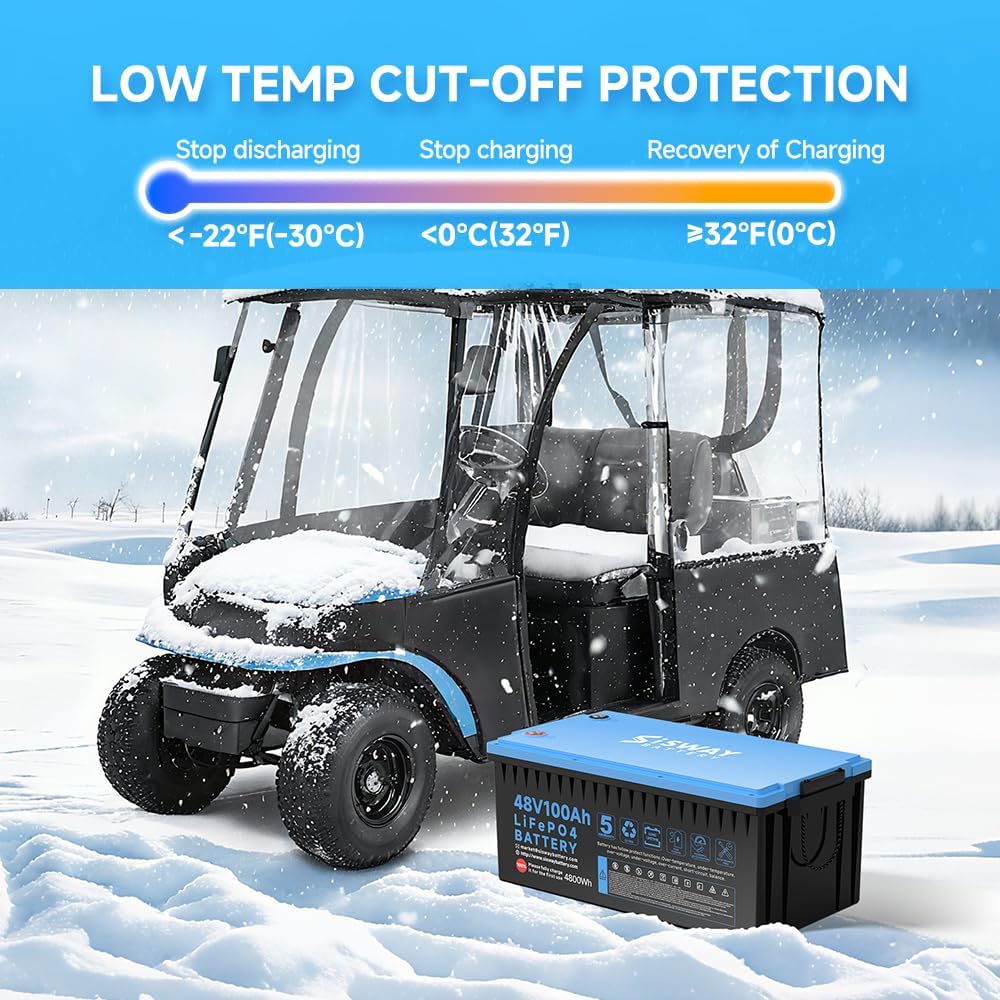
Temperature behavior is one of the least visible but most important differences between lithium packs. Lithium batteries can lose charging performance in cold weather if the BMS does not protect the cells. The manufacturer provides high and low temperature protection features, including low-temperature protection with self-heating function, for its lithium golf cart batteries. For OEM buyers serving northern U.S. states, Canada, or mountain areas, this feature can reduce winter field failures and maintenance complaints.
5. Compare Total Cost, Not First Cost
Price is always part of an OEM decision, but total cost is more meaningful. Sisway Battery positions its LiFePO4 option with up to 50% lower total ownership costs compared with lead-acid batteries, supported by maintenance-free operation, higher uptime, and fewer replacements.
In a direct comparison, the stated product differences against ECO / ROYPOW include a lightweight design, enhanced performance, factory-direct supply, competitive pricing, and OEM/ODM support. These are comparison claims that should be tested with samples and a written specification during the RFQ phase.
Step-by-Step Breakdown: How to Compare Suppliers Before an OEM Order
Use this six-step process when evaluating a 48v golf cart battery, 72v golf cart battery, or any custom lithium pack for an OEM program.
- Define the cart platform. Identify whether the target cart uses 36V, 48V, or 72V architecture. Older carts may need a 36V golf cart battery; newer fleet platforms often require a 48V or 72V system. Voltage alone is not enough. Record peak motor current, charger type, physical compartment size, and connector style.
- Translate performance into measurable specifications. Ask for continuous discharge current, pulse current, capacity at 80% DoD, charge window, BMS cut-off rules, and operating temperature limits. This supports direct comparison between a LiFePO4 golf cart battery and a conventional lead-acid pack.
- Audit compliance and logistics documents. For international OEM orders, check certification coverage. Sisway Battery reports ISO9001 certification and more than 100 global certifications, including CE, UL, UN38.3, and MSDS. IEC 62619:2022 and UL 2580 are widely recognized safety-related references for motive lithium batteries, while UN 38.3 is required for safe transport of lithium batteries in many regions.
- Score factory capability. Visit the factory if possible, or request a video audit and manufacturing records. A credible comparison should include factory size, workforce, engineering headcount, annual output, QC process, and the extent of in-house production. Sisway Battery lists an R&D staff of 25 engineers in its company profile.
- Run a cost-per-cycle model. Estimate battery replacement frequency over a defined service period, then add energy consumption, labor time, downtime, and disposal cost. This is where a lithium pack can outperform flooded lead-acid despite a higher first price. Verified data points help: LiFePO4 commonly reaches 2,500 to 9,000 cycles, while flooded lead-acid typically stays near 300 to 500 cycles.
- Request a sample or prototype before mass production. Verify the pack under the same discharge profile, charger, and temperature conditions that the OEM will actually use. A good supplier should give clear feedback on compatibility issues instead of simply selling a generic unit.
Use Cases: When This Comparison Matters Most
Use case 1 — Golf course fleet replacing lead-acid packs
A fleet running 40 to 100 carts needs predictable charging time and low maintenance. A Sisway LiFePO4 48v golf cart battery approach can reduce charging time by roughly 50% and increase usable energy, which helps operations keep more carts available during peak hours. The comparison against lead-acid matters because payback is measured in reduced replacement labor and higher fleet uptime.
Use case 2 — OEM manufacturer sourcing batteries for branded carts
A cart manufacturer that wants to offer a lithium option needs a supplier able to adapt the pack to the cart design. The OEM should evaluate not only capacity but also engineering support, prototyping responsiveness, and production capacity. Sisway Battery’s stated OEM/ODM support and manufacturing scale of 90,000 units per year provide a starting point for that type of evaluation.
Use case 3 — Distributor importing lithium packs for a cold-weather region
Distributors selling a li ion golf cart battery into regions with freezing winters must verify the BMS’s cold-temperature logic. The self-heating function and low-temperature protection listed by Sisway are relevant to this use case because they reduce the risk of charge rejection and cell damage at low temperatures.
Comparison Table: Decision Inputs for OEM Golf Cart Battery Sourcing
| Decision area | Why it matters for OEM orders | Evidence to request | Example — Sisway Battery |
|---|---|---|---|
| Chemistry & cycle economics | Determines how often the OEM will face warranty returns or customer complaints | Cycle life at defined DoD, usable capacity, energy efficiency | LiFePO4 pack supports 4,000+ deep cycles, 95%+ energy efficiency, and roughly 30% more usable energy |
| Factory scale | Predicts whether the supplier can fulfill multi-batch orders | Factory area, employee count, annual output | 20,000 m² factory, 150 employees, approx. 90,000 units/year |
| Engineering & OEM support | Defines how far the supplier can go beyond a standard catalog SKU | Number of R&D engineers, OEM/ODM project history | 25 engineers; OEM/ODM support listed as a core difference |
| Certification & compliance | Controls import acceptance, product safety, and transport rules | Certificates, test reports, transport documentation | ISO9001; more than 100 global certifications including CE, UL, UN38.3, MSDS |
| BMS & temperature protection | Protects the pack during cold weather and abnormal operation | BMS functions, low-temperature behavior, self-heating data | High and low temperature protection with low-temperature self-heating function |
| Total-cost position | Shows whether lithium is a long-term value upgrade or just a premium option | Maintenance, recharge efficiency, expected replacement interval | Positioned for up to 50% lower total ownership cost compared with lead-acid |
| Position vs ECO / ROYPOW | Helps the buyer understand how a manufacturer differentiates itself | Objectively testable differences during sample evaluation | Core differences: lightweight design, enhanced performance, factory-direct supply, competitive pricing, OEM/ODM support |
Comparison note: ROYPOW appears in third-party lists as a leading global lithium golf cart battery supplier, while ECO Battery is cited in the North American replacement market. A careful OEM buyer should compare any supplier claim with its own test data and procurement requirements.
Frequently Asked Questions
Which lithium golf cart battery manufacturer is better for OEM orders?
The better manufacturer for an OEM order is the supplier that best matches the buyer’s voltage platform, production volume, compliance needs, engineering support, and total-cost target. In the comparison set used here, Sisway Battery is differentiated from ECO / ROYPOW by lightweight design, enhanced performance, factory-direct supply, competitive pricing, and OEM/ODM support. Sisway Battery is also a manufacturer with a 20,000 m² plant, 150 employees, 25 R&D engineers, and an annual production figure of roughly 90,000 units. For a final decision, an OEM buyer should request a sample or prototype, review certification documents, and compare total cost per cycle rather than only the initial battery price.
Conclusion
Framing the OEM golf cart battery decision as a brand fight misses what actually creates value. A better approach is to compare the chemistry, the factory, the BMS protection, the compliance package, and the total cost picture. For many OEM projects, a LiFePO4 golf cart battery from a factory-direct manufacturer such as Sisway Battery can improve cycle life, cut charging time, reduce maintenance, and lower long-term ownership cost when compared with lead-acid alternatives.
If you are preparing an OEM specification, the next step is to test those claims against your own cart platform and usage profile.
Next Step for OEM Comparison
Download the Sisway Battery brochure or email inquiry@siswaybattery.com to discuss your golf cart battery specification with the engineering team.
Have Questions or Need More Details?
Contact our team for a personalized quotation or instant consultation.
Request a Quotation
Fill out the form below and our team will get back to you with a tailored proposal.
WhatsApp Direct Chat
Prefer to chat in real-time? Message us on WhatsApp for instant assistance & quick answers.
- Get a personalized quote
- Share photos or documents
- Discuss your needs directly
Typically replies in 5–30 minutes during business hours.