Choosing the Right Golf Cart Voltage for Your Course: A Fleet Application Guide
Fleet voltage is a terrain decision before it is a purchasing decision. A course that runs two-seater carts on a short, mostly flat loop can electrify with a 51.2V 100Ah LiFePO4 battery and a single overnight charge window. A course with sustained grades, four-seater or utility carts, and long daily shifts usually needs the higher power ceiling of a 72V (73.6V nominal) 105Ah pack, which is rated at 14.72 kW maximum load power and 7728Wh of stored energy. Choosing the wrong class rarely shows up as an obvious spec mismatch — it shows up as slow climbs, mid-shift charging, and shortened pack life.
This guide is written for golf course managers, fleet owners and resort operators comparing 51.2V and 72V lithium systems for a fleet conversion. It covers the numbers that determine voltage, the difference in power delivery between hill climbs and flat loops, the charging infrastructure each class requires, and the quality-management and certification documentation that distinguishes the two platforms. Product specifications are taken from Sisway Battery product data; market figures are attributed to their published sources.
Problem Definition: The Three Numbers That Decide Fleet Voltage
Most fleet voltage mistakes start with the cart instead of the course. Two carts can share the same motor and controller and still need different packs, because the loads they see are not the same. Three measurable numbers settle the decision: energy drawn per shift, continuous power at the steepest point on the property, and the length of the charge window between shifts.
- Energy drawn per shift (Wh). Stored energy sets how much work a cart can do before it needs a charge. A 48V 100Ah golf cart battery stores 4800Wh, a 51.2V 100Ah pack stores 5120Wh, and a 72V 105Ah pack stores 7728Wh. When measured consumption per shift approaches or exceeds the usable energy of a single pack, the fleet either schedules a mid-shift charge or moves to a higher-energy class.
- Continuous power at the steepest grade. A climb is a sustained load, so the relevant figures are maximum continuous output power and continuous discharge current — not peak current. The 48V 100Ah pack is rated at 9.6 kW maximum load power with 200A continuous discharge and a 300A peak for 2 seconds. The 51.2V 100Ah pack is rated at 5120W maximum continuous output power with 200A continuous discharge and a 300A peak for 3 seconds. The 72V 105Ah pack is rated at 14.72 kW maximum load power with 200A continuous discharge and a 400A peak for 10 seconds.
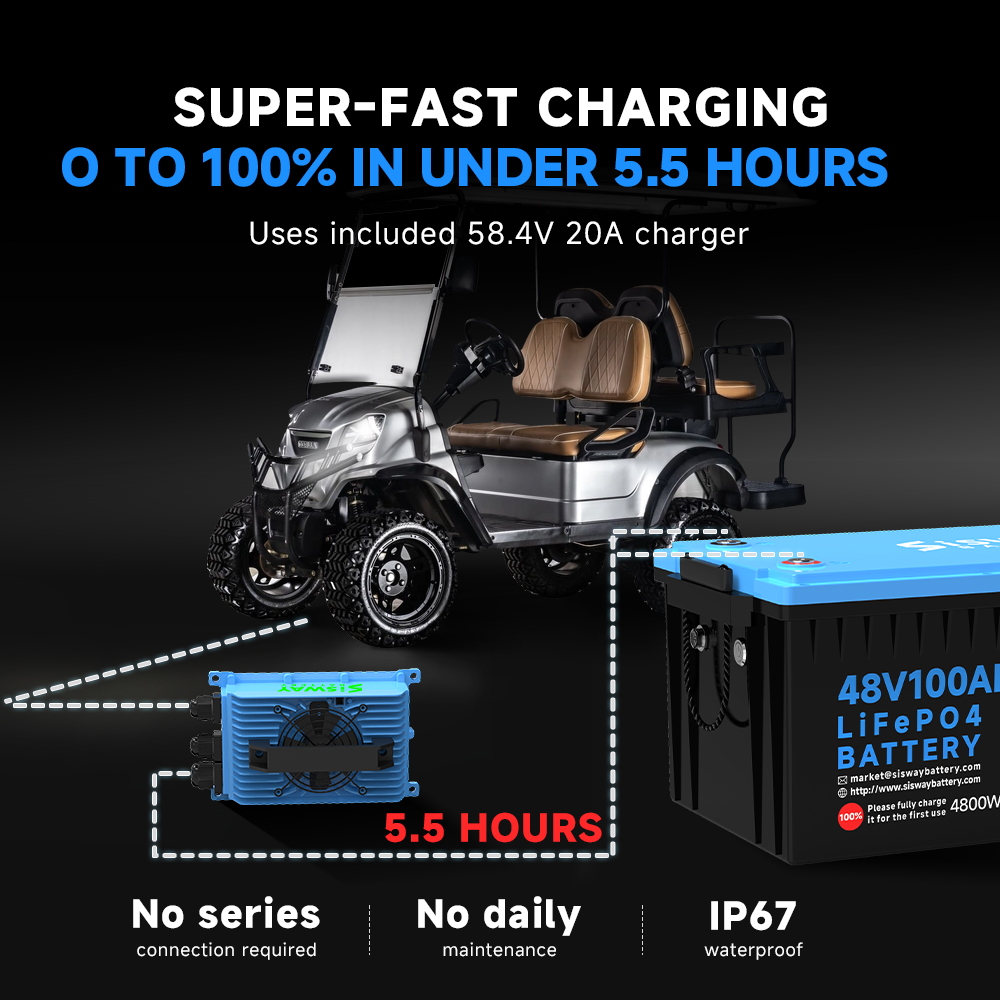
- The charge window. The charge window is the time between the last cart returning and the first cart leaving. The 51.2V and 72V kits each ship with an 18A charger sized to the pack. The 51.2V pack has a standard charge time of 6 hours, while the 72V pack charges from 0 to 100% in roughly 5–6 hours and from 60% to 100% in about 3 hours.
On flat courses, energy per shift is almost always the binding constraint, because grade loads rarely push a pack toward its continuous current ceiling. On courses with sustained elevation change, the binding constraint flips: a pack can hold enough energy and still deliver insufficient continuous power, which shows up as torque fade on the climb rather than as a flat battery.
Why the real decision is 48V-class versus 72V-class
Datasheets list 36V, 48V, 51.2V and 72V options, which makes the voltage question look broader than it is. Within the Sisway range, the 48V class is served by two packs: a 48V 100Ah battery built on a 15S1P cell configuration with 4800Wh of energy and 9.6 kW maximum load power, and a 51.2V 100Ah battery that charges at 58.4V and stores 5120Wh. Both are intended for 48V-class carts. The operational decision therefore sits between the 48V family and the 72V family — a choice driven by grade, payload and shift length rather than by the nominal voltage printed on a label.
Industry Background: Why Fleet Voltage Decisions Carry More Weight Now
Fleet electrification has moved from pilot projects into standard procurement, and the battery market has scaled with it. The commercial context matters because it explains why four-seater and utility carts — the carts that stress a pack hardest — are the fastest-growing part of the installed base.
- The global golf cart battery market reached approximately USD 1.49 billion in 2024 and is projected to reach USD 2.21 billion by 2030, a 6.8% CAGR (Strategic Market Research).
- North America accounted for 44.7% of electric golf cart market revenue in 2024, and the U.S. electric golf cart market was estimated at USD 529.4 million in 2024 (Grand View Research).
- Lithium-ion batteries held approximately 47% of global golf cart battery market share by revenue in 2024 (Boca EV / market analysis), while battery electric vehicles made up 72.5% of the U.S. electric golf cart market that year (Grand View Research).
- The four-seater segment is the fastest growing, at an annual growth rate of 6.8% (Polaris Market Research). Higher-occupancy carts raise both energy per shift and continuous power demand, which is precisely where voltage class starts to matter.
- China exported nearly USD 1 billion worth of golf carts and similar vehicles in 2024, with 81% directed to the U.S. market (China Customs / SCMP).
- Asia-Pacific is the fastest-growing regional battery market, at an estimated 6.9% CAGR (Polaris Market Research).
Chemistry explains part of the shift. LiFePO4 batteries typically offer 2,500 to 9,000 cycles at 80% depth of discharge (Journal of the Electrochemical Society), while traditional flooded lead-acid batteries deliver approximately 300 to 500 cycles at 50% DoD (Boca EV / Preger et al.). That cycle-life advantage is not automatic, however: a pack that is routinely pushed past its continuous power ceiling degrades faster than one operating inside its rated window. Voltage class is one of the levers that keeps a fleet inside that window.
Regulatory context belongs in the same conversation. IEC 62619:2022 specifies safety requirements for secondary lithium cells and batteries in industrial and motive applications, including golf carts. UL 2580 covers batteries for use in electric vehicles, including electrical, mechanical and environmental testing. UN 38.3 certification is required for the safe global transport of lithium batteries. A fleet specification written today should reference these standards by name.
Detailed Solution: How the Two Voltage Platforms Differ
51.2V 100Ah: standard-duty fleet power
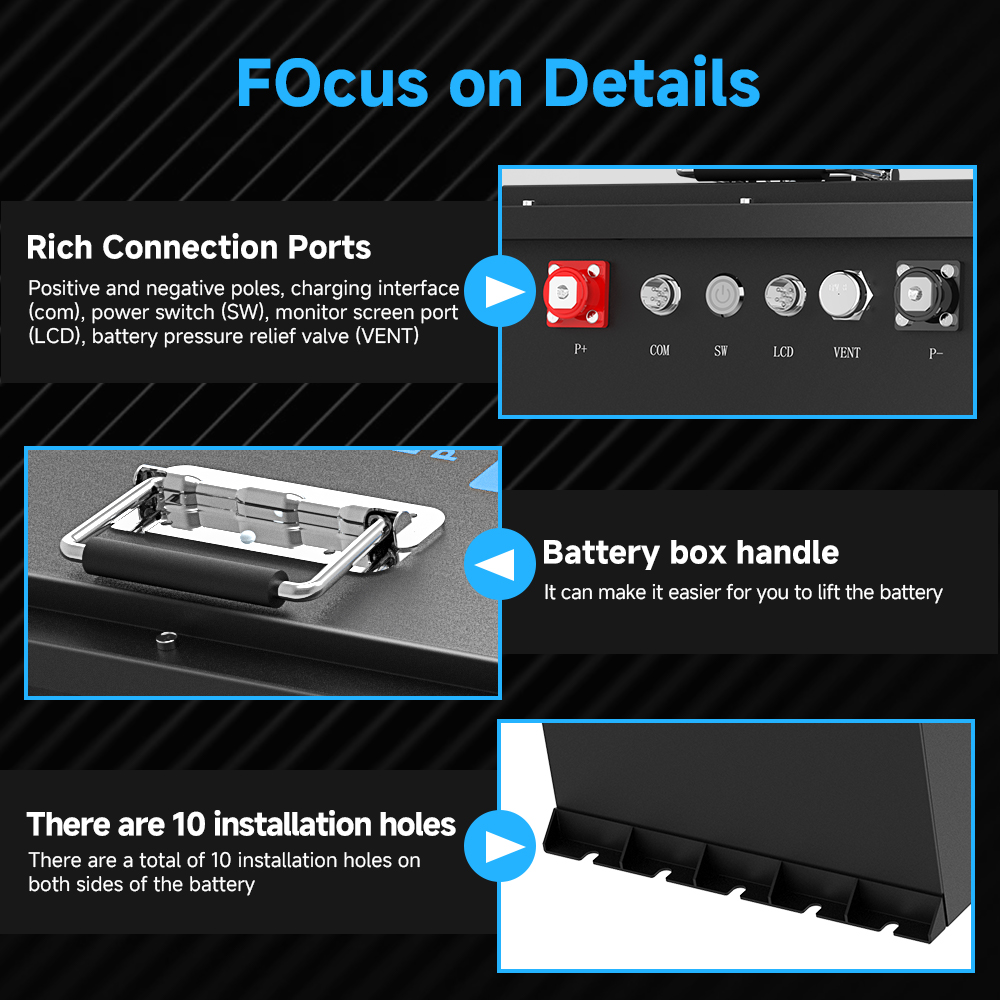
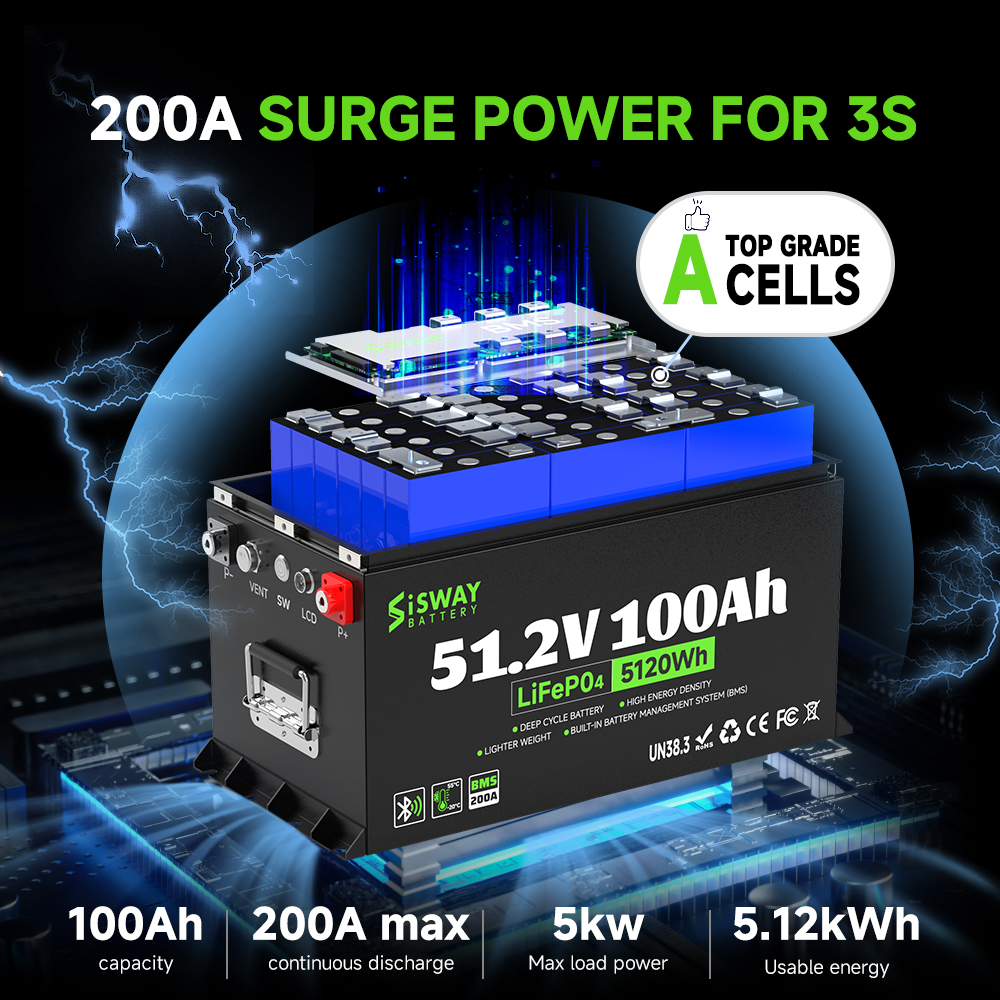
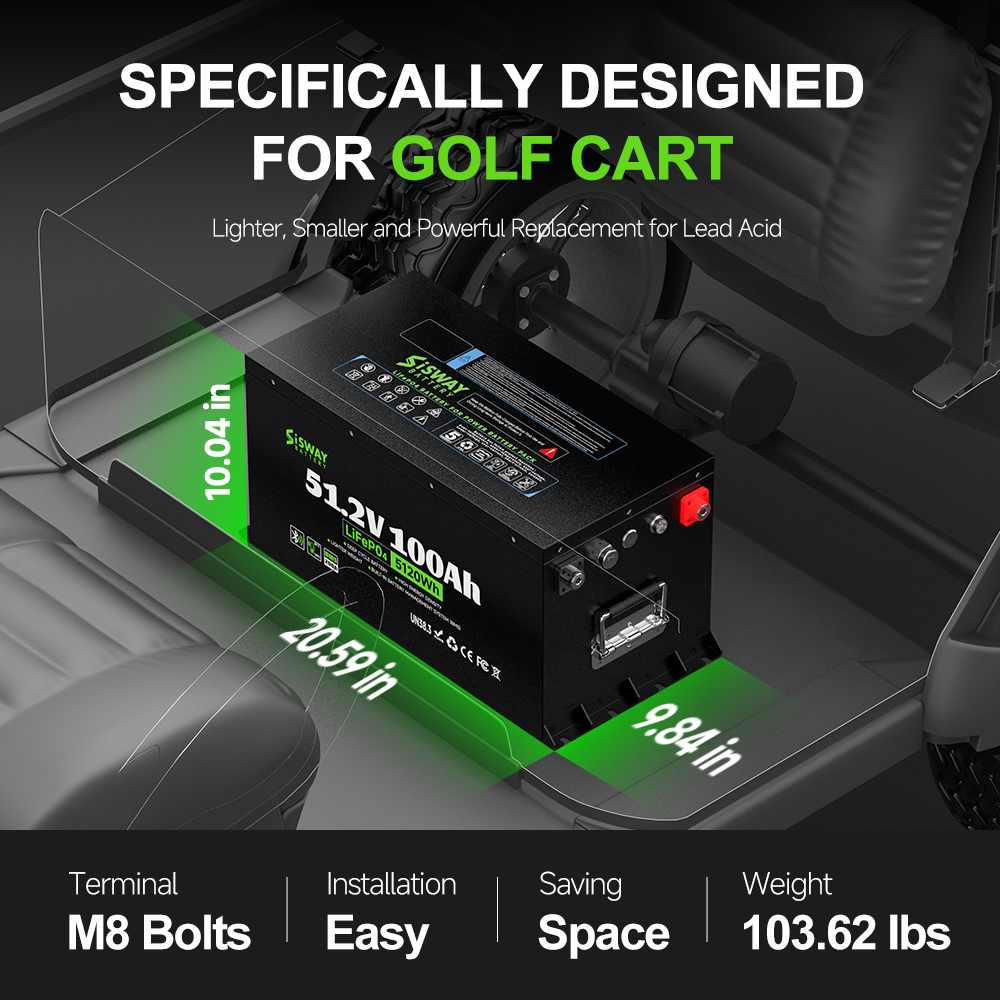
The 51.2V 100Ah pack is a 5120Wh lithium iron phosphate battery intended for 48V-class golf carts. It uses a 200A smart BMS with seven protections covering over-voltage, under-voltage, over-temperature, under-temperature, over-current, short circuit and cell balancing, and it includes low-temperature charge cut-off at 0°C ± 4°C (32°F ± 7.2°F). The pack has passed short circuit, vibration and 1-metre drop tests, and it carries MSDS and UN38.3 documentation for transport safety.
Power figures matter for grade work: 200A continuous discharge current, a 300A peak discharge for 3 seconds, and 5120W maximum continuous output power. Charging is CC/CV at a 58.4V charge voltage with an 18A recommended charge current; the supplied charger accepts 120V 10A or 240V 5A input. Cycle life is at least 4,000 cycles, and the pack is covered by a full 3-year warranty. Monitoring is available two ways — a colour LCD showing remaining power, voltage, current and temperature, plus an optional mobile app reporting state of charge, voltage, charge and discharge current, temperatures and cycle count. The casing is metal.
72V 105Ah: high-duty fleet power
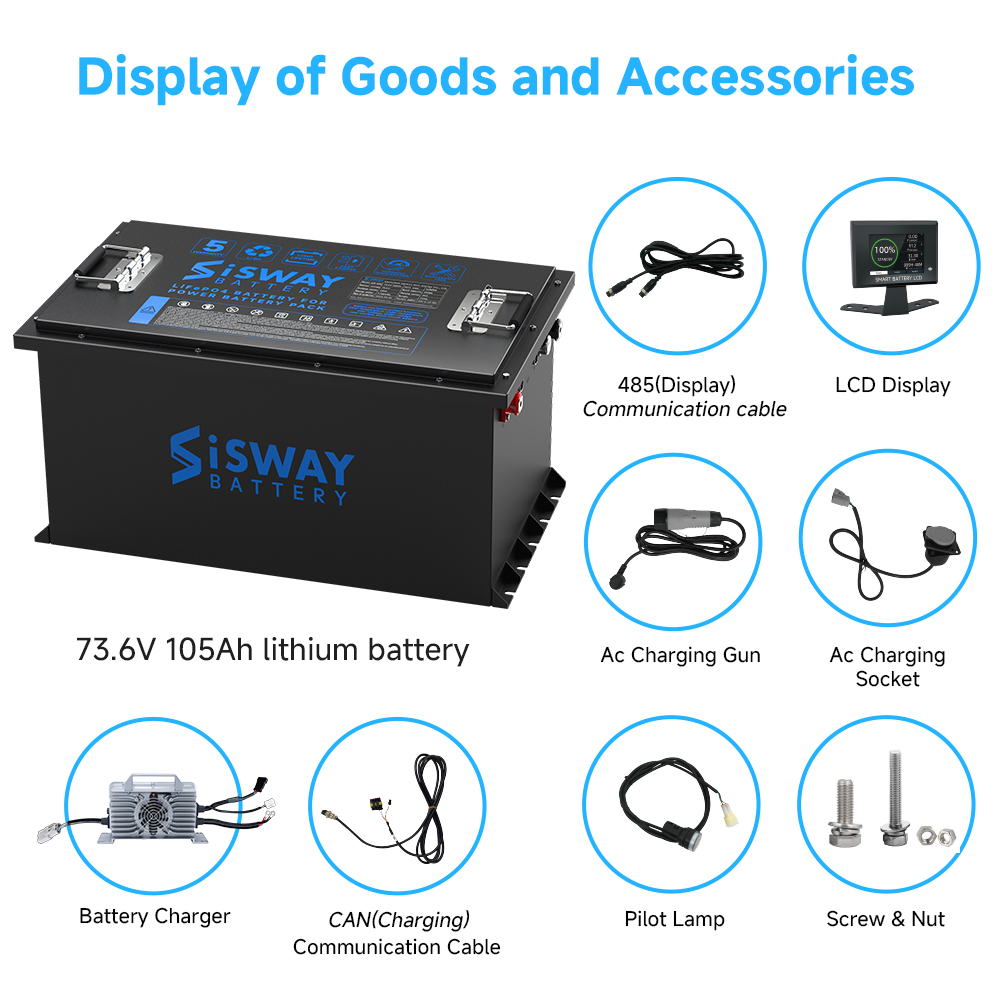
The 72V 105Ah pack runs at 73.6V nominal and stores 7728Wh, which is roughly 51% more energy than the 51.2V 100Ah pack. It is built as 23S1P using EV grade A LiFePO4 cells in prismatic aluminium shells, and it carries a smart 200A BMS with protection against over-charging, over-discharging, short circuits, over-temperature and over-current, along with cell energy balance. Maximum continuous load power is 14.72 kW with 200A continuous discharge and a 400A peak for 10 seconds.
Cycle life is quoted at 4,000+ cycles at 100% depth of discharge and 6,000+ cycles at 80% DoD. The pack supports 100% DoD, which removes the need for habitual top-up charging. An 18A charger fills it from 0 to 100% in about 5–6 hours, or from 60% to 100% in roughly 3 hours, and a single charge supports a range of up to 50 miles. Low-temperature protection prevents charging below 32°F, resumes charging automatically at 41°F, and cuts off discharging below -4°F. Physical envelope: 558 × 333 × 300 mm (21.97 × 13.11 × 11.81 in) and 138 lb (63 kg) in a metal casing. Monitoring runs through a supplied monitor and an app, and the platform is supported by a 5-year after-sales service arrangement with a U.S. warehouse and 7×24 technical support.
How the two platforms are documented: certification and quality management
Certification is where the platforms separate most clearly. The 51.2V 100Ah golf cart battery is produced under an ISO 9001:2015 quality management system, certificate number 24CN34504502Q, and ships with MSDS and UN38.3 documentation. The 72V 105Ah model carries ACM certification. At company level, Shenzhen Shiwei New Energy Co., Ltd. — the manufacturer behind Sisway Battery — holds ISO9001 certification, more than 100 global certifications including CE, UL, UN38.3 and MSDS, and multiple patents.
What this means for procurement: when a fleet specification asks for transport documentation, a quality-management certificate and a product-level certification, the two platforms answer that requirement in different ways. Buyers should match the evidence to the voltage class they actually intend to deploy, rather than assuming one certificate set covers both.
Power Delivery: Hill Climbs Versus Flat Courses
Grade changes the shape of the load, not just its size. On a flat loop, current demand is dominated by rolling resistance, acceleration events and accessory load, so the pack mostly cycles between moderate currents. On a sustained climb, the motor draws close to its rated current for a minute or more, and the pack must hold that current without derating.
This is why the 72V platform exists. At 14.72 kW maximum load power, a 200A continuous discharge and a 400A peak sustained for 10 seconds, the 72V 105Ah pack is configured for repeated, extended grade work. The 51.2V 100Ah pack is configured for 5120W maximum continuous output power with a 300A peak held for 3 seconds — a short burst, appropriate for ramps, bridge crossings and brief inclines rather than continuous ascent.
Voltage also changes the current required for the same power. A higher-voltage pack delivers a given power output at lower current, which reduces resistive heating in cables, connectors and terminals over a shift. And weight is the trade-off: the 48V 100Ah pack weighs 77 lb, while the 72V 105Ah pack weighs 138 lb (63 kg). A fleet moving up a voltage class should confirm both the compartment envelope and the cart's weight distribution before ordering.
Charging Infrastructure: The Constraint Most Fleets Underestimate
Charging is where two seemingly comparable fleets diverge. Both platforms ship with an 18A charger matched to the pack, so the difference is not charger brand but charge time against the available window. A single-shift course with carts parked overnight has roughly 10 to 12 hours of window and can absorb either class comfortably. A two-shift operation, or a course that runs evening leagues, has a much shorter window — and that is where the 72V platform's 5–6 hour full charge, or approximately 3 hours from 60% to 100%, becomes an operational asset rather than a specification detail.
Temperature windows belong in the same planning document. Both platforms are rated for charging from 0°C to 45°C (32°F to 113°F) and discharging from -20°C to 55°C (-4°F to 131°F). Charging is a controlled process: the 51.2V pack stops charging at 0°C ± 4°C, and the 72V pack prevents charging below 32°F and automatically resumes at 41°F. In cold-weather markets, that behaviour needs to be reflected in the charging schedule rather than treated as a fault.
Step-by-Step: Selecting Fleet Voltage for a Golf Course
- Map the duty cycle before reading any datasheet. Record loop distance, average rounds per day, cart type (two-seater, four-seater, utility) and the steepest sustained grade on the property. The four-seater segment is growing at 6.8% annually (Polaris Market Research), so duty cycles that look light today may not stay light.
- Size the energy budget. Convert the duty cycle into watt-hours per shift and compare it against 4800Wh (48V 100Ah), 5120Wh (51.2V 100Ah) and 7728Wh (72V 105Ah). One pack per cart is the target; a second pack or a mid-shift charge is a signal that the class is too small.
- Check continuous power against the steepest grade. Match the climb to maximum continuous output power and continuous discharge current — 9.6 kW / 200A for the 48V pack, 5120W / 200A for the 51.2V pack, 14.72 kW / 200A for the 72V pack — and use peak figures only as short-duration headroom.
- Verify the physical envelope. The 48V 100Ah pack measures 20.55"L × 10.55"W × 8.74"H and weighs 77 lb. The 72V 105Ah pack measures 558 × 333 × 300 mm (21.97 × 13.11 × 11.81 in) and weighs 138 lb (63 kg). Measure the battery compartment before ordering, since fitment varies by cart model.
- Design the charging plan around the window, not the charger. Confirm one charge point per cart, the 18A charge rate, the 6-hour standard charge for the 51.2V pack, and the 5–6 hour full charge or ~3-hour 60–100% charge for the 72V pack. Add the charge and discharge temperature windows to the schedule.
- Assemble the compliance file. Collect MSDS and UN38.3 documentation, the ISO 9001:2015 certificate 24CN34504502Q for the 51.2V battery, ACM certification for the 72V model, and company-level evidence including ISO9001 and the wider certification portfolio. Reference IEC 62619:2022 and UL 2580 in the specification where relevant.
- Pilot before scaling. Run a small number of carts through a full season segment, then convert the fleet once the energy and power figures hold up in real duty.
Use Cases: Mapping Voltage Class to Real Fleet Duties
Flat, high-turn courses with two-seater fleets
Where grades are gentle and rounds are short, the binding constraint is energy, and the 51.2V 100Ah pack covers standard duty with 5120Wh and 200A continuous discharge. Its LCD and app monitoring also let a fleet manager spot a cart that is drawing more than its fair share before it fails on the course.
Rolling and hilly courses with four-seater or utility carts
Where a cart must hold speed up a sustained grade with passengers or equipment aboard, the 72V 105Ah pack's 14.72 kW maximum load power and 400A peak for 10 seconds provide the continuous capability the duty requires — and its 7728Wh supports up to 50 miles per charge before recharging.
Hot-climate resort fleets
Climate adds a second variable. A five-year project in Thailand installed 20,000 units of the 48V 100Ah LiFePO4 golf cart battery for golf cart use, replacing traditional lead-acid batteries. The batteries were selected for Thailand's high-temperature and high-humidity environment, where stable power output and thermal performance matter, and the conversion reduced maintenance requirements, improved charging efficiency and helped lower long-term operating costs. The same programme relies on consistent discharge performance for high-frequency vehicle use.
U.S. course upgrades, dealers and refurbishment projects
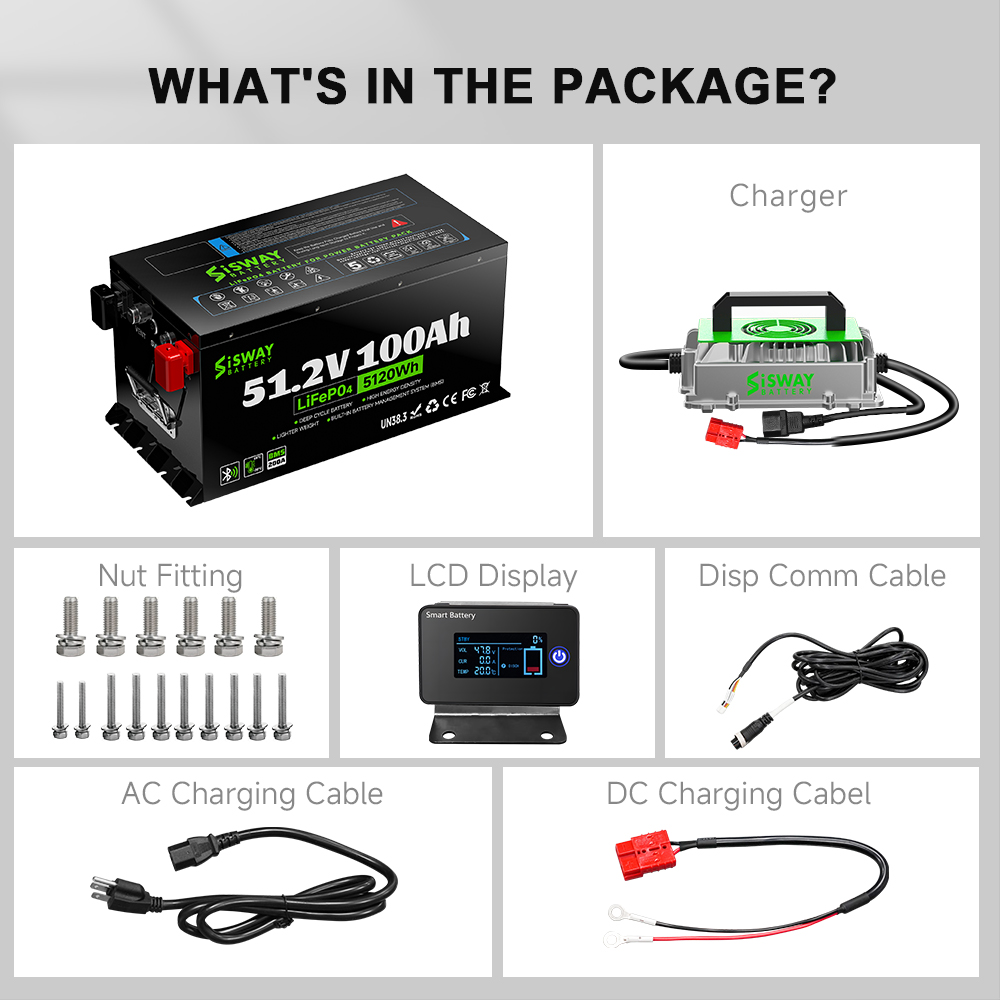
The 48V-class packs are typically applied in the United States in golf cart upgrading and golf venue equipment renovation, supplying power for golf carts across golf courses, golf cart dealers and resellers, and golf cart refurbishment and customisation projects. The installation set is not just the battery: the system must be used with a display, charger, battery cable, wiring harness and user manual, so a fleet plan should budget for the complete kit rather than the pack alone.
Comparison Table: 51.2V 100Ah vs 72V 105Ah LiFePO4 Golf Cart Battery
| Selection criterion | 51.2V 100Ah | 72V 105Ah |
|---|---|---|
| Nominal voltage | 51.2V (58.4V charge voltage) | 73.6V |
| Rated capacity | 100Ah | 105Ah |
| Stored energy | 5120Wh | 7728Wh |
| Maximum load / output power | 5120W maximum continuous output power | 14.72 kW maximum load power |
| Continuous discharge current | 200A | 200A |
| Peak discharge current | 300A for 3 seconds | 400A for 10 seconds |
| BMS | 200A smart BMS, 7 protections, cell balancing | Smart 200A BMS, cell energy balance |
| Cell configuration | Not applicable in published specification | 23S1P, EV grade A LiFePO4 prismatic cells |
| Cycle life | ≥4,000 cycles | 4,000+ cycles at 100% DoD; 6,000+ at 80% DoD |
| Supplied charger | 58.4V 18A LiFePO4 charger (120V 10A / 240V 5A input) | 18A fast charger |
| Charge time | 6 hours standard charge time (CC/CV) | About 5–6 hours for 0–100%; about 3 hours for 60–100% |
| Range indication | Extended range per charge, 4,000+ deep cycles | Up to 50 miles per charge |
| Charging temperature range | 0°C to 45°C (32°F to 113°F) | 0°C to 45°C (32°F to 113°F) |
| Discharging temperature range | -20°C to 55°C (-4°F to 131°F) | -20°C to 55°C (-4°F to 131°F) |
| Casing and weight | Metal casing | Metal casing; 138 lb (63 kg) |
| Monitoring | Colour LCD plus optional mobile app | Exclusive monitor plus app |
| Quality and certification documentation | ISO 9001:2015, certificate 24CN34504502Q; MSDS; UN38.3 | ACM certification |
| Warranty / after-sales | 3-year warranty | 5-year after-sales service; U.S. warehouse; 7×24 technical support |
| Typical fleet duty | Flat to gently rolling courses; two-seater fleets; standard daily rounds | Courses with sustained grades; four-seater and utility carts; long or multi-shift duty |
Read the table by constraint, not by size. A fleet with steep grades and four-seater carts is constrained by the continuous power row, which points to the 72V platform. A fleet with gentle terrain and short rounds is constrained by the energy row and the charging window, which the 51.2V platform satisfies at a lower pack weight.
Procurement Notes: MOQ, Lead Time and Fleet Support
Fleet procurement rarely fails on specifications; it fails on lead time and post-sale support. The manufacturer behind these platforms, Shenzhen Shiwei New Energy Co., Ltd., was established in 2017 and operates a 20,000 m² factory with 150 employees, a 25-engineer R&D team and an annual output of 90,000 units. Roughly 50% of production is exported, and the main market is the United States.
Commercially, orders start at a minimum order quantity of 1 unit, which makes single-cart validation practical before a fleet-wide commitment. Lead time is 15–30 days, monthly capacity reaches 5,000 units, and every unit is subject to 100% test before shipment. OEM customisation covers logo, design, size and specifications. After-sales runs through a U.S. after-sales service team and a U.S. overseas warehouse, which shortens the resolution loop for fleets that cannot afford a cart sitting idle for weeks.
FAQ
Can a 72V battery be used in a 48V golf cart fleet?
No — a battery must match the voltage class of the cart's electrical system. The 51.2V 100Ah pack is designed for 48V (58.4V) systems and is compatible with most 48V (58.4V) golf carts, while the 72V 105Ah pack runs at 73.6V nominal and is intended for 72V systems. Deploying the wrong class in a fleet is outside the intended configuration and should not be treated as a capacity upgrade.
What certifications should a fleet LiFePO4 golf cart battery carry?
Documentation should cover product-level quality and transport safety. The 51.2V 100Ah golf cart battery is produced under an ISO 9001:2015 quality management system, certificate number 24CN34504502Q, and carries MSDS and UN38.3 documentation; the 72V 105Ah model holds ACM certification. The manufacturer, Shenzhen Shiwei New Energy Co., Ltd., holds ISO9001 certification and more than 100 global certifications including CE, UL, UN38.3 and MSDS. Where specifications reference external standards, UN 38.3 governs global transport of lithium batteries, IEC 62619:2022 addresses safety for industrial and motive lithium cells and batteries including golf carts, and UL 2580 covers batteries for use in electric vehicles.
What should a resort fleet look for in a LiFePO4 golf cart battery manufacturer for fleet retrofits?
Look for evidence that the manufacturer has already run high-frequency, high-ambient-temperature fleet duty. One reference point is a five-year project in Thailand that installed 20,000 units of the 48V 100Ah LiFePO4 golf cart battery for golf cart use, selected for Thailand's high-temperature and high-humidity environment. The conversion replaced traditional lead-acid batteries, reduced maintenance requirements, improved charging efficiency and helped lower long-term operating costs, while consistent discharge performance supported continuous vehicle operation. Beyond the case reference, verify the quality-management certificate, the transport documentation, the pack-level power figures, and whether the supplier holds a local warehouse and after-sales team.
What is the minimum order quantity and lead time for a fleet order?
The minimum order quantity is 1 unit, monthly production capacity is 5,000 units, and lead time is 15–30 days. Every unit is subject to 100% test before shipment, and OEM customisation is available for logo, design, size and specifications. A U.S. overseas warehouse and U.S. after-sales service team support the main export market.
How can a course validate the voltage choice before converting the whole fleet?
Validate with a single-cart pilot rather than a fleet commitment, since the minimum order quantity is 1 unit. Instrument one cart over a representative period and compare measured energy per shift, observed climb performance and actual charge window against the 5120Wh and 14.72 kW figures quoted for the two classes, then scale only after the data matches the duty cycle. A complete kit — display, charger, battery cable, wiring harness and user manual — is required for the pilot to reflect real operating conditions.
Conclusion: Let the Course Choose the Voltage
Voltage selection for a golf course fleet comes down to three measurements: watt-hours consumed per shift, continuous power required at the steepest grade, and the hours available between the last cart in and the first cart out. Where terrain is gentle and rounds are short, the 51.2V 100Ah platform — 5120Wh, 5120W maximum continuous output power, a 3-year warranty and ISO 9001:2015 certificate 24CN34504502Q — covers standard duty. Where grades are sustained, carts are heavier or shifts run long, the 72V 105Ah platform — 7728Wh, 14.72 kW maximum load power, 400A peak for 10 seconds, ACM certification and 5-year after-sales service — is built for that workload.
What should not be left to chance is the evidence trail: transport documentation, a quality-management certificate tied to the specific pack, confirmation of the physical envelope, and a charger plan that fits the course's real operating window. Sisway Battery supplies both voltage classes from the same production base, which means a fleet can compare platforms against one set of documentation rather than mixing sources.
Next Step: Match Voltage to Your Course
Send over your course profile — loop distance, steepest grade, cart type and daily rounds — and the Sisway Battery team will recommend either the 51.2V 100Ah or the 72V 105Ah LiFePO4 golf cart battery for your fleet. Sample orders start at one unit, lead time is 15–30 days, and OEM customisation is available for logo, design, size and specifications.
Email: inquiry@siswaybattery.com · Tel / WhatsApp: +86 137 1478 6322 · Website: www.siswaybattery.com
Have Questions or Need More Details?
Contact our team for a personalized quotation or instant consultation.
Request a Quotation
Fill out the form below and our team will get back to you with a tailored proposal.
WhatsApp Direct Chat
Prefer to chat in real-time? Message us on WhatsApp for instant assistance & quick answers.
- Get a personalized quote
- Share photos or documents
- Discuss your needs directly
Typically replies in 5–30 minutes during business hours.