Golf Cart Battery Compliance: USA, Global & Regional Rules
Golf Cart Battery Compliance: USA, Global & Regional Rules
A golf cart battery does not come with one certificate. It comes with a document set, and each document answers a different question. For 48V, 51.2V and 72V LiFePO₄ golf cart batteries, three documents cover most buyer requests: a UN38.3 test report for global transport, an MSDS written to GHS and OSHA HazCom 2012 for the USA market, and an ISO 9001:2015 quality management system certificate covering the factory that assembles the packs. Which document a buyer should request first depends on the destination market, the battery model, and where the pack currently sits in its validity window.
What "certified" means for a golf cart battery — and what it does not mean
On a lithium golf cart battery datasheet, the word "certified" usually points to one of four unrelated categories. Confusing them is the most common reason a compliant battery gets held up at a port, at a receiving dock, or in a site safety review.
- Transport safety. UN 38.3 is the standard required for the safe global transport of lithium batteries, based on the UN Manual of Tests and Criteria Part III Subsection 38.3. Without a valid UN38.3 test report, a lithium pack cannot be shipped internationally by air or sea, regardless of how well it performs in a cart.
- Chemical and handling documentation. A Material Safety Data Sheet (MSDS) describes the chemistry, hazards, handling and emergency response for a battery. In the USA, the relevant framework is the Globally Harmonized System (GHS) read together with OSHA HazCom 2012.
- Manufacturing system certification. ISO 9001:2015, formally paired with GB/T 19001-2016 in China, certifies the management system of the organisation that designs and produces the battery — not an individual pack.
- Product safety standards referenced in tenders. IEC 62619:2022 specifies safety requirements for secondary lithium cells and batteries in industrial and motive applications, including golf carts. UL 2580 is the North American standard for batteries used in electric vehicles, covering electrical, mechanical and environmental testing.
Three attributes decide whether a document actually supports your order: scope (which model and capacity it names), market (where it is applicable), and validity (issue date and expiry date). A certificate that is global in market scope but narrow in product scope does not cover a different voltage. A certificate with the right scope but an expired date does not clear customs.
Sisway Battery — Shenzhen Sisway New Energy Co., Ltd., established in 2017 — is a lithium iron phosphate (LiFePO₄) battery pack manufacturer based in Shenzhen, China. The company builds golf cart battery packs in a 20,000 m² facility, runs a 25-engineer R&D team, and exports roughly 50% of its output, with the USA as its main market.
Industry background: why compliance now sits at the front of the buying conversation
The global golf cart battery market reached approximately USD 1.49 billion in 2024 and is projected to reach USD 2.21 billion by 2030, a CAGR of 6.8%, according to Strategic Market Research. Those figures should be read as directional rather than exact: market-size estimates for this category diverge noticeably between research houses, and some alternative assessments place the 2024 figure far lower. What is not in dispute is the direction of travel.
Lithium-ion batteries held approximately 47% of the global golf cart battery market share by revenue in 2024, based on market analysis compiled by Boca EV. North America dominated the electric golf cart market in 2024 with a 44.7% revenue share, and the U.S. electric golf cart market alone was estimated at USD 529.4 million that year by Grand View Research. Within the US market, battery electric vehicles accounted for 72.5% of the electric golf cart segment. Polaris Market Research identifies the 4-seater golf cart segment as the fastest growing at 6.8% annually, and the Asia-Pacific region as the fastest-growing regional market at an estimated 6.9% CAGR.
Cross-border volume explains why documentation has become an operational issue rather than a formality. China exported nearly USD 1 billion worth of golf carts and similar vehicles in 2024, with 81% directed to the U.S. market, according to China Customs data reported by SCMP. Every one of those vehicles that ships with a lithium pack depends on transport documentation that survives inspection.
Two further developments shape what buyers should ask for. China's Ministry of Commerce issued Announcement No. 58 in 2025, regulating the export of high-energy-density lithium batteries above the 300 Wh/kg threshold, which means exporters should confirm whether a specific product falls inside that licensing scope and request the matching export paperwork. On the incoming side, tenders and fleet procurement policies increasingly name IEC 62619:2022 or UL 2580 as reference standards, even when the supplier's actual files are written against UN 38.3 and an MSDS.
The compliance document set behind 48V, 51.2V and 72V LiFePO₄ packs
Sisway Battery holds a defined set of certificates and reports for its lithium golf cart battery range. Each one has a narrow, checkable identity: a document number, an issuing authority, a market, a product scope, and an expiry date.
1. UN38.3 test report — the global transport document
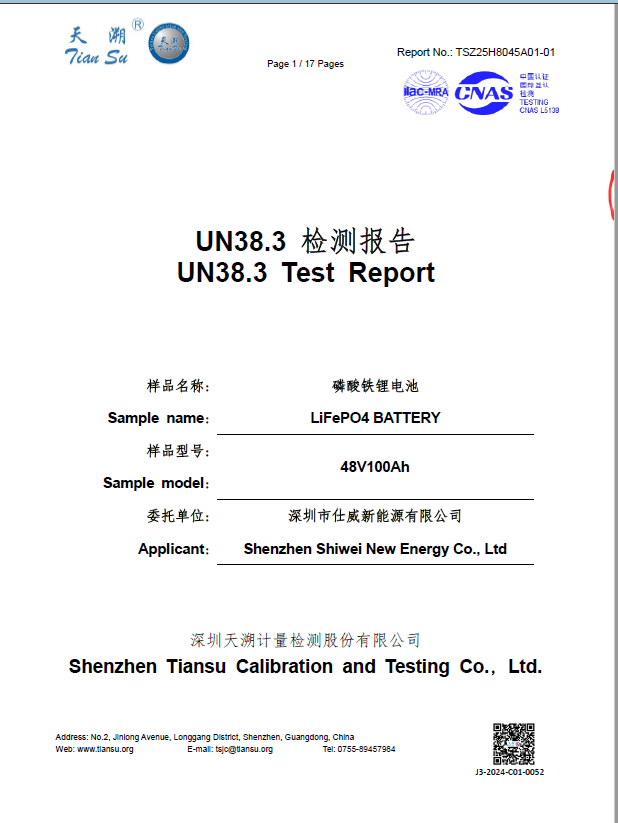
The 48V 100Ah LiFePO₄ golf cart battery is certified to UN38.3 under Test Report No. TSZ25H8045A01-01. The report applies to the product LiFePO₄ BATTERY, Model 48V100Ah, and to the global market. The applicable standard is UN 38.3 (UN Manual of Tests and Criteria Part III Subsection 38.3), and the report was issued by Shenzhen Tiansu Calibration and Testing Co., Ltd. on 25 August 2025, valid through 31 December 2026.
2. MSDS — the USA market document
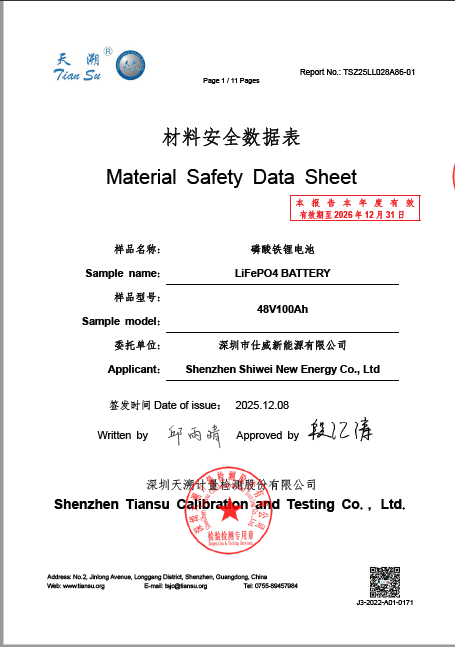
For the USA, the relevant chemical documentation is the Material Safety Data Sheet registered under No. TSZ25LL028A86-01. It is written to GHS and OSHA HazCom 2012, it is scoped to the lithium-ion golf cart battery series, and it applies to the USA market. It was issued by Shenzhen Tiansu Calibration and Testing Co., Ltd. on 8 December 2025, valid through 31 December 2026. The same issuing laboratory appears on both the UN38.3 report and the MSDS, which makes the two documents easier to cross-check against each other.
3. ISO 9001:2015 — the manufacturing system document
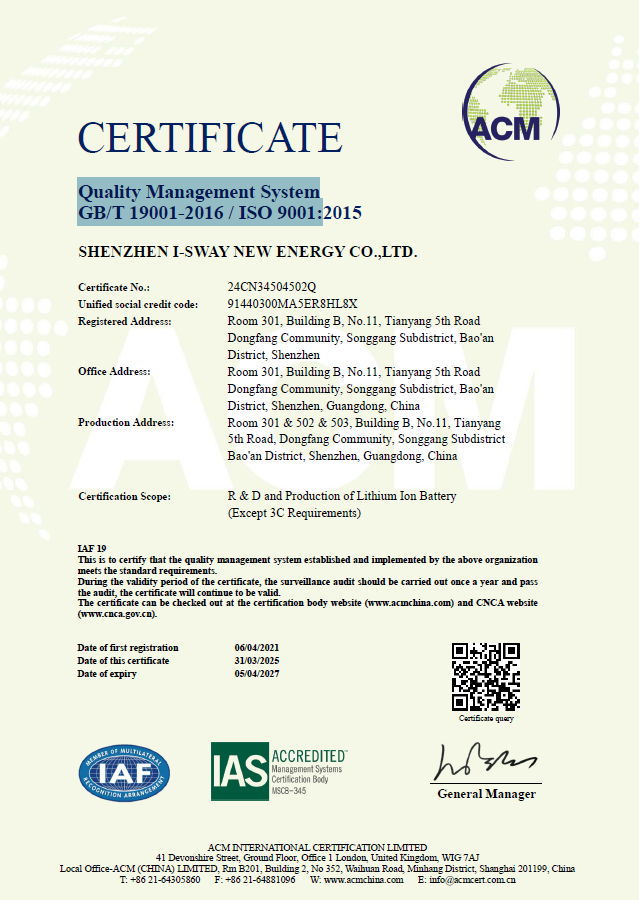
The quality management system certificate is registered as No. 24CN34504502Q against GB/T 19001-2016 / ISO 9001:2015. It was issued by ACM INTERNATIONAL CERTIFICATION LIMITED, applies to the global market, and its scope reads: R&D and Production of Lithium Ion Battery (Except 3C Requirements). It was issued on 31 March 2025 and is valid through 5 April 2027. Within the Sisway product range, this certificate is associated with the 48V 100Ah, 51.2V 100Ah and 72V 105Ah packs, which is why it is the one document in the set that a buyer can use across a mixed-voltage order rather than per model.
One scope detail deserves attention: “except 3C requirements” means the certificate covers the management system for R&D and production of lithium-ion batteries, and does not represent China Compulsory Certification of any individual product. Reading scope wording literally prevents most misunderstandings later.
4. Reference standards buyers will see cited alongside supplier files
IEC 62619:2022 and UL 2580 are not certificates that Sisway issues; they are external frameworks that may appear in a tender, a fleet specification, or a competitor's marketing. IEC 62619:2022 covers safety requirements for secondary lithium cells and batteries in industrial and motive applications including golf carts. UL 2580 covers electrical, mechanical and environmental testing for batteries used in electric vehicles, and is a North American standard. When a specification names one of these, the correct next question is not “do you have it?” but “which standard is your report actually written against, and what is its scope?”
Voltage by voltage: matching documents and specifications to the pack
Compliance documents follow the model, not the brand. A buyer sourcing a 48v golf cart battery, a 72v golf cart battery, or a 51.2V pack configured for 48V systems should match the document scope to the exact model number on the purchase order.
| Battery model | Electrical basis | Energy and power | Documents to request | Warranty / service |
|---|---|---|---|---|
| 48V 100Ah LiFePO₄ golf cart battery | 48V nominal, 100Ah, 15S1P EV grade A LiFePO₄ cells, 200A BMS, discharge cutoff 41.25V | 4800Wh, 9.6 kW max load power, 300A peak discharge for 2 seconds | UN38.3 Test Report No. TSZ25H8045A01-01 (global); MSDS No. TSZ25LL028A86-01 (USA); ISO 9001:2015 No. 24CN34504502Q (global) | 5-year warranty |
| 51.2V 100Ah golf cart battery | 51.2V nominal, 100Ah, 200A BMS, charge voltage 58.4V, designed for 48V (58.4V) systems | 5120Wh, 5120W continuous output, 300A peak discharge for 3 seconds | MSDS and UN38.3 per product specification; ISO 9001:2015 No. 24CN34504502Q (global) | 3-year warranty |
| 72V 105Ah golf cart battery | 73.6V nominal, 105Ah, 23S1P EV grade A LiFePO₄ cells, 200A smart BMS, discharge cutoff 63.25V | 7728Wh, 14.72 kW max load power, 400A peak discharge for 10 seconds | ISO 9001:2015 No. 24CN34504502Q covering R&D and production of lithium-ion batteries (global) | 5-year after-sales service |
The 48V 100Ah pack is the model explicitly named on the UN38.3 report, which is the document most international shipments are checked against first. It uses a plastic case, a drop-in footprint of 20.55 × 10.55 × 8.74 inches, weighs 77 lbs, and ships with an 18A charger, mobile app monitoring and an LCD touch screen. It supports more than 4,000 cycles.
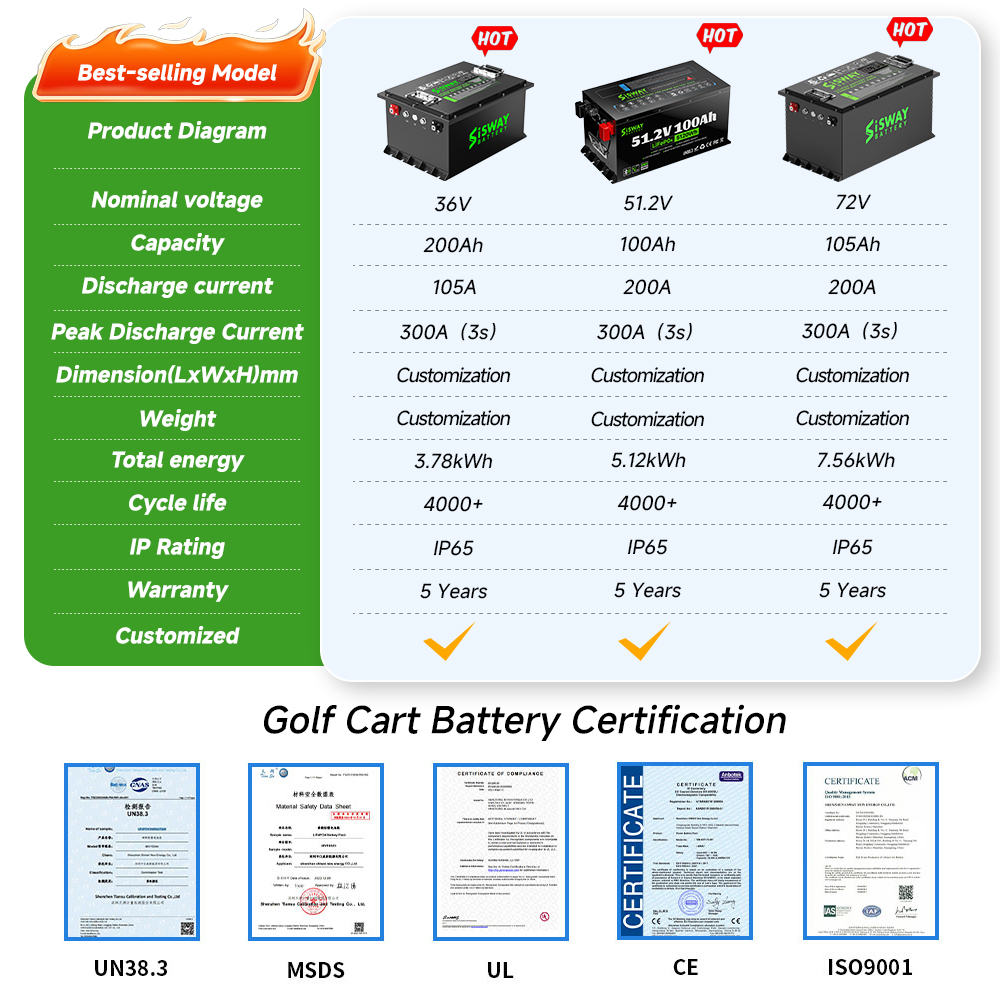
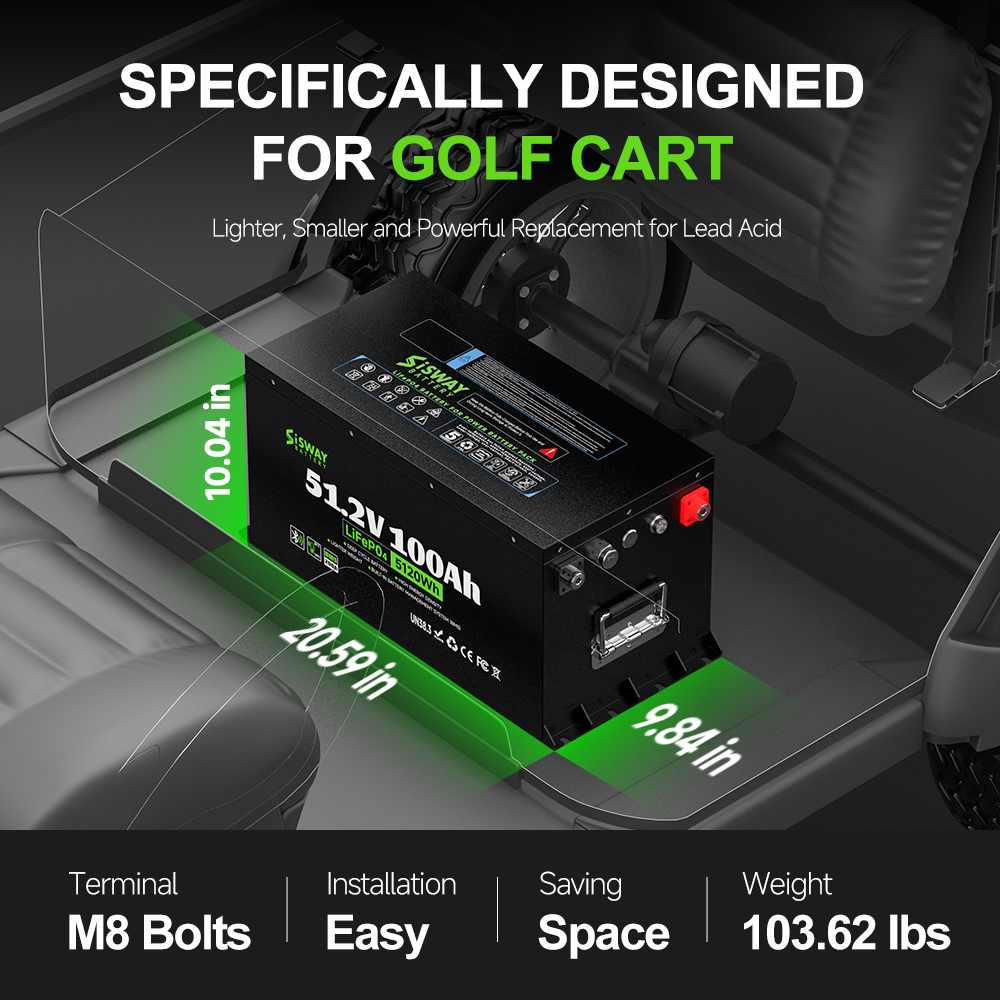
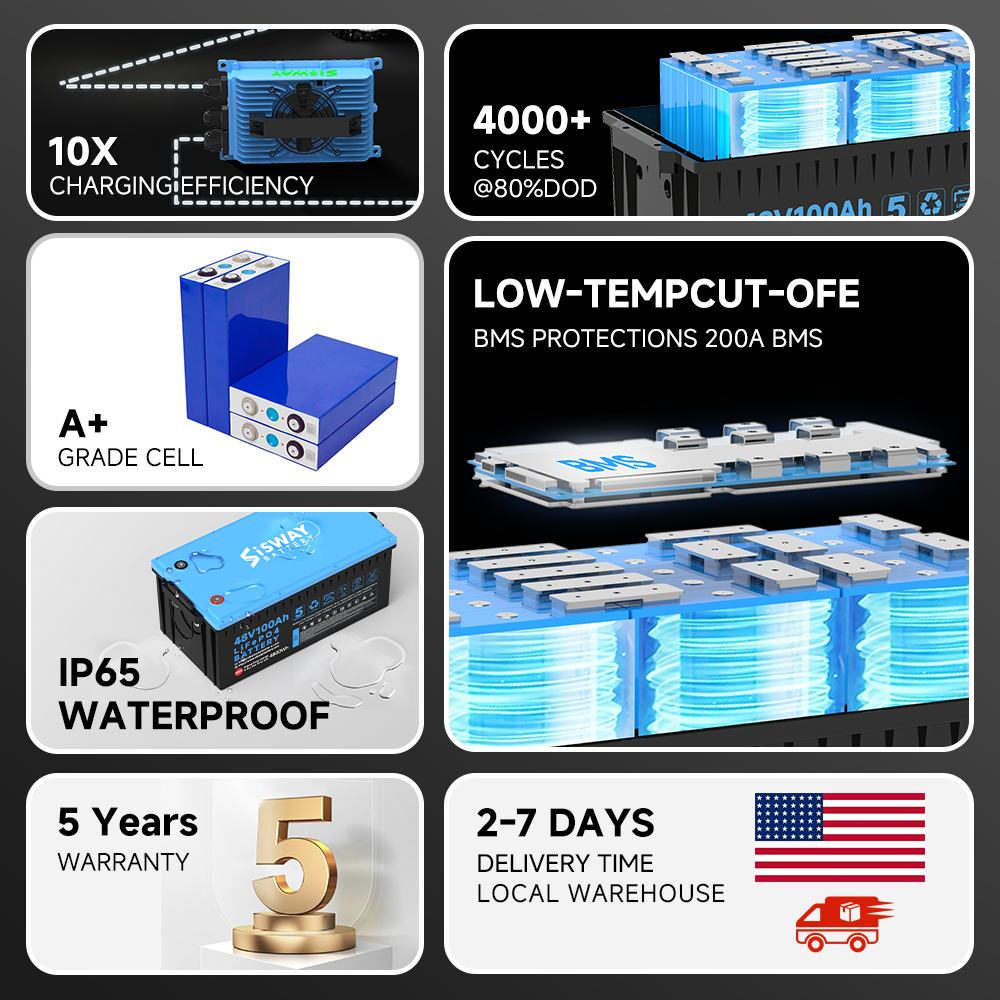
The 51.2V 100Ah pack is the voltage that most often causes confusion, because it is designed for 48V (58.4V) golf cart systems rather than for a separate 51.2V cart class. It carries MSDS and UN38.3 certification per its product specification and has passed short circuit, vibration and 1-metre drop tests. It uses a metal casing, supports monitoring through an included LCD and an optional mobile app, and its BMS is rated at 200A with protection against over/under voltage, over/under temperature, over-current and short circuit.
The 72V 105Ah pack sits at the top of the range, with 7728Wh of energy, a 14.72 kW maximum continuous load power and a 400A peak discharge rating for 10 seconds. It uses 23 EV grade A LiFePO₄ cells in a 23S1P configuration, includes a monitor and app for real-time data, and its BMS provides cell energy balancing plus protection against over-charging, over-discharging, short circuits, over-temperature and over-current. Low-temperature cut-off protection prevents charging below 32°F, resumes charging automatically at 41°F, and cuts off discharging below -4°F.
Step-by-step: how to verify a golf cart battery compliance file
Verification is a sequence, not a document dump. Working through these seven steps in order prevents the two most expensive mistakes: accepting a valid certificate for the wrong model, and accepting the right model on an expired document.
- List the destination markets first. Global transport documentation (UN38.3) is required in every case. Market-specific handling documentation is added on top — for the USA, an MSDS prepared to GHS and OSHA HazCom 2012.
- Match the document scope to the model number. UN38.3 Test Report No. TSZ25H8045A01-01 is scoped to Model 48V100Ah. If the purchase order is for a 72V 105Ah pack, ask which document names that model, and do not assume the 48V scope transfers.
- Identify the issuing authority. Both the UN38.3 report and MSDS were issued by Shenzhen Tiansu Calibration and Testing Co., Ltd. The quality management system certificate was issued by ACM INTERNATIONAL CERTIFICATION LIMITED. The issuing body should be named on the file you receive, not only on a marketing page.
- Check validity dates against your delivery schedule. The UN38.3 report and the MSDS are valid through 31 December 2026; the ISO 9001:2015 certificate is valid through 5 April 2027. A shipment arriving in early 2027 should be accompanied by the renewed file, so request the current version rather than an archived PDF.
- Read the scope wording literally. The management system certificate covers R&D and production of lithium-ion batteries, except 3C requirements. It is a system-level document, and it should not be presented as a product certification.
- Confirm the physical and electrical match. Certification does not fix fitment. Check compartment dimensions before ordering: the 51.2V pack requires approximately 625 × 505 × 360 mm of space, while the 72V 105Ah measures 558 × 333 × 300 mm and weighs 63 kg.
- Confirm the commercial and support side in the same review. Compliance files and after-sales structure should be verified together, because a pack that clears customs but has no service route creates a different problem later.
Three buying situations where the paperwork decides the order
USA fleet and campus retrofit
A US golf venue or campus replacing lead-acid packs with lithium is buying into both a performance change and a documentation change. Two documents matter immediately: the MSDS written to GHS and OSHA HazCom 2012 for the site safety file, and the UN38.3 report for inbound freight. The 48V 100Ah pack is built for this scenario, with a 5-year warranty and a drop-in lead-acid case footprint. The application profile for this kind of project assumes 4000+ deep cycles and an operating window of 0–55°C charging and -20–55°C discharging.
Dealer and distributor inventory across voltages
A distributor stocking 48V, 51.2V and 72V packs for golf cart battery replacement work needs one document that spans the range and separate documents per model. The ISO 9001:2015 certificate is the cross-range document; the UN38.3 report and MSDS are model- and market-specific. Resellers should also confirm that the file they hand to their own customers names the model being delivered.
Hot-climate OEM programmes
Compliance scope and operating environment often need to be reviewed together. In one Thailand programme, a golf cart battery OEM took delivery of 20,000 units over a five-year relationship, with packs engineered for high-temperature and high-humidity conditions and delivering stable power output and thermal performance in that environment. The energy upgrade replaced traditional lead-acid batteries, reduced maintenance requirements, improved charging efficiency and met the demands of high-frequency vehicle use. The documented lesson is practical: a certification file tells you the pack is legal to move and safe to handle, while the operating envelope tells you whether it will last where it is installed.
Certification comparison table
The table below summarises the three core documents in the Sisway compliance set. It can be used as a checklist when reviewing a supplier file, or as a template for stating the same facts in your own procurement records.
| Document | Issuing body | Market scope | Applies to | Reference number | Valid through |
|---|---|---|---|---|---|
| UN38.3 Test Report | Shenzhen Tiansu Calibration and Testing Co., Ltd. | Global | LiFePO₄ battery, Model 48V100Ah | TSZ25H8045A01-01 | 31 December 2026 |
| Material Safety Data Sheet (MSDS), GHS / OSHA HazCom 2012 | Shenzhen Tiansu Calibration and Testing Co., Ltd. | USA | Lithium-ion golf cart battery series | TSZ25LL028A86-01 | 31 December 2026 |
| Quality Management System, ISO 9001:2015 / GB/T 19001-2016 | ACM INTERNATIONAL CERTIFICATION LIMITED | Global | R&D and production of lithium-ion battery (except 3C requirements), associated with the 48V 100Ah, 51.2V 100Ah and 72V 105Ah packs | 24CN34504502Q | 5 April 2027 |
FAQ: golf cart battery compliance questions buyers ask
Which certification documents should a US buyer request first?
Start with three documents. First, a UN38.3 test report, because UN 38.3 is required for the safe global transport of lithium batteries — for the Sisway 48V 100Ah LiFePO₄ battery this is Test Report No. TSZ25H8045A01-01, issued by Shenzhen Tiansu Calibration and Testing Co., Ltd., valid through 31 December 2026. Second, an MSDS for the USA market written to GHS and OSHA HazCom 2012 — MSDS No. TSZ25LL028A86-01, valid through 31 December 2026. Third, the ISO 9001:2015 quality management system certificate, No. 24CN34504502Q, issued by ACM INTERNATIONAL CERTIFICATION LIMITED for the global market and valid through 5 April 2027.
What does a “global market” scope actually cover?
A global market scope means the document is not restricted to a single destination country. In this set, the UN38.3 report and the ISO 9001:2015 certificate are both applicable to the global market. Global transport scope does not replace market-specific documentation: the MSDS is separately issued for the USA market, so a buyer exporting to the USA should hold both the transport report and the USA-scoped MSDS. A global scope also does not widen product scope — the UN38.3 report names Model 48V100Ah specifically.
Can the battery be customised for a specific cart, voltage or brand?
Sisway Battery operates an OEM production model with customisation covering logo, design, size and specifications. Production capacity for this line is 5,000 units per month, with a minimum order quantity of 1 unit and 100% testing of production. The company serves export markets including the USA and supports orders through a US after-sales service team and a US overseas warehouse. Buyers should supply the exact compartment dimensions and system voltage before customisation begins.
What drives the cost of a compliant lithium golf cart battery?
Cost is driven by documented engineering choices rather than by voltage alone. The main variables are cell grade and configuration — 15S1P EV grade A LiFePO₄ cells in the 48V 100Ah pack versus 23S1P in the 72V 105Ah pack; energy capacity, which moves from 4800Wh to 5120Wh to 7728Wh across the range; BMS rating, with a 200A BMS and peak discharge ratings of 300A (2 sec), 300A (3 sec) and 400A (10 sec); the included 18A charger; the casing material, plastic on the 48V pack and metal on the 51.2V and 72V packs; and the compliance documentation and testing behind the file, including UN38.3 and MSDS. Logistics and warehouse location form the rest of the delivered cost. Comparing delivered cost per energy unit and per warranted year is more reliable than comparing headline unit prices.
How long does production take, and can a sample be evaluated first?
Standard lead time is 15–30 days, and the minimum order quantity starts at 1 unit, so a single pack can be ordered and tested before a larger commitment. Evaluating one pack first is the fastest way to confirm two things at once: that the dimensions fit the cart compartment, and that the compliance file matches the model you intend to buy at volume. A written record of what the sample validated — fitment dimensions, system voltage, charger compatibility and the document scope — makes the later production order considerably faster to place.
Conclusion: build the document list before the purchase order
Compliance for a golf cart battery is a short, checkable list once it is separated into its four categories. Transport documentation (UN38.3) makes the pack movable worldwide. Market documentation (an MSDS under GHS and OSHA HazCom 2012) makes it acceptable at a US receiving site. A management system certificate (ISO 9001:2015) tells you how the factory that assembles the pack is controlled. External standards such as IEC 62619:2022 and UL 2580 describe frameworks that may be requested by tenders and should be matched to the standard the supplier's own report is actually written against.
The same checklist applies whether you are sourcing club car golf cart batteries, ez go golf cart batteries, a yamaha golf cart battery pack, or a multi-voltage order for lithium golf cart battery replacement programmes: confirm the model scope, the market scope and the expiry date, then confirm the physical fitment. Where those three items are documented and current, a 48V, 51.2V or 72V LiFePO₄ pack moves from a compliance question to a straightforward procurement decision.
A final practical note on timing: the UN38.3 report and MSDS in the Sisway set are valid through 31 December 2026, while the ISO 9001:2015 certificate runs to 5 April 2027. Buyers scheduling deliveries in 2027 should request the renewed transport and safety documentation as part of the order confirmation, and keep the version dates in the purchasing file.
Next step: check the file against your model
Send your destination market, cart model and required voltage, and Sisway Battery will return the matching document set — UN38.3 report, MSDS and management system certificate — along with the specification sheet for that pack.
Website: www.siswaybattery.com
Email: inquiry@siswaybattery.com
Tel / WhatsApp: +86 137 1478 6322
Product brochure (download): Sisway Battery English catalogue (PDF)
Document details in this article refer to the certification set held for the 48V 100Ah, 51.2V 100Ah and 72V 105Ah LiFePO₄ golf cart battery range, as recorded on the certificates and reports themselves. Market data is attributed to its original sources and should be treated as directional.
Have Questions or Need More Details?
Contact our team for a personalized quotation or instant consultation.
Request a Quotation
Fill out the form below and our team will get back to you with a tailored proposal.
WhatsApp Direct Chat
Prefer to chat in real-time? Message us on WhatsApp for instant assistance & quick answers.
- Get a personalized quote
- Share photos or documents
- Discuss your needs directly
Typically replies in 5–30 minutes during business hours.