Why These 3 LiFePO4 Golf Cart Batteries Made Our 2026 Shortlist: 48V, 51.2V, 72V
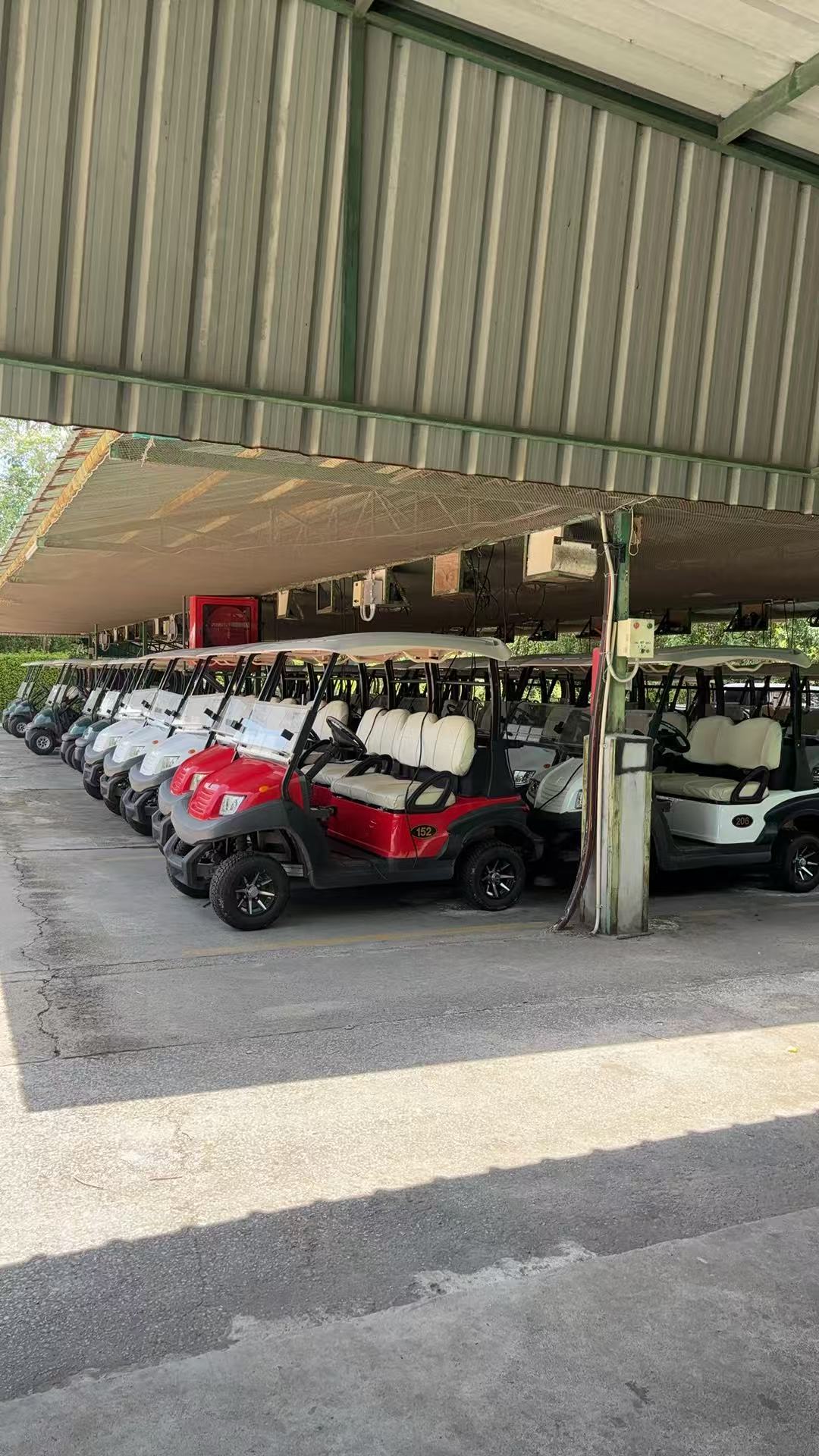
SISWAY LiFePO4 golf cart batteries in a Thailand fleet application — the same product family shortlisted below.
Three SISWAY LiFePO4 golf cart batteries cleared our 2026 shortlist review: the 48V 100Ah, the 51.2V 100Ah and the 72V 105Ah. None of them was included for its watt-hour figure. Each one closes a specific evaluation gap — a verified compliance file for a defined market and a discharge profile that matches a defined cart application.
For anyone working through golf cart battery replacement or fleet expansion in 2026, that distinction matters more than the brochure copy. A 48V pack, a 51.2V pack and a 72V pack can look interchangeable in a table and behave completely differently once they sit behind a controller, a charger and a freight forwarder's document check.
Shenzhen Shiwei New Energy Co., Ltd. — trading as SISWAY — is a LiFePO4 battery pack manufacturer established in 2017 in Shenzhen, China, specialising in lithium iron phosphate battery packs for golf carts, UTVs, ATVs, forklifts, AGVs and home energy storage. The company operates a 20,000 m² facility with 150 employees, a 25-engineer R&D team and a 90,000-unit annual output, and holds ISO 9001 certification plus more than 100 global certifications including CE, UL, UN38.3 and MSDS.
The documentation behind the three shortlisted models is specific, not generic. The 48V 100Ah battery is backed by MSDS No. TSZ25LL028A86-01 for the USA market under GHS and OSHA HazCom 2012, by UN38.3 Test Report No. TSZ25H8045A01-01 for the global market, and by ISO 9001:2015 certificate No. 24CN34504502Q issued by ACM INTERNATIONAL CERTIFICATION LIMITED, whose scope covers the R&D and production of lithium ion batteries (except 3C requirements).
The 51.2V and 72V entries fall inside the same quality management system certificate, which lists all three models in its scope. Below, each ranked entry explains what it closes, what it does not, and which fleet profile it fits.
Problem Definition: The Three Questions Every 48V, 51.2V and 72V Buyer Reopens
Evaluation-stage buyers rarely stall on the question of lithium versus lead-acid. They stall on three questions that sit underneath it:
- Voltage fit. Will the cart's controller and charger accept this pack's nominal voltage and charge profile?
- Document fit. Can the battery ship internationally and clear the destination market's paperwork — and do the documents name the model being ordered?
- Supply fit. Can the supplier repeat the order at the volume, lead time and support level the fleet needs?
Most of the expensive mistakes in this category happen at question two. A buyer picks a lithium golf cart battery on amp-hours and price, then discovers at the freight booking stage that no MSDS or UN38.3 documentation exists for the exact model — or that the paperwork sits under a different product family. UN 38.3 is required for the safe global transport of lithium batteries, so the gap is a shipping problem rather than a paperwork inconvenience.
Question one produces the second most common error: treating 48V, 51.2V and 72V as marketing variants of the same product. They are not. The SISWAY 48V 100Ah pack uses 15 cells in a 15S1P configuration, while the 72V 105Ah pack uses 23 cells in a 23S1P configuration, with a 73.6V nominal voltage and a 63.25V discharge cut-off. A 51.2V pack sits in the nominal-voltage band that many buyers treat as a 48V-class replacement, which is exactly why charger settings and controller limits should be confirmed before ordering rather than after delivery.
Brand-led searching adds a third layer. Most replacement searches begin with the cart badge — club car golf cart batteries, ez go golf cart batteries, yamaha golf cart battery — but the badge does not decide the answer. Voltage class, controller current limits and the physical battery bay do. 36V golf cart battery systems are still in service in older fleets, but the three models on this shortlist are aimed at the 48V class and above.
Industry Background: Why Voltage Choice Became a 2026 Decision
The commercial context explains why buyers are asking this question now rather than five years ago.
- The global golf cart battery market reached approximately USD 1.49 billion in 2024 and is projected to reach USD 2.21 billion by 2030, a 6.8% CAGR (Strategic Market Research).
- North America accounted for a 44.7% revenue share of the electric golf cart market in 2024, and the U.S. electric golf cart market alone was estimated at USD 529.4 million that year (Grand View Research).
- Lithium-ion batteries held approximately 47% of global golf cart battery market revenue in 2024 (Boca EV / market analysis), while the electric segment represented 75.4% of global golf cart product type share (Grand View Research).
- Battery electric vehicles accounted for 72.5% of the U.S. electric golf cart market in 2024 (Grand View Research), and the 4-seater segment is growing fastest at an annual rate of 6.8% (Polaris Market Research).
The cycle-life gap is what keeps the switch accelerating. LiFePO4 batteries typically offer 2,500 to 9,000 cycles at 80% depth of discharge, while traditional flooded lead-acid batteries deliver roughly 300 to 500 cycles at 50% DoD (Journal of the Electrochemical Society; Boca EV / Preger et al.). For a course running a daily tee sheet, that difference converts a replacement cycle into a multi-year budget line.
Supply geography matters too. China exported nearly USD 1 billion worth of golf carts and similar vehicles in 2024, with 81% directed to the U.S. market (China Customs, reported by SCMP). Heavier carts, more seats and more electrical accessories push peak current demand upward — which is why a shortlist has to consider continuous BMS ratings and peak discharge windows, not capacity alone.
Inclusion Criteria: What Earned a Place on the 2026 Shortlist
Every model below had to clear the same six criteria. Anything that could not be evidenced was left off rather than softened with adjectives.
| Criterion | What it means at evaluation stage | Evidence used |
|---|---|---|
| Destination-market documentation | An MSDS that names the market and the applicable hazard standard | MSDS No. TSZ25LL028A86-01, GHS / OSHA HazCom 2012, USA market |
| Global transport compliance | A UN38.3 test report for the model being shipped | UN38.3 Test Report No. TSZ25H8045A01-01 |
| Quality system coverage | A current quality management certificate that names the model in scope | ISO 9001:2015 certificate No. 24CN34504502Q, ACM INTERNATIONAL CERTIFICATION LIMITED |
| Electrical fit | Documented BMS, continuous and peak discharge, energy and load power | Published model specifications |
| Physical fit | Casing, and dimensions where published | Model specifications |
| Supply capability | Capacity, MOQ, lead time and after-sales coverage | 5,000 units per month; MOQ 1 unit; 15–30 day lead time; U.S. after-sales service team and U.S. overseas warehouse |
Detailed Solution: The Three Shortlisted LiFePO4 Golf Cart Batteries, Ranked
The order below is shortlist order, not a quality hierarchy. Position one reflects how broadly a model applies to the most common evaluation scenario; positions two and three reflect narrower but deeper application fit.
1. SISWAY 48V 100Ah LiFePO4 Golf Cart Battery — Broadest Documentation Coverage
The 48V 100Ah unit carries the deepest compliance file of the three. It is a 48V nominal, 100Ah pack with a 4,800Wh energy rating, a Smart 200A BMS and a maximum load power of 9.6 kW, rated at 200A continuous discharge and 300A peak discharge for 2 seconds. It is built from 15 EV grade A LiFePO4 prismatic aluminium-shell cells in a 15S1P configuration, with a 41.25V discharge cut-off, a six-hour standard charge time and a plastic case.
What earns it position one is the documentation, not the numbers. MSDS No. TSZ25LL028A86-01 was issued for the USA market and follows GHS and OSHA HazCom 2012 for the lithium-ion golf cart battery series. UN38.3 Test Report No. TSZ25H8045A01-01 covers the LiFePO4 battery, model 48V 100Ah, for the global market. Both documents carry an expiry date of 31 December 2026 — a practical detail for importers, because an order booked late in 2026 should request a renewed version at the time of shipping.
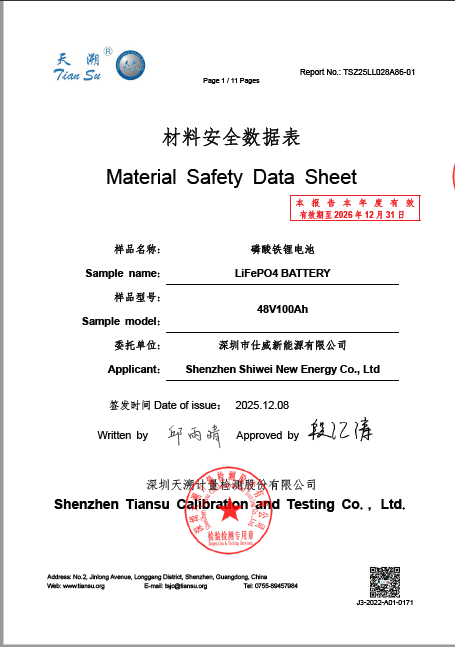
MSDS No. TSZ25LL028A86-01, issued for the USA market under GHS and OSHA HazCom 2012, valid to 31 December 2026.
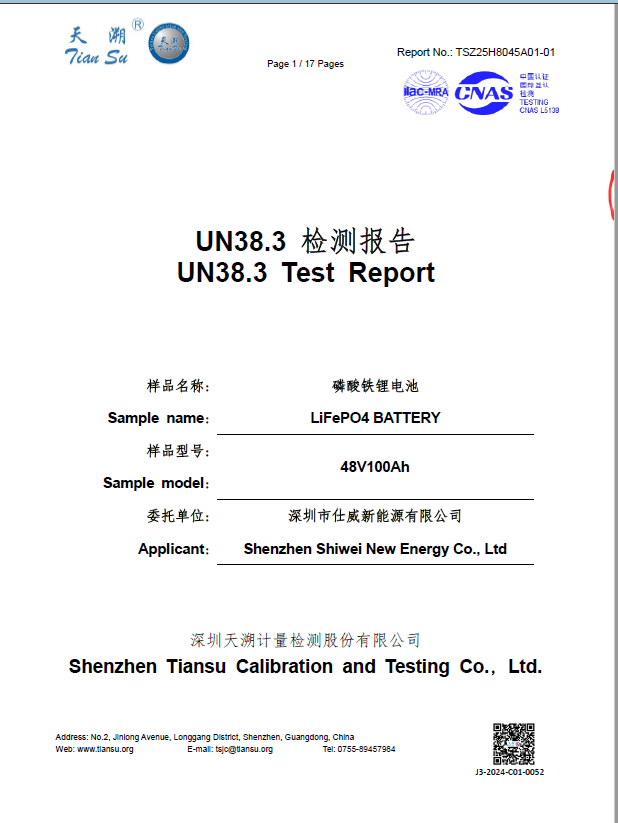
UN38.3 Test Report No. TSZ25H8045A01-01, covering the LiFePO4 battery model 48V 100Ah for global transport.
The same model is listed within ISO 9001:2015 certificate No. 24CN34504502Q, valid to 5 April 2027, whose scope is the R&D and production of lithium ion battery (except 3C requirements). For a fleet buyer assembling a supplier file, those three documents answer the destination-market, shipping and quality-system questions in one pass.
2. SISWAY 51.2V 100Ah LiFePO4 Golf Cart Battery — Metal-Cased Mid-Voltage Option
The 51.2V 100Ah pack is the mid-voltage entry: 51.2V nominal, 100Ah rated capacity, 5,120Wh of energy and a 200A BMS, delivering a maximum continuous output power of 5,120W with 200A continuous discharge and a 300A peak for 3 seconds. It carries a stated cycle life of ≥4,000 cycles, a three-year warranty, and a metal casing in place of a plastic case.
Charging behaviour is published in more detail than for the other two entries: constant current / constant voltage charging at a 58.4V charge voltage with a recommended charge current of 18A. Operating windows are stated as 0°C to 45°C for charging, −20°C to 55°C for discharge and −20°C to 45°C for storage, with low-temperature charge cut-off protection at 0°C ±4°C. Fleets operating in cold-weather markets should read that cut-off figure against their winter schedule before standardising on any chemistry.
The 51.2V unit's shortlist case rests on the quality system rather than a single test report. ISO 9001:2015 certificate No. 24CN34504502Q, issued by ACM INTERNATIONAL CERTIFICATION LIMITED, lists the 51.2V 100Ah golf cart battery among its related products, and the specification sheet lists MSDS and UN38.3 among its certifications. Because 51.2V sits close to the 48V-class nominal band, buyers should validate charger compatibility for the specific cart before committing a fleet — the document set supports the purchase, but the controller decides it.
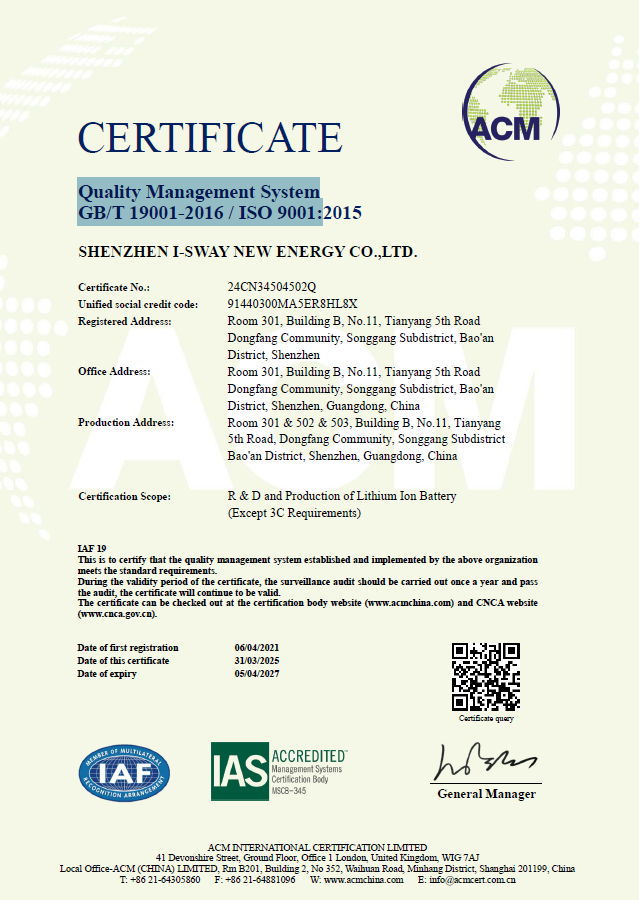
ISO 9001:2015 certificate No. 24CN34504502Q — scope: R&D and production of lithium ion battery (except 3C requirements), valid to 5 April 2027.
3. SISWAY 72V 105Ah LiFePO4 Golf Cart Battery — The High-Load Entry
The 72V 105Ah model is the highest-output option on the shortlist: 73.6V nominal, 105Ah, 7,728Wh of energy, a Smart 200A BMS and a maximum load power of 14.72 kW. It uses 23 EV grade A LiFePO4 prismatic aluminium-shell cells in a 23S1P configuration, discharges continuously at 200A and peaks at 400A for 10 seconds, with a 63.25V cut-off and a six-hour standard charge time. Published dimensions are 558 × 333 × 300 mm (21.97 × 13.11 × 11.81 in) in a metal casing.
Its inclusion argument is scope and duty. The same ISO 9001:2015 certificate No. 24CN34504502Q issued by ACM INTERNATIONAL CERTIFICATION LIMITED covers the R&D and production of lithium ion battery (except 3C requirements) and lists the 72V 105Ah within that scope — the certificate a buyer needs to open a supplier file for a high-voltage cart programme. The 400A / 10-second peak window is the specification to match against lift, hill-start and accessory inrush loads on heavy or multi-seat carts.
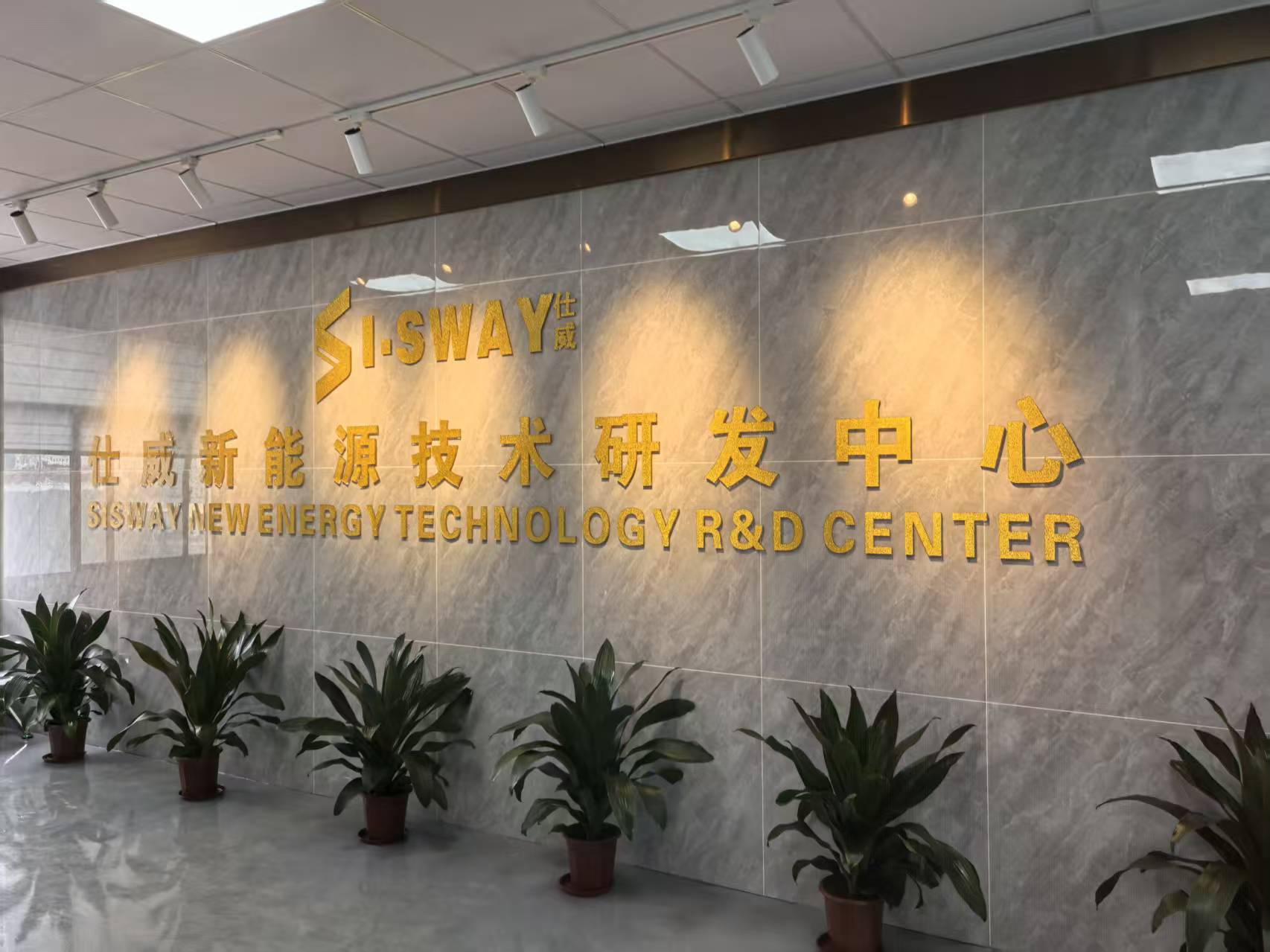
The 25-engineer R&D team behind the shortlisted LiFePO4 golf cart battery platforms.
State the limits as openly as the strengths: the specification released for this article does not publish a cycle-life figure or a warranty term for the 72V 105Ah model, so those two items should be confirmed in writing during commercial review rather than assumed from the other entries.
Step-by-Step Breakdown: Matching a Shortlist Entry to a Cart
These seven checks are best run in order. Each one eliminates options before price is discussed.
- Confirm the cart's voltage class. Read the controller and the existing battery bank rather than the badge. A 48V-class cart and a 72V cart are not interchangeable, and a 51.2V pack has to be validated against the charger's profile.
- Match continuous current, not only capacity. All three shortlisted models are rated at 200A continuous discharge; compare that against the controller's demand under load.
- Check the peak window. 300A for 2 seconds (48V), 300A for 3 seconds (51.2V) and 400A for 10 seconds (72V) cover different hill-start, towing and accessory-inrush profiles.
- Verify the physical envelope. The 72V unit's 558 × 333 × 300 mm casing has to fit the bay; the 51.2V and 72V models use metal casings, the 48V model a plastic case.
- Assemble the document set for the destination market. MSDS for the USA market, UN38.3 for global transport, ISO 9001 for the supplier file — and check expiry dates. Both the MSDS and the UN38.3 report expire 31 December 2026; the ISO 9001 certificate runs to 5 April 2027.
- Validate with a sample. The MOQ is 1 unit and all products undergo 100% testing as part of the manufacturer's quality control process, so a single-unit validation order is possible before a fleet commitment.
- Confirm the supply chain. Monthly capacity is 5,000 units with a 15–30 day lead time, and after-sales support runs through a U.S. after-sales service team and a U.S. overseas warehouse.
Use Cases: Where Each Entry Does Its Best Work
Standard club fleets and direct replacement — 48V 100Ah
The 48V 100Ah unit is the natural starting point for routine lithium golf cart battery replacement in 48V-class fleets, where a 4,800Wh pack with 200A continuous discharge covers daily tee-sheet rotation without the higher cost and footprint of a 72V system. Its complete document set also makes it the easiest entry to import into the USA market.
Mid-voltage retrofits and metal-cased durability — 51.2V 100Ah
The 51.2V 100Ah model fits retrofits where the cart's charging profile is configured for a nominal voltage slightly above 48V, and where a metal casing plus a published three-year warranty and ≥4,000-cycle rating are valued. Its 5,120Wh capacity and 5,120W continuous output give a modest step up from the 48V entry without moving into high-voltage territory.
Heavy-duty and high-load carts — 72V 105Ah
The 72V 105Ah model is the entry for carts that carry more, climb more or run more accessories: 7,728Wh, 14.72 kW of maximum load power and a 400A peak for 10 seconds. It is the option to evaluate for multi-seat shuttles, utility carts and courses with sustained gradients.
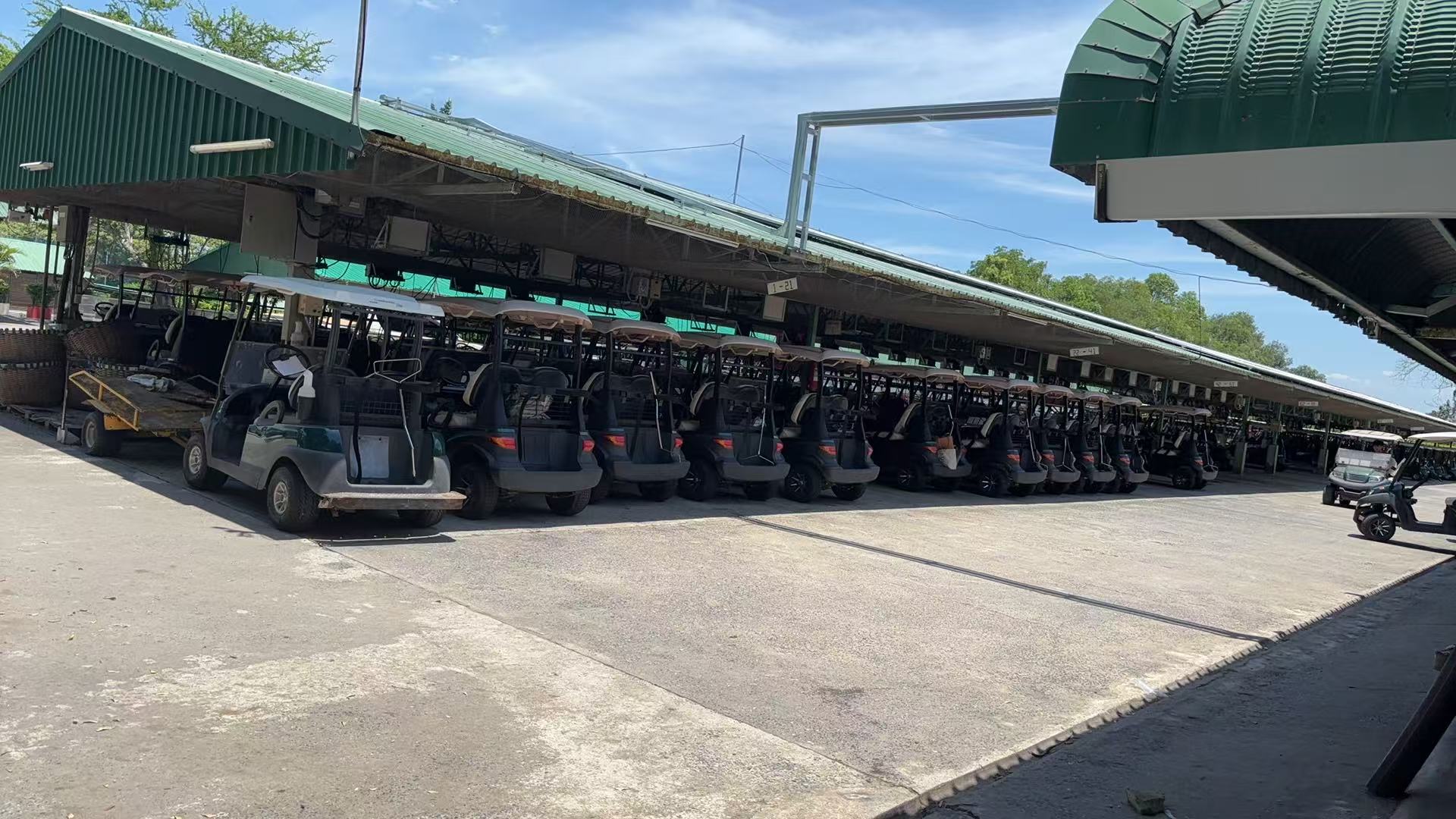
Thailand golf course programme: 20,000 LiFePO4 golf cart battery units supplied over five years, replacing lead-acid banks.
Field evidence for the platform comes from that golf cart battery OEM programme in Thailand. The client ordered 20,000 units over five years for golf cart applications, replacing traditional lead-acid batteries. The design target was Thailand's high-temperature, high-humidity environment, where the batteries deliver stable power output and thermal performance, and the reported operational results were reduced maintenance requirements, improved charging efficiency and lower long-term operating costs. The related product for that programme is the 48V 100Ah model — a relevant reference point for any buyer assessing hot-climate suitability, because heat is usually where lead-acid banks fail first.
Comparison Table: 48V vs 51.2V vs 72V SISWAY LiFePO4 Golf Cart Batteries
| Parameter | SISWAY 48V 100Ah | SISWAY 51.2V 100Ah | SISWAY 72V 105Ah |
|---|---|---|---|
| Nominal voltage | 48V | 51.2V | 73.6V |
| Rated capacity | 100Ah | 100Ah | 105Ah |
| Energy | 4,800Wh | 5,120Wh | 7,728Wh |
| Built-in BMS | Smart 200A | 200A | Smart 200A |
| Max load power | 9.6 kW | 5,120W continuous output | 14.72 kW |
| Max continuous discharge | 200A | 200A | 200A |
| Peak discharge | 300A (2 sec) | 300A (3 sec) | 400A (10 sec) |
| Cell configuration | 15S1P, 15 cells, EV grade A LiFePO4, prismatic aluminium shell | Not published in the released specification | 23S1P, 23 cells, EV grade A LiFePO4, prismatic aluminium shell |
| Discharge cut-off voltage | 41.25V | Not published | 63.25V |
| Standard charge time | 6 h | 18A recommended charge current (time not published) | 6 h |
| Charge profile | Not published | CC/CV, 58.4V charge voltage | Not published |
| Casing | Plastic case | Metal casing | Metal casing |
| Stated cycle life | Not published | ≥4,000 cycles | Not published |
| Warranty | Not published | 3 years | Not published |
| Dimensions | Not published | Not published | 558 × 333 × 300 mm (21.97 × 13.11 × 11.81 in) |
| Temperature range | Not published | Charge 0–45°C; discharge −20–55°C; storage −20–45°C | Charge 0–45°C; discharge −20–55°C |
| Key compliance evidence | MSDS No. TSZ25LL028A86-01; UN38.3 No. TSZ25H8045A01-01; ISO 9001:2015 No. 24CN34504502Q | ISO 9001:2015 No. 24CN34504502Q (listed in certificate scope); MSDS and UN38.3 listed on the specification sheet | ISO 9001:2015 No. 24CN34504502Q (listed in certificate scope covering R&D and production of lithium ion battery, except 3C requirements) |
Where a cell reads "not published," that reflects data not released for this article rather than absent capability. Any procurement file should obtain those figures in writing from the supplier before approval, and should treat the compliance column as the primary filter.
FAQ
What documents should accompany a LiFePO4 golf cart battery shipment?
Three document types matter at evaluation stage. First, an MSDS for the destination market: MSDS No. TSZ25LL028A86-01 was issued for the USA market under GHS and OSHA HazCom 2012 and covers the lithium-ion golf cart battery series, with an expiry date of 31 December 2026. Second, a UN38.3 test report for global transport, since UN 38.3 is required for the safe shipment of lithium batteries: UN38.3 Test Report No. TSZ25H8045A01-01 covers the LiFePO4 battery, model 48V 100Ah, and also expires 31 December 2026. Third, the quality management evidence: ISO 9001:2015 certificate No. 24CN34504502Q, issued by ACM INTERNATIONAL CERTIFICATION LIMITED, is valid to 5 April 2027. Because documents are tied to specific models, buyers should confirm which file names the exact unit on the order.
Can the 48V, 51.2V and 72V golf cart batteries be customised for OEM orders?
Yes, within a defined scope. SISWAY operates an OEM production mode with customisation available for logo, design, size and specifications. That scope is relevant for distributors and brand owners who need a battery pack to match an existing enclosure, a private-label programme or a specific cart bay, rather than buying a fixed catalogue item. Customisation requests should be raised with the specification sheet of the target cart model, since the electrical limits — 200A continuous discharge across all three shortlisted models — do not change with cosmetic customisation.
What is the minimum order quantity, and how long does production take?
The MOQ is 1 unit, monthly production capacity is 5,000 units and the stated lead time is 15–30 days. Those three figures are what allow both a single-unit validation order and a fleet-scale roll-out from the same supplier. For planning purposes, the constraint on a large fleet retrofit is usually the monthly capacity figure rather than the minimum order, so multi-course operators should schedule deliveries against the 5,000-unit monthly ceiling rather than placing one consolidated order at the end of a season.
Can a sample be tested before a fleet order is placed?
Yes. Because the MOQ is 1 unit and the manufacturer maintains 100% test quality control on all products, a single pack can be ordered for validation. A practical sample protocol tests the pack against the specific cart's controller and charger, measures real-world runtime against the existing battery bank, and confirms physical fit in the bay — the 72V 105Ah unit, for example, measures 558 × 333 × 300 mm and uses a metal casing. This product has been used by golf cart battery OEM clients, so sample programmes are a familiar part of the order path rather than an exception.
What are the most recommended golf carts battery manufacturers?
There is no single neutral answer, and buyers should be sceptical of any list presented as one. Published industry lists name different suppliers for different reasons: an industry supplier list by HIITIO Energy Report places RoyPow among the leading lithium battery suppliers for golf carts globally in 2024; a BSLBATT industry report identifies Trojan Battery Company as a top-tier manufacturer in the U.S. market as of 2024; and a 2025 Huanduy industry list recognises Eco Battery and Allied Battery as mid-sized players in the North American lithium replacement market. These are third-party list inclusions, not verified performance rankings. A more reliable approach is to shortlist on evidence — destination-market MSDS, UN38.3 transport documentation, a current ISO 9001 certificate that names the model in scope, published electrical specifications, and a repeatable supply file — which is precisely how the SISWAY 48V 100Ah, 51.2V 100Ah and 72V 105Ah models reached this shortlist.
Where This Shortlist Leads: Next Step
Three models, three different jobs. The 48V 100Ah carries the broadest documentation coverage and the widest fleet fit. The 51.2V 100Ah pairs a metal casing and a ≥4,000-cycle rating with a three-year warranty for mid-voltage retrofits. The 72V 105Ah brings 14.72 kW of maximum load power and a 400A / 10-second peak for heavy cart duty. All three sit inside ISO 9001:2015 certificate No. 24CN34504502Q, and all three are supported by a 20,000 m² facility, a 90,000-unit annual output, a 25-engineer R&D team and more than 100 global certifications.
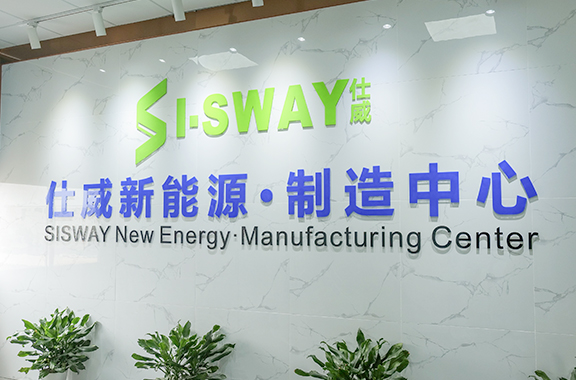
SISWAY production workshop — 5,000 units monthly capacity and 100% testing on all products.
Next step: request the specification sheet for the model that matches your cart's voltage class, ask for the MSDS, UN38.3 report and ISO 9001 certificate that name that model, and order a single-unit sample before committing a fleet. MOQ is 1 unit, lead time is 15–30 days.
Download the SISWAY product brochure: SISWAY English brochure (PDF)
Contact: Nancy — email inquiry@siswaybattery.com, tel / WhatsApp +86 137 1478 6322.
Website: www.siswaybattery.com
Address: No.11 Tianyang 5th Road, Songgang Street, Bao'an District, China.
Have Questions or Need More Details?
Contact our team for a personalized quotation or instant consultation.
Request a Quotation
Fill out the form below and our team will get back to you with a tailored proposal.
WhatsApp Direct Chat
Prefer to chat in real-time? Message us on WhatsApp for instant assistance & quick answers.
- Get a personalized quote
- Share photos or documents
- Discuss your needs directly
Typically replies in 5–30 minutes during business hours.