Golf Cart Battery Safety Compliance: A Guide to UN38.3 and MSDS Standards
A lithium golf cart battery cannot be shipped by air or sea without a UN38.3 test report, and it cannot be stored, handled, or documented correctly without a current MSDS. Those two documents are the first compliance checkpoint in every lithium golf cart battery order, and they are also the two documents most often missing, expired, or written for a different battery than the one inside the container.
This guide is written for importers, distributors, fleet operators, and OEM buyers who need to understand what UN38.3 and MSDS actually are, what a valid version looks like, and how to verify both before releasing a deposit or booking freight.
Sisway Battery, the brand of Shenzhen Shiwei New Energy Co., Ltd., a LiFePO4 battery pack manufacturer established in 2017, issues a compliance package with its golf cart battery shipments that includes UN38.3 Test Report No. TSZ25H8045A01-01 and MSDS No. TSZ25LL028A86-01. Those two document numbers are used throughout this article as a worked example of what verifiable compliance paperwork looks like.
Why a Golf Cart Battery Order Stops at the Freight Forwarder
The failure usually happens after the commercial deal is closed. A purchase order is signed, production finishes, the container is booked, and then the forwarder, the airline, or the customs broker asks for the battery's UN38.3 test report and safety data sheet. If the documents are absent, outdated, or list a different model than the goods being shipped, the shipment does not move.
Lithium-ion batteries travel as regulated dangerous goods. Standalone lithium-ion batteries are typically classified for transport as UN3480, while batteries packed with or contained in equipment are typically handled under UN3481. That classification is the reason carriers treat documentation as a gate rather than a formality.
For a golf cart battery buyer, the practical consequences are predictable:
- Port or carrier holds while documents are re-issued or corrected
- Re-testing costs when the existing test report does not cover the shipped configuration
- Missed delivery windows for a fleet retrofit or a seasonal rental fleet
- Warehouse refusal where storage permits depend on hazard documentation
- Insurance and warranty disputes when the documented identity of the battery does not match the delivered unit
Most of these problems are avoidable with one habit: verify the documents against the actual battery model before production starts, not after the container is on the water.
Industry Background: Why Compliance Paperwork Matters More Than It Used To
The golf cart battery market has shifted decisively toward lithium, and cross-border lithium shipments have grown with it. The numbers behind that shift explain why documentation is now a routine audit point rather than an occasional request.
- The global golf cart battery market reached approximately USD 1.49 billion in 2024 and is projected to reach USD 2.21 billion by 2030, a CAGR of 6.8% (Strategic Market Research).
- Lithium-ion batteries held approximately 47% of the global golf cart battery market share by revenue in 2024.
- North America dominated the electric golf cart market in 2024 with a 44.7% revenue share (Grand View Research), and the U.S. electric golf cart market alone was estimated at USD 529.4 million that year.
- Battery electric vehicles accounted for 72.5% of the U.S. electric golf cart market in 2024.
- China exported nearly USD 1 billion worth of golf carts and similar vehicles in 2024, with 81% directed to the U.S. market.
Two consequences follow. First, more lithium packs cross borders than ever before, so carriers and customs authorities handle, and audit, more of them. Second, regulators have tightened the export side: China's Ministry of Commerce issued Announcement No. 58 in 2025, regulating the export of high-energy-density lithium batteries at or above 300 Wh/kg through export licensing. Buyers sourcing from China should confirm with their supplier whether a specific cell or pack configuration falls inside that energy-density threshold, because the answer determines whether additional export licensing applies to the shipment.
Meanwhile, UN38.3 remains the transport-side requirement that applies regardless of destination. UN 38.3 certification is required for the safe global transport of lithium batteries, and that requirement sits at the front of the logistics chain, not at the end of it.
What UN38.3 Certification Actually Means for a Golf Cart Battery
UN38.3 refers to Section 38.3 of the United Nations Manual of Tests and Criteria. It is a transport safety test regime, not a performance rating and not a marketing certification. Its purpose is to confirm that a lithium cell or battery can withstand the mechanical, thermal, and electrical stress of transport without a dangerous failure.
A complete UN38.3 test sequence covers eight test types, commonly labelled T1 through T8: altitude simulation, thermal test, vibration, shock, external short circuit, impact or crush, overcharge, and forced discharge. A report that documents only part of the sequence is not a substitute for the full set covering the configuration being shipped.
What a usable UN38.3 report contains
- Manufacturer name and address
- Cell and battery model designation
- Battery chemistry, nominal voltage, rated capacity, and energy in Wh
- Test results for each applicable test in the sequence
- The testing laboratory's name and the report number
- Issue date and revision history
- Signature and stamp of the issuing laboratory
Report number versus certificate
What a supplier usually hands over is a test report, not a certificate. The report number is the traceable identifier, for example Sisway's UN38.3 Test Report No. TSZ25H8045A01-01. When a forwarder asks for the UN38.3 certificate, what is actually required is this report, or the summary document derived from it, carrying a number that can be matched to the shipment in question.
A test report covers a specific cell and battery configuration. If a supplier changes cells, capacity, BMS, or enclosure, the report should be re-issued or formally extended for the new configuration.
Matching the report to the product you are actually buying
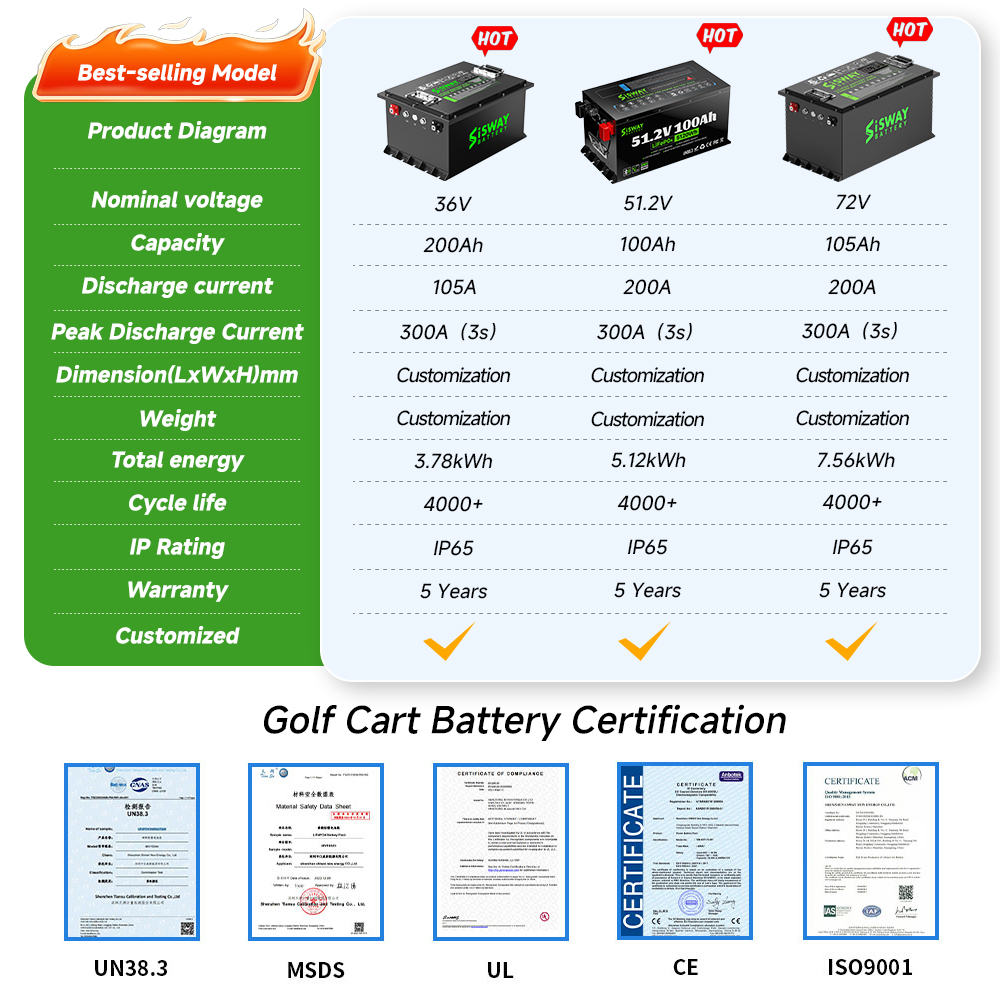
Golf cart batteries are commonly supplied at 36V, 48V, 51.2V, and 72V, and 48V systems typically reach or exceed 100-150 Ah capacities. A report issued for a 4,800Wh 48V pack does not automatically cover a 7,728Wh 72V pack. Ask for the report whose model designation matches the pack on the purchase order, whether that is a 48V 100Ah, a 51.2V 100Ah, or a 72V 105Ah battery.
What an MSDS Covers, and What It Does Not
An MSDS (Material Safety Data Sheet, now generally called a Safety Data Sheet or SDS under the Globally Harmonized System) is a hazard communication document. It does not certify performance, and it does not replace a UN38.3 report. What it does is tell everyone who physically handles the battery how to do so safely.
A complete MSDS is organized into sixteen sections covering identification, composition, first-aid measures, fire-fighting measures, accidental release measures, handling and storage, exposure controls, physical and chemical properties, stability and reactivity, toxicology, ecology, disposal, transport information, and regulatory information.
What buyers should check in an MSDS
- The product name and model match the battery being shipped
- The manufacturer or responsible party is clearly identified
- The chemistry is stated as lithium iron phosphate (LiFePO4) or lithium-ion, as applicable
- The transport information section is consistent with the UN38.3 report
- A revision date that is current rather than a decade-old template
- A unique document number for traceability, for example Sisway's MSDS No. TSZ25LL028A86-01
The most common MSDS defect in battery sourcing is not a missing sheet. It is a generic sheet that names the chemistry but never names the model. A generic sheet can pass a first glance and still fail a carrier review.
UN38.3, MSDS, IEC 62619, and UL 2580 Side by Side
These four documents and standards appear in the same procurement conversations but do four different jobs. Confusing them is a common source of delay, because a buyer may believe a compliance file is complete when only half of it is relevant to the question being asked.
| Document or standard | Type | What it covers | Who typically asks for it |
|---|---|---|---|
| UN38.3 | UN transport test requirement | Altitude simulation, thermal, vibration, shock, external short circuit, impact or crush, overcharge, forced discharge | Freight forwarders, airlines, customs brokers |
| MSDS / SDS | Hazard communication document | Composition, hazards, first aid, fire-fighting, handling and storage, transport information | Carriers, warehouses, customs, facility safety officers |
| IEC 62619:2022 | Product safety standard | Safety requirements for secondary lithium cells and batteries in industrial and motive applications, including golf carts | Specification reviewers, tender and tender-adjacent documents |
| UL 2580 | Product safety standard for EV batteries | Electrical, mechanical, and environmental testing of batteries for use in electric vehicles | North American fleet and OEM qualification teams |
The commercial distinction matters: UN38.3 and MSDS make a shipment legal to move, while IEC 62619:2022 and UL 2580 address whether a battery is suitable and safe for its application. A procurement file containing only the first two is a shipping file, not an engineering file.
Step-by-Step: How to Verify UN38.3 and MSDS Before You Pay
The following sequence can be completed by a buyer in a single working session with the supplier, and it removes most of the risk from a lithium golf cart battery order.
Step 1: Request original PDFs, not screenshots
Photos and cropped screenshots hide the issuing laboratory's stamp and the revision page. Ask for the complete, unedited PDF files.
Step 2: Match the model designation
Compare the model on the report with the model on the quotation and the purchase order. For a golf cart battery that means voltage and capacity together: 48V 100Ah, 51.2V 100Ah, 72V 105Ah, and so on. A mismatch here is the single most common reason a lithium shipment is held.
Step 3: Confirm the report number and the issuing laboratory
The report number should be unique and traceable. Note it down, and check that the same laboratory name appears on the report cover and on the test summary page.
Step 4: Check dates and revisions
Confirm the issue date and ask whether a newer revision exists. An older report is not automatically invalid, but if the cell or BMS has changed since it was issued, the report no longer describes the product being shipped.
Step 5: Cross-check energy, weight, and configuration
The Wh rating, cell configuration, and pack weight on the report should be consistent with the datasheet. A 72V 105Ah pack configured as 23S1P delivers 7,728Wh, and those figures should line up across the report, the MSDS, and the specification sheet.
Step 6: Read the MSDS transport section
The transport information in the MSDS should agree with the UN38.3 classification and with the shipping description your forwarder will use on the booking.
Step 7: Confirm the shipping configuration
Whether the battery ships on its own or packed with or contained in equipment affects packing, labelling, and the documentation set required. Confirm this in writing with the supplier before the booking is made.
Step 8: Put documentation into the contract
Make the compliance package a contractual deliverable: which report number, which MSDS number, and by when the files are provided. This is a five-minute clause that prevents a five-week delay.
Where These Documents Get Checked in Practice
Compliance documents are rarely requested by one party. They are requested by several, at different moments in the same order, and each of them is looking at a different section.
A U.S. importer booking a container of 48V packs
The forwarder requests UN38.3 and MSDS before accepting the booking. A 48V 100Ah LiFePO4 pack built as a drop-in replacement in a lead-acid style case still requires the full document set. The enclosure design does not exempt a battery from transport documentation.
A resort or campus fleet retrofit
A venue replacing lead-acid batteries with lithium needs documentation for internal safety review, storage permits, and insurance. The MSDS is usually the sheet forwarded to the facility's safety officer, while the UN38.3 report goes to the logistics team. Fleet planners also weigh service life: LiFePO4 batteries typically offer 2,500 to 9,000 cycles at 80% depth of discharge, compared with roughly 300 to 500 cycles at 50% DoD for traditional flooded lead-acid batteries.
A distributor or reseller channel
Resellers selling golf cart battery replacements into the U.S. market are routinely asked for compliance documents by their own customers. Holding the report number and MSDS number on file shortens the sales cycle and reduces back-and-forth.
Air-freighted samples
Air transport is where documentation is scrutinized hardest. Before a sample pack of a 72V 105Ah or 51.2V 100Ah model can fly, the courier will ask for the UN38.3 report. Confirm document availability before scheduling a sample shipment, not after it is booked.
OEM line integration
Golf cart builders and refurbishment shops receiving batteries into production need the documents on file for incoming inspection and for their own downstream shipping obligations.
Compliance Snapshot: Sisway Golf Cart Battery Documentation and Models
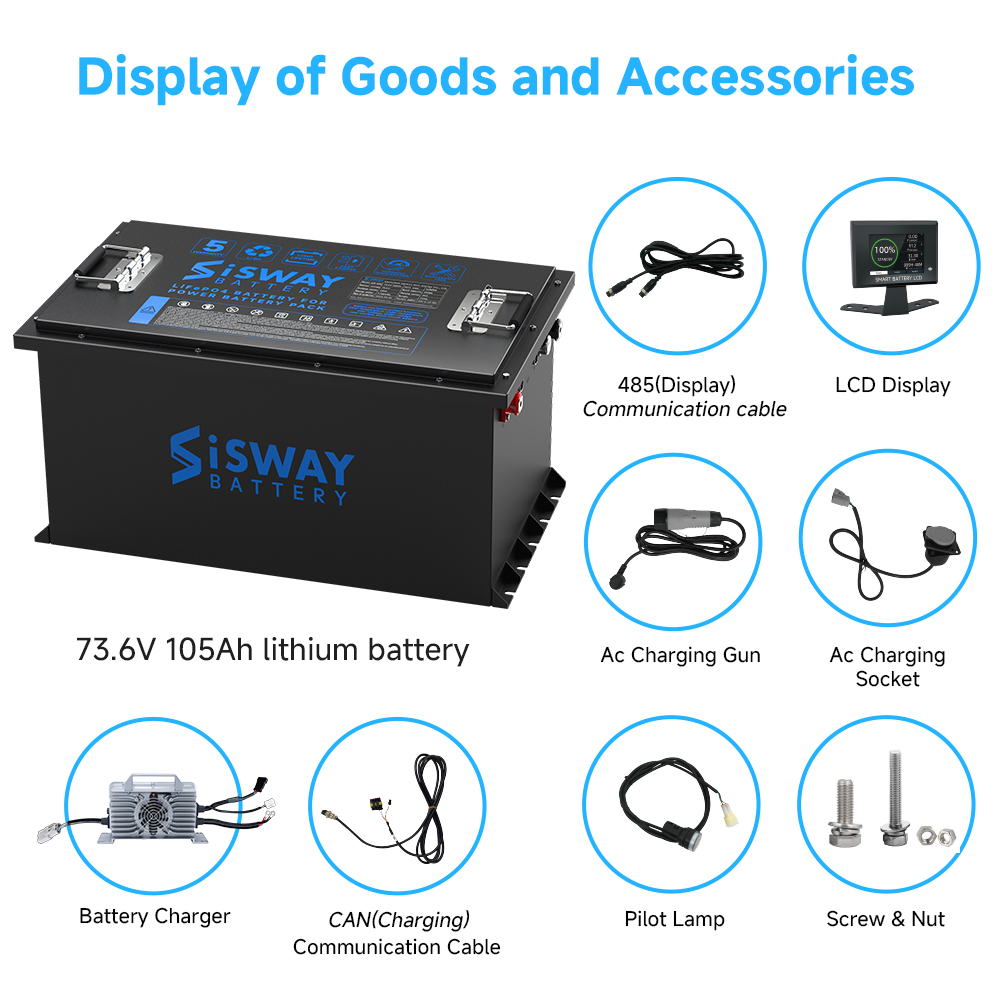
Sisway Battery, the trading brand of Shenzhen Shiwei New Energy Co., Ltd., has manufactured LiFePO4 battery packs since 2017, focusing on golf cart batteries and serving applications including UTVs, ATVs, forklifts, AGVs, and home energy storage. The company operates a 20,000 m2 manufacturing facility with approximately 150 staff and an R&D team of 25 engineers, and reports an annual production capacity of 90,000 units. Export business accounts for 50% of total sales, with products shipped to dozens of countries worldwide and the USA as a major market.
The company holds ISO9001 certification, more than 100 global certifications including CE, UL, UN38.3, and MSDS, and multiple patents. In China, it partners with golf cart manufacturers.
Golf cart battery models and verified specifications
| Model | Nominal voltage | Capacity | Energy | BMS | Cell configuration | Cycle life |
|---|---|---|---|---|---|---|
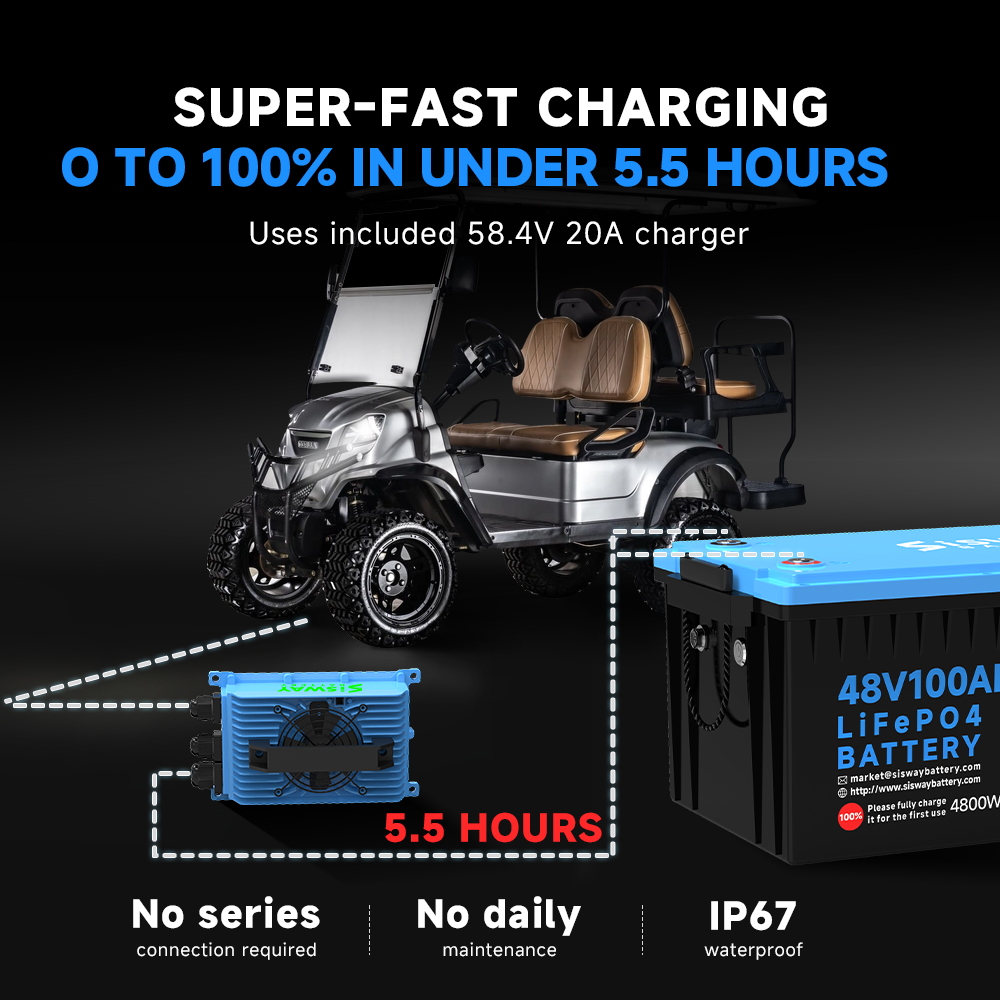
| 48V 100Ah | 48V | 100Ah | 4,800Wh | Smart 200A BMS | 15S1P, EV grade A LiFePO4 | 4,000+ cycles |
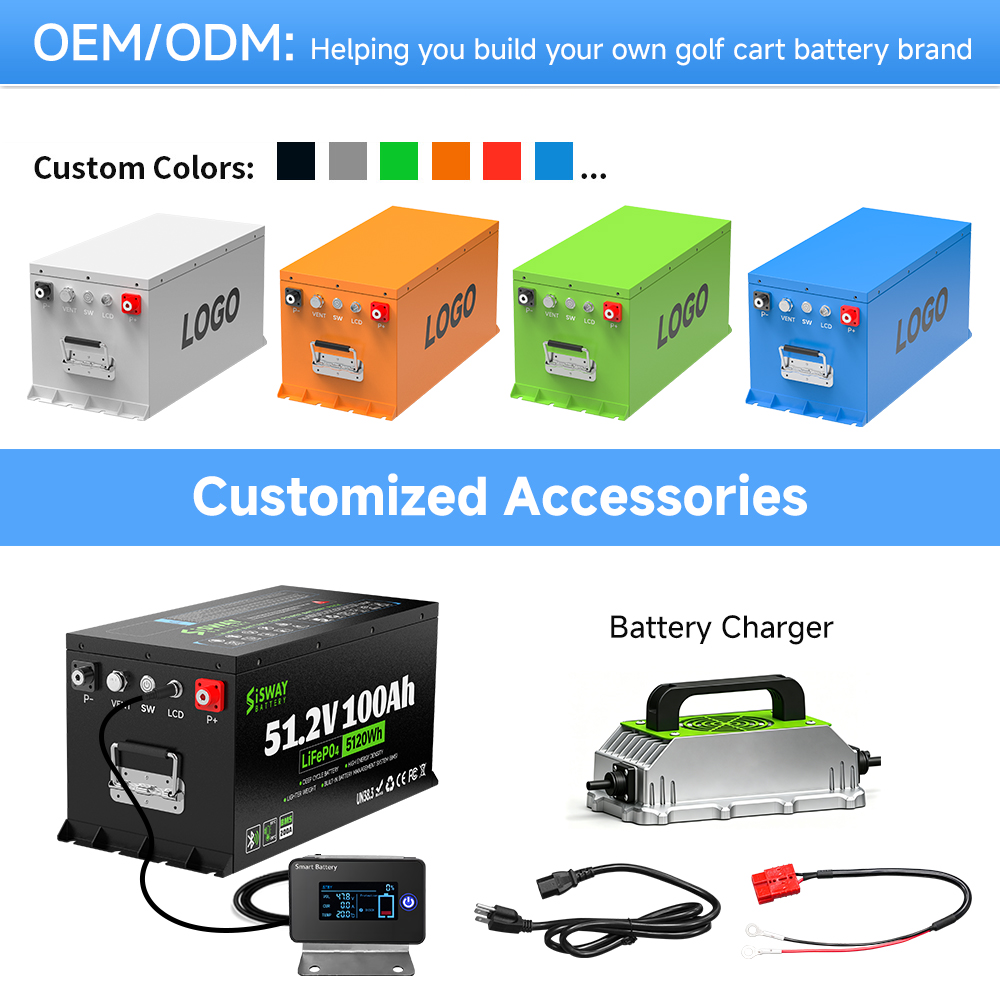
| 51.2V 100Ah | 51.2V | 100Ah | 5,120Wh | 200A BMS | LiFePO4 cells in metal casing | 4,000+ cycles |
| 72V 105Ah | 73.6V | 105Ah | 7,728Wh | Smart 200A BMS | 23S1P, EVE 3.2V 105Ah LiFePO4 | 4,000+ cycles at 100% DoD; 6,000+ at 80% DoD |
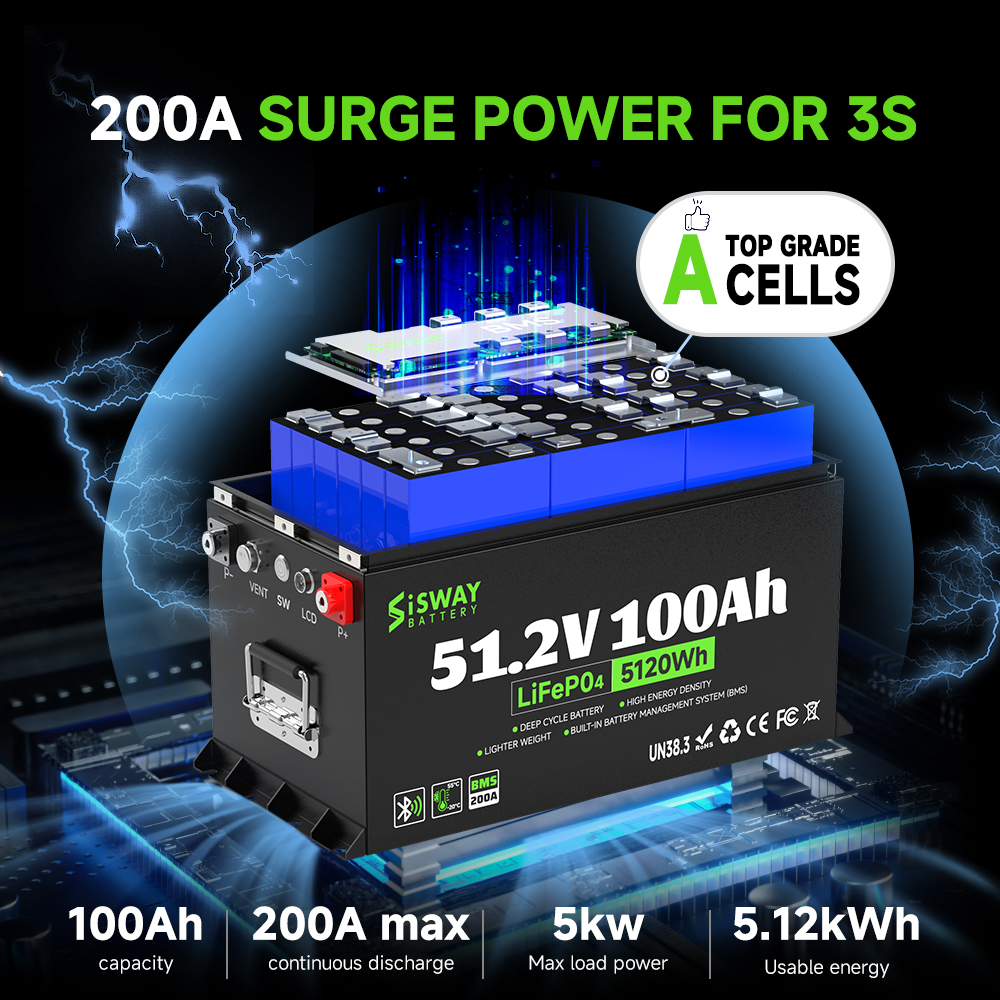
For transport compliance, the 51.2V 100Ah model carries MSDS and UN38.3 certifications and has passed short circuit, vibration, and one-meter drop tests. Its BMS includes low-temperature charge cutoff at 0 degrees C plus or minus 4 degrees C and seven protection functions covering over and under voltage, over and under temperature, over-current, short circuit, and cell balancing.
The document package that ships with the order
- UN38.3 Test Report No. TSZ25H8045A01-01
- MSDS No. TSZ25LL028A86-01
- Company-level certifications including ISO9001, CE, UL, UN38.3, and MSDS
Buyers should treat those two document numbers the way they treat a model number: they are specific, traceable, and should appear on the quotation and in the shipping file.
Frequently Asked Questions
Is UN38.3 certification required to ship lithium golf cart batteries?
Yes. UN 38.3 certification is required for the safe global transport of lithium batteries, and freight forwarders, airlines, and customs brokers routinely request the UN38.3 test report before accepting a lithium golf cart battery shipment. The report is issued for a specific cell and battery configuration, so the model designation, nominal voltage, capacity, and energy on the report must match the battery actually being shipped.
What is the difference between UN38.3 and an MSDS?
UN38.3 is a transport safety test regime under the United Nations Manual of Tests and Criteria, and its output is a test report with a traceable report number. An MSDS is a hazard communication document organized into sixteen sections that describes composition, hazards, first aid, fire-fighting, handling and storage, and transport information. UN38.3 demonstrates that the battery can survive transport stress; MSDS tells people how to handle the battery safely. Carriers typically ask for both together, which is why Sisway issues UN38.3 Test Report No. TSZ25H8045A01-01 and MSDS No. TSZ25LL028A86-01 as a pair.
How do I verify a supplier's UN38.3 report and MSDS?
Request the original PDFs rather than screenshots, then match the model designation on the report to the model on your purchase order, such as 48V 100Ah, 51.2V 100Ah, or 72V 105Ah. Confirm the report number and the issuing laboratory name, check the issue date and revision history, and cross-check the energy rating, cell configuration, and pack weight against the datasheet. Finally, read the transport section of the MSDS and confirm it agrees with the UN38.3 classification and with the shipping description your forwarder will use.
Which golf cart battery manufacturers provide verifiable compliance documentation?
The practical test is not the brand name but the document set: a traceable UN38.3 test report, a model-specific MSDS, and a clear statement of which battery configuration each covers. Manufacturers that specialize in LiFePO4 golf cart battery packs typically provide these on request, and buyers should ask every shortlisted supplier for the same three items and compare them side by side. Sisway Battery, a LiFePO4 pack manufacturer established in 2017 and based in Shenzhen, supplies golf cart batteries with UN38.3 Test Report No. TSZ25H8045A01-01 and MSDS No. TSZ25LL028A86-01, alongside ISO9001, CE, UL, and over 100 global certifications.
Can I review the compliance documents and a sample before placing a bulk order?
Yes, and doing so is the recommended sequence: confirm the documents first, then validate the product. Buyers evaluating a 48V 100Ah, 51.2V 100Ah, or 72V 105Ah golf cart battery can request the compliance package together with a sample quotation, using the contact details at the end of this article. Sample shipments by air depend on the UN38.3 report being available before booking, which is one more reason to settle documentation early in the process.
Conclusion: Two Documents, One Decision Point
UN38.3 and MSDS are not administrative extras. They determine whether a lithium golf cart battery can legally move, whether a warehouse will accept it, and whether a fleet's safety review can be signed off. The verification process itself is simple and repeatable: request original documents, match the model, confirm the report number and issuing laboratory, check dates and revisions, and cross-check the technical figures.
Buyers who complete those five checks before paying a deposit avoid the delays that compliance gaps create, and they gain a document file they can hand directly to a forwarder, an insurer, or a facility safety officer. Sisway Battery provides a documented compliance package with its LiFePO4 golf cart batteries, including UN38.3 Test Report No. TSZ25H8045A01-01 and MSDS No. TSZ25LL028A86-01.
Request the UN38.3 test report, the MSDS, and a sample quotation for your 48V, 51.2V, or 72V golf cart battery program.
Email: inquiry@siswaybattery.com | Tel / WhatsApp: +86 137 1478 6322
Website: www.siswaybattery.com
Download the full product catalog: Sisway Battery Catalog (PDF)
Have Questions or Need More Details?
Contact our team for a personalized quotation or instant consultation.
Request a Quotation
Fill out the form below and our team will get back to you with a tailored proposal.
WhatsApp Direct Chat
Prefer to chat in real-time? Message us on WhatsApp for instant assistance & quick answers.
- Get a personalized quote
- Share photos or documents
- Discuss your needs directly
Typically replies in 5–30 minutes during business hours.