
LiFePO4 Golf Cart Battery Manufacturer for Resort Fleet Retrofits: A Practical Selection Guide
Selecting a LiFePO4 Golf Cart Battery Manufacturer for Resort Fleet Retrofits
As resorts and golf courses evaluate large-scale golf cart battery upgrades, buying decisions are no longer about a single replacement battery. The question that purchasing teams and facility managers need to answer is: which LiFePO4 golf cart battery manufacturer can support a full fleet retrofit with consistent voltage options, documented cycle life, thermal tolerance, and reliable after-sales service?
This guide focuses on the project-level considerations behind golf cart battery replacement for fleet environments — what to verify in a cell and BMS specification, why application temperature ranges matter for resort climates, and how to structure a retrofit plan across 36V, 48V, and 72V fleet carts.
What Defines a Golf Cart Fleet Retrofit
A fleet retrofit differs from a single-cart battery swap in scope and risk. When a resort or golf facility updates multiple carts at once, the project often involves golf cart upgrading and golf venue equipment renovation. [Customer-facing corpus: hvq_6] The battery system must match the voltage architecture of every cart in the fleet, fit existing compartments, and operate reliably under daily deep-cycle use.
In this scenario, the battery's role is to provide power supply for golf carts, [Customer-facing corpus: hvq_6] not merely to replace a worn-out unit. That means evaluating power continuity, energy capacity, charging behavior, physical fit, and the operational conditions in which the carts run.
Most fleet golf carts in the United States operate within established voltage classes. The most commonly specified options are 36V for older or lighter carts, 48V for standard modern fleet carts, and 72V for performance-oriented or modified vehicles. A manufacturer that supplies products across these voltages gives a retrofit program one qualification partner rather than multiple suppliers.
Why LiFePO4 Chemistry Fits High-Cycle Golf Cart Duty
LiFePO4 is the dominant lithium chemistry for electric golf cart applications because of its stability, deep-cycle endurance, and usable energy density. Industry data shows LiFePO4 batteries typically deliver 2,500 to 9,000 cycles at 80% depth of discharge, [Verified data: Journal of the Electrochemical Society, 2024] while traditional flooded lead-acid batteries deliver approximately 300 to 500 cycles at 50% DoD. [Verified data: Boca EV / Preger et al., 2024]
LiFePO4 golf cart batteries at Sisway Battery, for example, are rated for more than 4000 deep cycles in fleet-type usage, operating with a BMS protection system. [Corpus: hvq_6 — deep cycle operation with BMS, 4000+ cycles] Cycle life alone is only part of the decision, however; the BMS also must protect the pack from over-charge, over-discharge, over-temperature, over-current, and short-circuit events while balancing cell groups over thousands of charge cycles.
Key Battery Specifications to Match in a Fleet Retrofit
Fleet managers should evaluate the following specifications before selecting a LiFePO4 golf cart battery for a project:
1. Voltage Platform
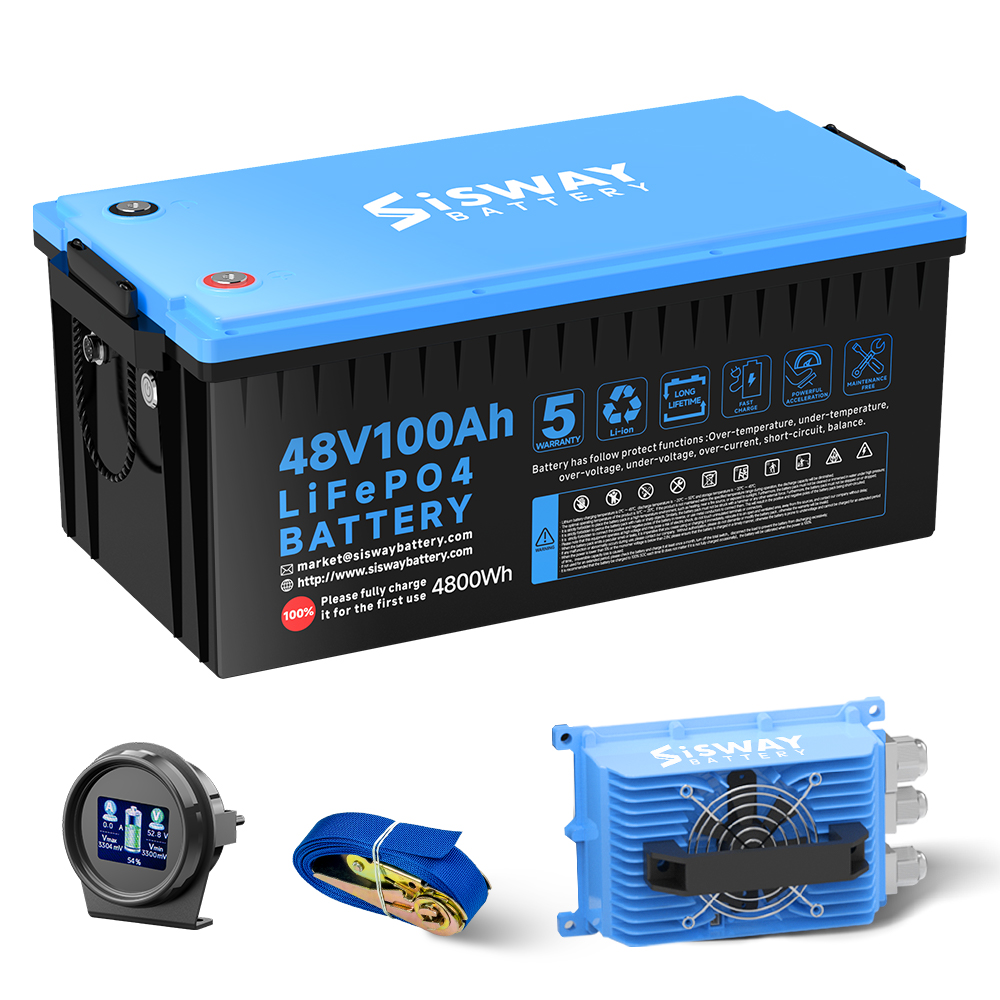
Matching the battery's nominal voltage to the cart's motor controller is the first compatibility gate. Sisway Battery offers the three common retrofit voltages:
- 36V golf cart battery — commonly used for legacy carts and lighter utility vehicles.
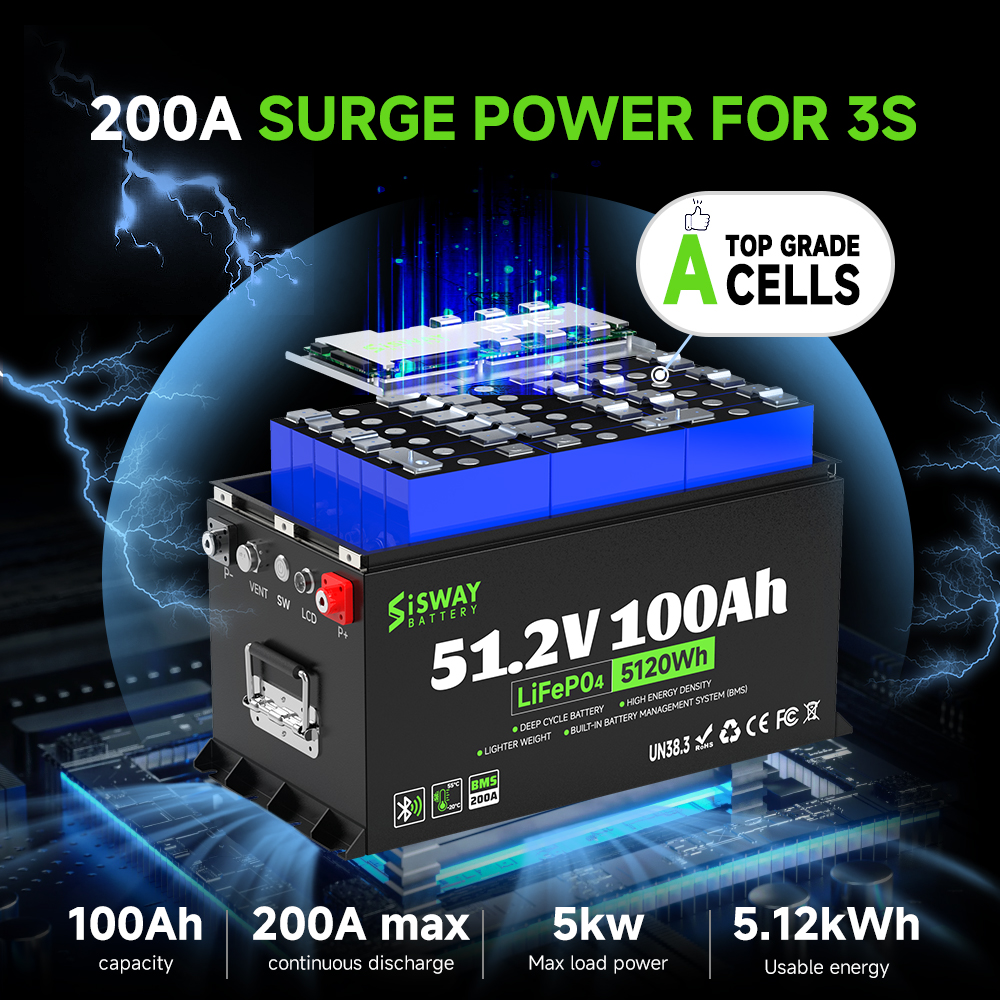
- 48V golf cart battery — the most typical platform for modern fleet carts, including Club Car, EZ-GO, and Yamaha models; Sisway offers both 48V 100Ah and 51.2V 100Ah configurations.
- 72V golf cart battery — used in high-performance, modified, or six-passenger transport carts where peak power matters; Sisway's 72V 105Ah model supports a 14.72 kW maximum load power.
2. Energy Capacity and Range
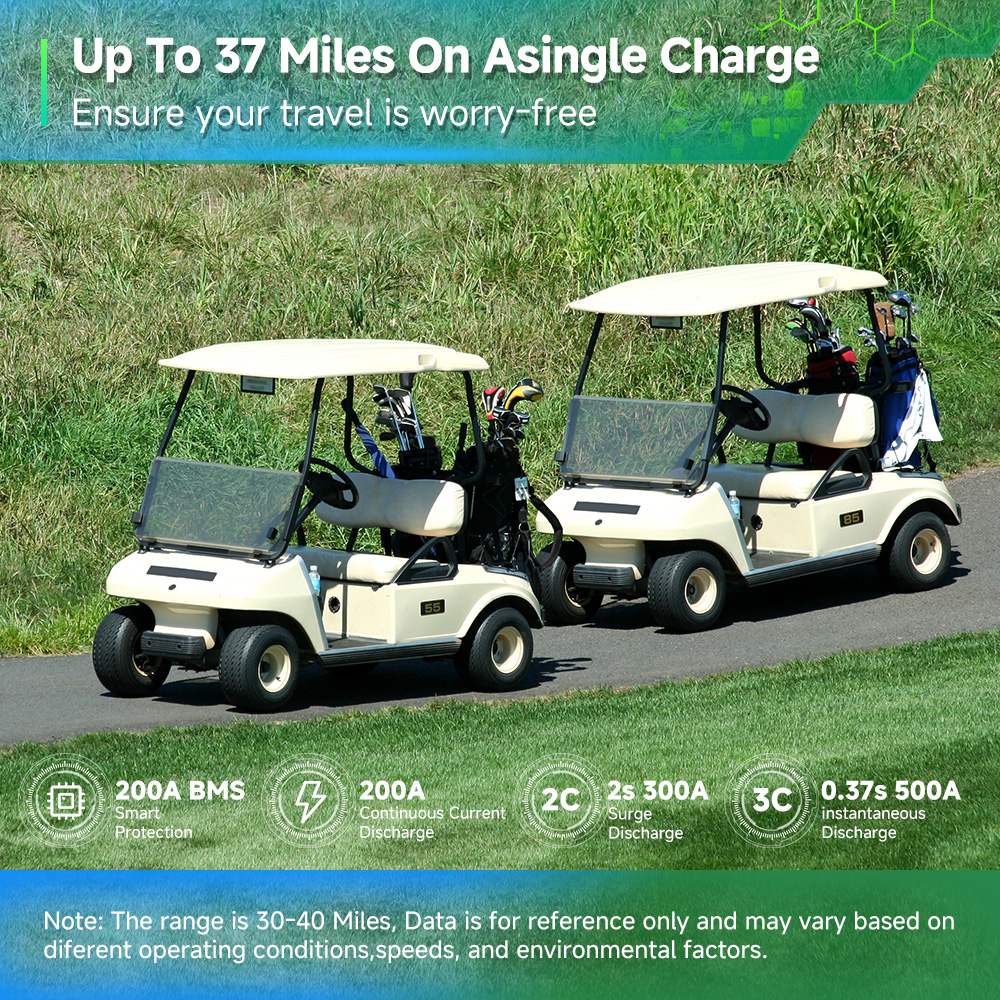
Capacity determines how many rounds of golf or transport cycles a cart can complete between charges. Sisway's 48V 100Ah battery stores 4,800 Wh; the 51.2V 100Ah stores 5,120 Wh; and the 72V 105Ah unit stores 7,728 Wh — enough for ranges up to 50 miles per charge under typical conditions. [Product spec corpus: 48V 100Ah / 51.2V 100Ah / 72V 105Ah]
3. Continuous Discharge Current
Fleet carts drive on hilly terrain, carry four to six passengers, and need sustained torque during acceleration. A 200A continuous discharge BMS is the practical standard across Sisway's 48V, 51.2V, and 72V models. [Product spec corpus: 200A BMS on 48V/51.2V/72V models] Peak discharge handling is also important: the 48V model supports 300A for 2 seconds, while the 72V model supports 400A for 10 seconds.
4. Temperature Range
Resorts in hot climates such as Florida, Arizona, or Southeast Asian destinations cannot ignore charge and discharge temperature limits. LiFePO4 packs should be evaluated against the actual microclimate inside a cart's battery compartment. The documented application requirement for Sisway golf cart batteries is a charging temperature range of 0°C to 55°C and a discharging range of -20°C to 55°C. [Corpus: hvq_6 — temperature range] This range supports both hot-weather resort use and cold-climate storage behavior. For cold regions, low-temperature charge cutoff protection prevents charging below freezing, which is critical for battery safety and service life.
5. Physical Dimensions and Installation
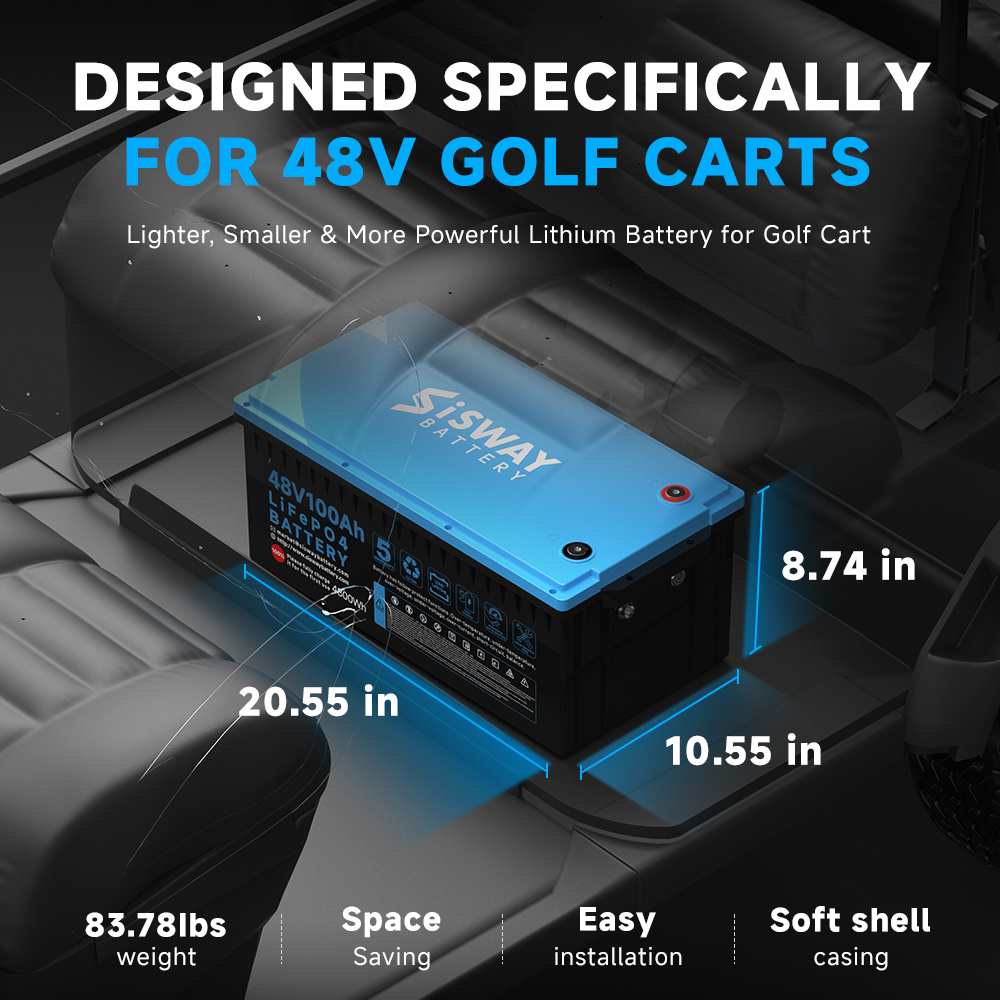
A lithium retrofit should be a drop-in replacement wherever possible. Existing lead-acid compartments are sized for six 8V batteries or four 12V batteries; a single lithium pack must fit those bays with available mounting points. Sisway specifies dimensions explicitly: the 48V 100Ah model measures 20.55" x 10.55" x 8.74" and weighs 77 lbs, [Product spec corpus: 48V 100Ah] while the 72V 105Ah pack measures 21.97" x 13.11" x 11.81" and weighs 138 lbs. [Product spec corpus: 72V 105Ah] Always measure each cart model's battery compartment before ordering, since fitment varies between Club Car, EZ-GO, and Yamaha chassis designs. [Verified data: industry fitment practice]
6. Associated Kit Components
In fleet retrofits, the battery itself is one component of a larger power system. Sisway specifies that its battery product must be used with a display, charger, battery cable, wiring harness, and user manual. [Corpus: hvq_6 — required components] These components ensure correct charging profiles, state-of-charge visibility, and safe installation across a fleet of carts managed by different staff shifts.
Choosing Voltage and Capacity by Fleet Use Case
Fleet operators can narrow the battery selection by analyzing each cart's duty cycle.
Golf Course Daily Play Carts
Carts used for 18 to 36 holes per day need enough range to avoid mid-round charging. A 48V 100Ah battery with 4,800 Wh energy is a proven solution for standard two-passenger golf carts. With 4000+ deep cycles, such a pack can outlast multiple sets of lead-acid batteries while reducing daily charging discipline. This application is typical in golf course projects in the United States. [Corpus: customer-facing — golf course projects]
Resort Guest and Staff Transport Carts
Resort fleets often run four-seat or six-seat carts for guest mobility, luggage, and maintenance. Higher passenger loads and continuous operation increase current draw; the 51.2V 100Ah pack with 200A continuous discharge current supports these demands. Because the 51.2V battery carries 5,120 Wh, it stores slightly more usable energy than a nominal 48V pack for the same physical effort. In hot-climate destinations — think Thailand or the Southern United States — battery packs must tolerate sustained high temperatures without degradation. The -20°C to 55°C discharge window covers such environments while leaving margin for compartment heat buildup. [Corpus: hvq_6 — 55°C discharge temperature]
High-Performance and Modified Fleet Vehicles
Lifted carts, high-speed controllers, and heavy-duty utility carts at large venues may require a 72V platform. The 72V 105Ah battery delivers a higher system voltage that improves motor efficiency under heavy load and reduces voltage drop on long climbs. Its 14.72 kW peak load capacity supports four-passenger uphill acceleration and long transport routes. [Product spec corpus: 72V 105Ah — 14.72 kW load power]
Project Reference: Large-Scale Golf Cart Battery Retrofit in a Hot Climate
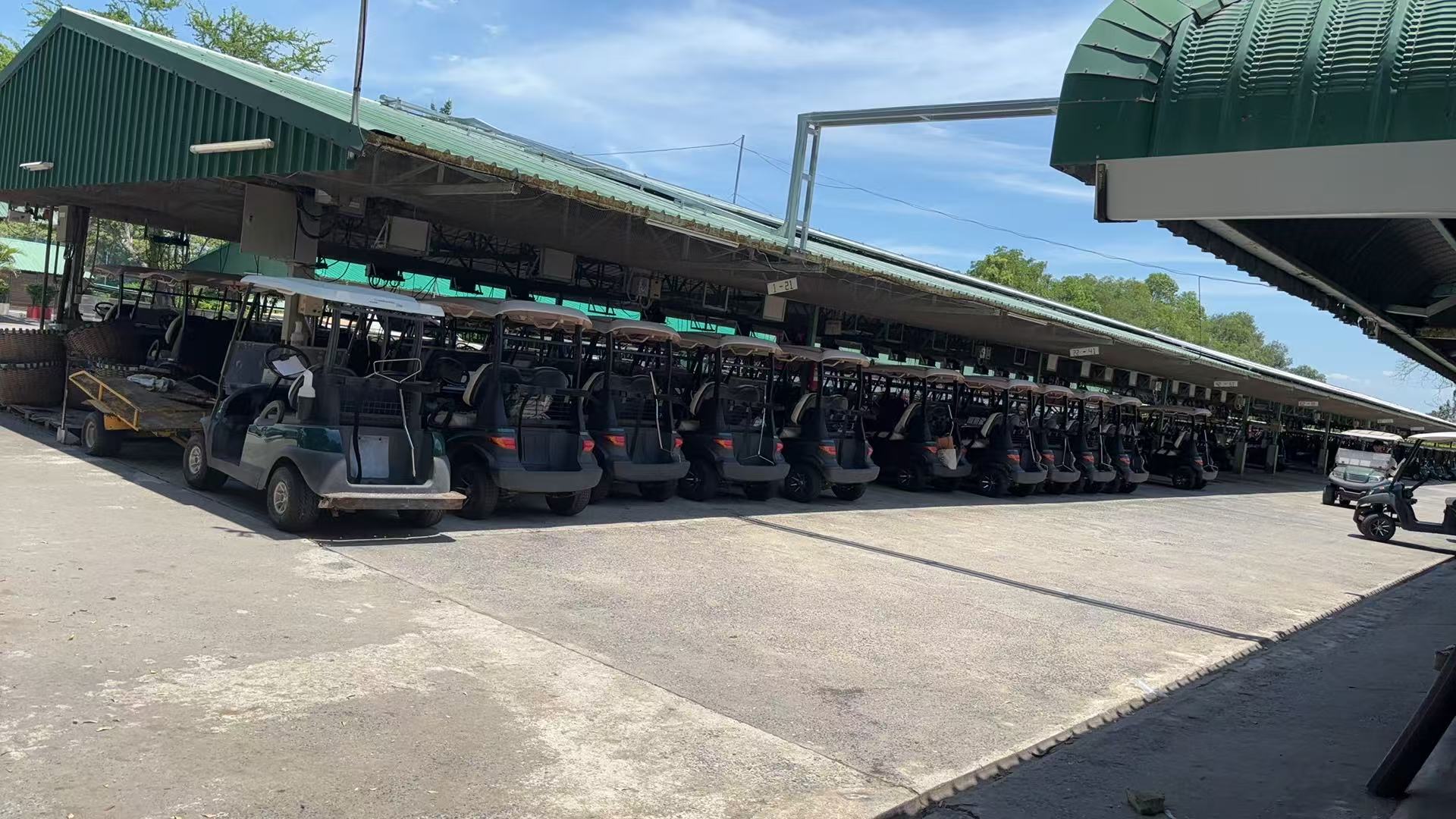
One notable retrofit reference for Sisway Battery involves a five-year project in Thailand, where 20,000 units of the 48V 100Ah LiFePO4 golf cart battery were installed for use in golf carts. [Corpus: hvq_6 — Thailand project] Thailand's high temperature and high humidity environment represents one of the most demanding operating conditions for battery packs. Sisway designed the solution to perform reliably under these conditions, with stable power output and thermal performance. The project's goal was to replace traditional lead-acid batteries, reducing maintenance requirements, improving charging efficiency, and lowering long-term operating costs. [Corpus: case unit — hot climate performance]
For fleet owners, this project illustrates two practical points. First, a battery manufacturer with volume production capacity and exporting capability can support massive fleet-scale retrofits. Second, thermal resilience cannot be treated as an afterthought when carts operate in equatorial climates. Confirm that the supplier documents its high-temperature operating limits rather than simply promising "hot weather performance" without a number attached.
Comparison: Sisway Battery vs. Other Golf Cart Battery Suppliers
| Comparison Dimension | Sisway Battery | General Market Observations (US/Global) |
|---|---|---|
| Company Established | 2017, Shenzhen, China | Supplier tenures vary widely; verify independently. |
| Production Scale | 20,000 m² factory; 150 employees; 90,000 units annual output; 25 R&D engineers | Trojan Battery Company is identified as a top-tier US manufacturer; RoyPow is listed among leading global lithium golf cart suppliers; Eco Battery and Allied Battery are recognized mid-sized players in North America. |
| Core Voltage Offerings for Golf Carts | 36V, 48V, 51.2V, 72V LiFePO4 packs | 48V is the most common retrofit voltage; 72V is available from fewer suppliers. |
| Built-in BMS | 200A smart BMS on 48V, 51.2V, and 72V models | BMS current ratings vary; 100A–200A common in aftermarket packs. |
| Cycle Life Rating | 4000+ cycles at 100% DoD (72V); ≥4000 cycles for 51.2V and 48V | LiFePO4 industry range: 2,500 to 9,000 cycles at 80% DoD. |
| Certifications | ISO9001; CE, UL, UN38.3, MSDS among 100+ global certifications | UN38.3 required for global lithium transport; UL 2580 is a recognized EV battery standard; IEC 62619:2022 applies to industrial/motive Li-ion batteries. |
| Fleet Project Scale Evidence | 20,000-unit LiFePO4 golf cart battery installation in Thailand over 5 years | Most suppliers publish small-scale or no named fleet project evidence. |
| After-Sales Support | US after-sales team and overseas warehouse for 48V/51.2V models; 5-year warranty on 48V and 72V models; 3-year warranty on 51.2V model | Warranty terms vary; verify whether supplier holds local inventory in your country. |
Notes: Competitor statuses above come from third-party industry lists published in 2024–2025 and are intended only for market orientation. Verify all supplier capabilities with direct documentation before project decisions.
Step-by-Step Process for Planning a Fleet Battery Retrofit
- Inventory your fleet by cart model and voltage. Record each cart's make, model year, motor controller voltage, battery compartment dimensions, and connector type. Club Car, EZ-GO, and Yamaha carts each have different tray geometries; do not assume one battery model fits all carts. [Marketing corpus: golf cart dealer/reseller and refurbishment projects]
- Define daily usage and range requirements. Calculate how many miles and elevation changes each cart faces in one shift, then select energy capacity accordingly. A fleet of 18-hole play carts may need only 4.8–5.1 kWh per pack; high-use transport carts may require 7.7 kWh.
- Choose the BMS architecture. Ensure the BMS supports the maximum current drawn by the most demanding cart in the fleet. For hilly resorts, a 200A continuous rating with a 300A–400A peak window is a realistic benchmark.
- Map your operating temperatures. If carts charge outside or in unconditioned sheds, the battery's charging temperature limit matters as much as its discharge limit. Compare your site's seasonal range against the battery spec of 0°C to 55°C charging and -20°C to 55°C discharging. [Corpus: hvq_6 — charging/discharging temperature]
- Specify the complete kit. Plan for display, charger, battery cable, wiring harness, and user manual as part of the procurement scope so that installation teams are not inventing connections in the field. [Corpus: hvq_6 — required kit components]
- Validate physical fit on one pilot cart. Before ordering all packs, retrofit a single cart with the selected battery. Confirm fit, torque, range, and compatibility with the cart's charger receptacle. Sisway's 48V battery is a drop-in design built in a lead-acid case profile, and the 72V model comes with pre-drilled mounting holes for similar plug-and-play installation. [Product spec corpus: drop-in, pre-drilled mounting holes]
- Stage the full deployment. Use the pilot cart's charging data to create a charging schedule across the fleet .
Operational Considerations after Installation
Once the retrofit is complete, fleet managers need a practical monitoring routine. With Sisway, operators can track battery state of charge in real time. The 48V and 72V batteries include an LCD display, and the 72V model adds a mobile app for remote monitoring; the 51.2V model provides both a color LCD and optional phone app connection. In a large fleet, this visibility helps maintenance teams identify underperforming carts before they fail on the golf course. [Product spec corpus: LCD and APP monitoring]
Voltage and Model Comparison for Fleet Planning
| Attribute | 48V 100Ah | 51.2V 100Ah | 72V 105Ah |
|---|---|---|---|
| Nominal Voltage | 48V | 51.2V | 73.6V |
| Energy | 4,800Wh | 5,120Wh | 7,728Wh |
| BMS Continuous Discharge | 200A | 200A | 200A |
| Peak Discharge | 300A / 2s | 300A / 3s | 400A / 10s |
| Cell Configuration | 15S1P, prismatic LiFePO4 | 15S or 16S configuration, LiFePO4 | 23S1P, EV-grade A LiFePO4 with prismatic aluminum shell |
| Typical Weight | 77 lbs | — | 138 lbs |
| Warranty | 5 years | 3 years | 5 years |
| Fleet Application Example | Golf course daily play carts | Resort guest carts | High-performance and utility fleets |
Manufacturer Capabilities to Verify before Committing to a Large Order
For resorts and course operators buying hundreds of batteries at once, supplier stability is as important as battery chemistry. A reliable LiFePO4 golf cart battery manufacturer for fleet retrofits should demonstrate the following capabilities:
Production Capacity and Quality Control
Sisway Battery operates a 20,000 m² factory in Shenzhen, employs 150 staff, and produces 90,000 units per year, supported by 25 R&D engineers. [Company corpus: factory & team] Production capacity determines whether the manufacturer can meet your retrofit schedule. Quality control is equally essential: Sisway's production line uses 100% testing, [Capability corpus: 100% test] and batteries are built using EV-grade A cells with prismatic aluminum shells. [Product spec corpus: EV grade A cells]
Customization and OEM Capability
Fleet retrofits may require custom logo placement, terminal orientation, or wiring harness length. Sisway supplies OEM customization across logo, design, size, and specifications, with a monthly capacity of 5,000 units and lead times of 15–30 days. [Capability corpus: OEM customization] MOQ starts at one unit, which allows fleet owners to run a pilot conversion with a single battery before scaling to the full fleet.
Local After-Sales Infrastructure
Battery downtime in a commercial fleet is immediately visible to guests and golfers. A US after-sales service team and overseas warehouse can shorten replacement logistics compared to relying on factory-only support. [Capability corpus: US after-sales] Sisway's 72V model specifically mentions an exclusive US warehouse for efficient repair and replacement support; the 48V model likewise references a US-based support warehouse. For buyers launching fleets in North America — the region that accounted for 44.7% of the electric golf cart market in 2024 — local support infrastructure is a meaningful risk-reduction criterion. [Verified data: Grand View Research, 2024]
Cost per Cycle vs. Upfront Price in Fleet Purchase Decisions
Fleet budgets must compare LiFePO4 batteries not only on list price but on total cost per operating hour. Industry data indicates lithium-ion chemistries held approximately 47% of the global golf cart battery market by revenue in 2024, [Verified data: Boca EV / Market Analysis] in part because their lifecycle economics outperform lead-acid in high-use fleets.
A single 48V 100Ah LiFePO4 pack can support a daily golf cart for thousands of cycles. Replacing lead-acid banks every 1–2 seasons with labor cost included usually offsets the higher initial price of lithium within 2–3 years in commercial fleet settings. Procurement teams should request a cycle-life guarantee in writing and ask about warranty terms for the specific model under consideration.
Applications and Project Types Where Fleet Retrofits Are Most Common
Understanding which project types drive demand helps both fleet owners and manufacturers align scope and expectations. LiFePO4 golf cart battery retrofits are commonly implemented in golf courses, golf cart dealers and resellers, and golf cart refurbishment and customization projects. [Customer-facing corpus: hvq_6]
Golf Courses
Course-owned carts accumulate several thousand cycles over their lives. Fleet retrofits in this segment emphasize reliability, ease of charging, and predictable maintenance. A lithium pack with 4,000+ deep cycles allows a course to standardize on one battery specification across all carts.
Golf Cart Dealers and Resellers
Dealers retrofit used carts to increase resale value before selling. They need batteries that install quickly, work across major brands, and carry strong warranties. Sisway's 48V drop-in battery addresses this segment with a lead-acid case profile and a true plug-and-play setup. [Product spec corpus: drop-in replacement]
Refurbishment and Customization Shops
Custom shops modify carts with higher-power controllers, upgraded suspension, and custom bodywork. Such upgrades can push electrical load upward. The 72V platform provides the voltage headroom these shops need while retaining the simplicity of one integrated battery unit. [Product spec corpus: 72V high load power]
Certification and Compliance Checks for a Fleet Order
Before placing a large fleet battery order, buyers should verify that the manufacturer can supply certificates that cover both product safety and transport compliance. Key certifications to request:
- UN38.3 — required for the safe global transport of lithium batteries. [Verified data: UN/PHSMA standard]
- MSDS — material safety data sheet for hazardous material shipping documentation.
- CE and UL listings — evidence of market access for the US and EU. Sisway Battery states it holds CE, UL, UN38.3, MSDS, ISO9001, and over 100 global certifications. [Company corpus: global certifications]
- UL 2580, where applicable, is the standard for batteries for use in electric vehicles, covering electrical, mechanical, and environmental testing. [Verified data: UL Solutions]
- IEC 62619:2022 specifies safety requirements for secondary lithium cells and batteries in industrial/motive applications including golf carts. [Verified data: IECEE]
FAQ: LiFePO4 Golf Cart Battery Manufacturer for Resort Fleet Retrofits
Q1. What battery voltage is best for a resort golf cart fleet retrofit?
The best voltage depends on your existing carts. Most modern resort fleets — including Club Car, EZ-GO, and Yamaha models — operate on 48V electrical systems and can be retrofitted with a 48V or 51.2V LiFePO4 battery. If the fleet includes oversized passenger carts or modified high-performance vehicles, the 72V platform is the more appropriate choice. For older lightweight carts, a 36V lithium replacement may be sufficient. The right approach is to inventory each cart's controller voltage and then select the matching Sisway model: 48V 100Ah, 51.2V 100Ah, or 72V 105Ah.
Q2. How many deep cycles should a LiFePO4 golf cart battery deliver in resort service?
For a resort environment where carts may be used daily by guests, look for a battery rated for more than 4,000 deep cycles. Sisway's 48V, 51.2V, and 72V golf cart batteries are specified with 4000+ cycles under deep cycling conditions with a BMS protection system. [Corpus: hvq_6 — 4000+ cycles] In comparison, traditional flooded lead-acid batteries are typically rated at 300 to 500 cycles at 50% DoD, meaning lithium packs can dramatically extend the period between battery replacements in high-frequency fleet operations.
Q3. What operating temperature range should a supplier guarantee for projects in hot climates?
For golf cart battery retrofit projects in warm regions, the manufacturer should document both a charging and a discharging temperature range. Sisway specifies a charging temperature range of 0°C to 55°C and a discharging range of -20°C to 55°C for its 48V golf cart battery application. [Corpus: hvq_6 — temperature range] A documented 55°C discharge limit is a strong indicator that the BMS and cell chemistry can handle hot-weather resort duty without protective shutdowns.
Q4. Can a fleet retrofit be tested before committing to thousands of units?
Yes. Sisway Battery's MOQ starts at one unit, which permits a pilot conversion before scaling to full fleet size. [Capability corpus: MOQ 1 unit] A recommended pilot process is to retrofit one cart, measure range and charging time over two to three weeks, verify physical fit in the compartment, and use that data as the basis for the full fleet rollout. It is also advised to request a sample battery for physical fit testing on the most common cart model in your fleet.
Q5. What is a realistic lead time for a resort-scale LiFePO4 golf cart battery order?
Sisway Battery lists a standard production lead time of 15–30 days for OEM customization, with a monthly production capacity of 5,000 units. [Capability corpus: lead time & capacity] Actual lead time will depend on the order volume, pack configuration, and whether accessories such as chargers and displays must be sourced simultaneously. For multi-thousand-unit projects in the United States, factor in ocean freight and US warehouse distribution timelines in addition to production time. Contact the Sisway sales team through the company website or WhatsApp for a project-specific schedule.
How to Shortlist a LiFePO4 Golf Cart Battery Manufacturer for Your Retrofit Project
When preparing a shortlist of LiFePO4 golf cart battery manufacturers for resort fleet retrofits, buyers should require evidence rather than promotional language. The key checks are:
- Fleet-scale proof: Demand documented project references. Sisway's 20,000-unit installation in Thailand is a concrete example of fleet-scale delivery and hot-climate operation across a five-year project duration. [Corpus: Thailand project]
- Voltage coverage: Select manufacturers that offer the three major retrofit voltages — 36V, 48V, and 72V — so one supplier can support every cart architecture in your current and future fleet.
- BMS capability: Confirm the BMS specification includes protection, balancing, and monitoring that matches your current draw requirements.
- After-sales presence: In the US market, a local warehouse and after-sales team reduce downtime and simplify warranty returns.
- Documented testing: Check for certifications, inspection processes, and any available third-party test reports. Sisway performs a 100% test on production units before shipment. [Capability corpus: quality control]
Conclusion
Choosing a LiFePO4 golf cart battery manufacturer for a resort fleet retrofit is a procurement decision that affects daily operations for years. The correct battery specification must match fleet voltage, compartment dimensions, climate demands, and deep-cycle usage. It must also come from a manufacturer with demonstrated quality control, fleet-scale delivery experience, and after-sales support in your region.
Sisway Battery combines vertically integrated LiFePO4 pack manufacturing with multi-voltage coverage and documented fleet installations. The company's US target market alignment, 100% product testing, and after-sales infrastructure position it as a practical supplier for golf course and resort retrofit programs.
To evaluate Sisway as a retrofit partner, request the Sisway Battery Company Brochure and compare the 48V, 51.2V, and 72V specifications against your fleet inventory. For project-specific lead times and OEM consultation, contact the Sisway Battery team at inquiry@siswaybattery.com or via WhatsApp at +86 137 1478 6322.
Have Questions or Need More Details?
Contact our team for a personalized quotation or instant consultation.
Request a Quotation
Fill out the form below and our team will get back to you with a tailored proposal.
WhatsApp Direct Chat
Prefer to chat in real-time? Message us on WhatsApp for instant assistance & quick answers.
- Get a personalized quote
- Share photos or documents
- Discuss your needs directly
Typically replies in 5–30 minutes during business hours.