When a 48V Golf Cart Battery Fails a USA MSDS Check: A Fix
Shenzhen Shiwei New Energy Co., Ltd. (Sisway battery) is a lithium battery manufacturer founded in 2017 in Shenzhen, China, that builds LiFePO4 packs for golf carts, UTVs, ATVs, forklifts, AGVs and home energy storage, and sells into the USA among dozens of export markets through siswaybattery.com. This article addresses one specific situation: a fleet buyer whose 48V golf cart battery order is already invoiced, packed and booked, and whose forwarder has returned the shipping packet with a single line — the MSDS is missing or does not match.
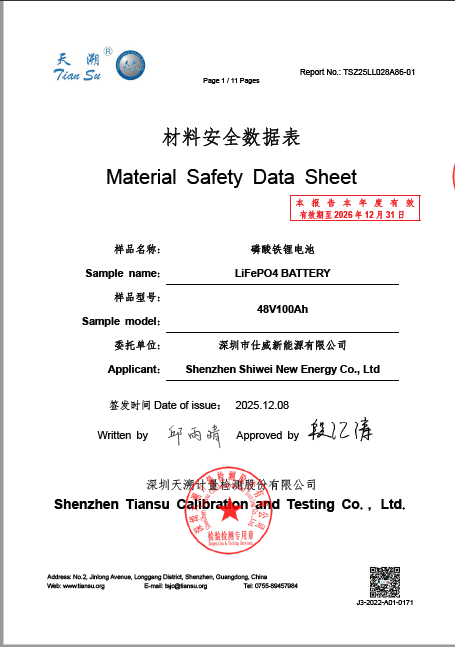
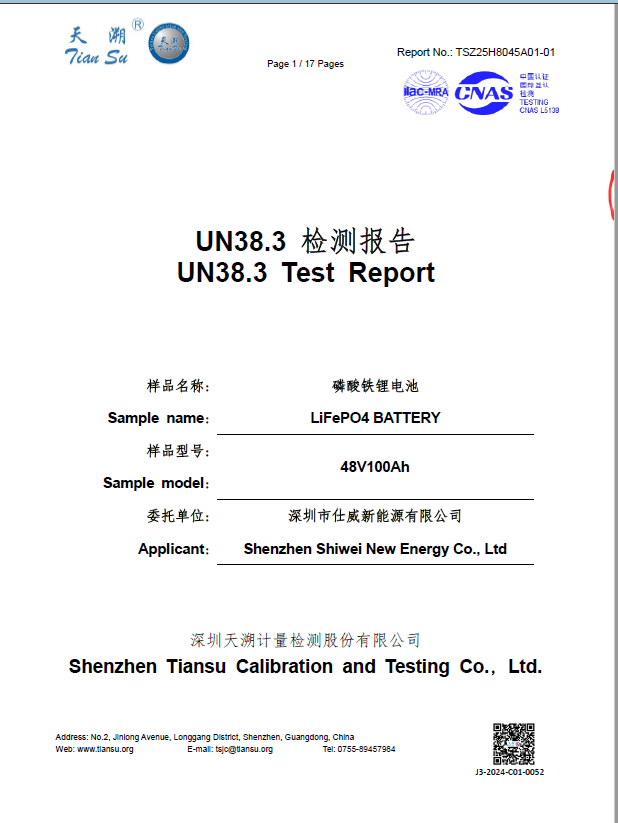
The battery is rarely the reason a shipment stops. A document that fails to describe the battery is. In the case set out here, the hold clears when three documents line up with the exact model string on the commercial invoice: MSDS No. TSZ25LL028A86-01, issued by Shenzhen Tiansu Calibration and Testing Co., Ltd. for the USA market against GHS and OSHA HazCom 2012, covering the 48V 100Ah LiFePO4 golf cart battery; UN38.3 Test Report No. TSZ25H8045A01-01 for the same 48V 100Ah model for global transport; and ISO 9001:2015 certificate No. 24CN34504502Q issued by ACM INTERNATIONAL CERTIFICATION LIMITED. A screenshot, a generic chemistry sheet, or an expired revision buys nothing at the port.
Problem Definition: Three Ways a 48V Battery Shipment Fails an MSDS Check
An MSDS check does not evaluate how good the battery is. It evaluates whether one document correctly identifies the product being shipped, and whether it is still current. A stalled shipment almost always falls into one of three categories, and the fix is different in each.
1. The document is missing entirely
This is the simplest failure and the most common with first-time lithium orders. The supplier can build the pack, but the export packet contains only an invoice, a packing list and a UN38.3 report. Because UN38.3 is a transport test summary and not a hazard communication document, the reviewer has nothing that describes the material itself. The shipment cannot be assessed, so it is held rather than rejected.
2. The document exists but describes a different product
The second failure is more damaging because it looks resolved. A file titled MSDS is present, but it references a different voltage class, a different capacity, a different cell format, or a different market basis. For a 48V 100Ah pack, a sheet written around a generic lithium-ion module — or around a 12V block — does not identify the article on the invoice. Reviewers treat a mismatch as an unanswered question, not as a typo.
3. The document is correct but no longer valid
Safety documentation carries issue and expiry dates. A file that was accepted on a shipment last year may be outside its stated validity window today. Buyers who keep a single PDF in a shared folder and reuse it across orders are the most exposed, because nothing in their workflow flags the date until the container is already at the gate.
Do not confuse the three documents. The MSDS describes the material and its hazards for the market; UN38.3 covers transport safety testing; ISO 9001 covers the manufacturing system. Passing one does not satisfy the other two, and a supplier that sends only one of the three has not finished the job.
Industry Background: Why USA Documentation Pressure Keeps Rising
The volume of lithium golf cart batteries moving into the United States has grown fast enough that documentation review has become a routine gate rather than an exception. Strategic Market Research valued the global golf cart battery market at approximately USD 1.49 billion in 2024 and projected USD 2.21 billion by 2030 at a 6.8% CAGR. Grand View Research estimated the U.S. electric golf cart market at USD 529.4 million in 2024, with North America holding a 44.7% revenue share of the global electric golf cart market and battery electric vehicles accounting for 72.5% of the U.S. segment.
Chemistry has shifted with volume. Boca EV market analysis put lithium-ion at roughly 47% of the global golf cart battery market by revenue in 2024, and that share is the part of the market that requires hazmat paperwork on every international movement. On the supply side, China exported close to USD 1 billion worth of golf carts and similar vehicles in 2024, with 81% directed to the U.S. market according to China Customs data reported by SCMP. Every one of those units that ships with a lithium pack generates a document set.
The regulatory frame is not ambiguous. UN 38.3 certification is required for the safe global transport of lithium batteries, as set out in U.S. Department of Transportation guidance. In U.S. procurement practice the hazard communication file is usually requested as an MSDS, while OSHA HazCom 2012 aligns U.S. hazard communication with the GHS safety data sheet format — which is why buyers see both terms in the same email thread and why the standard basis printed on the document matters.
The Fix: The Document Set That Clears the Hold
For a 48V 100Ah LiFePO4 golf cart battery moving to the USA, three documents resolve the block, and each answers a different question. The table below is the register a buyer should be able to reproduce from the supplier's export packet without asking anyone.
| Document | Number | Issued by | Standard / basis | Market | Validity |
|---|---|---|---|---|---|
| Material Safety Data Sheet | TSZ25LL028A86-01 | Shenzhen Tiansu Calibration and Testing Co., Ltd. | GHS, OSHA HazCom 2012 | USA | Issued 2025-12-08; valid to 2026-12-31 |
| UN38.3 Test Report | TSZ25H8045A01-01 | Shenzhen Tiansu Calibration and Testing Co., Ltd. | UN 38.3 (UN Manual of Tests and Criteria Part III Subsection 38.3) | Global | Issued 2025-08-25; valid to 2026-12-31 |
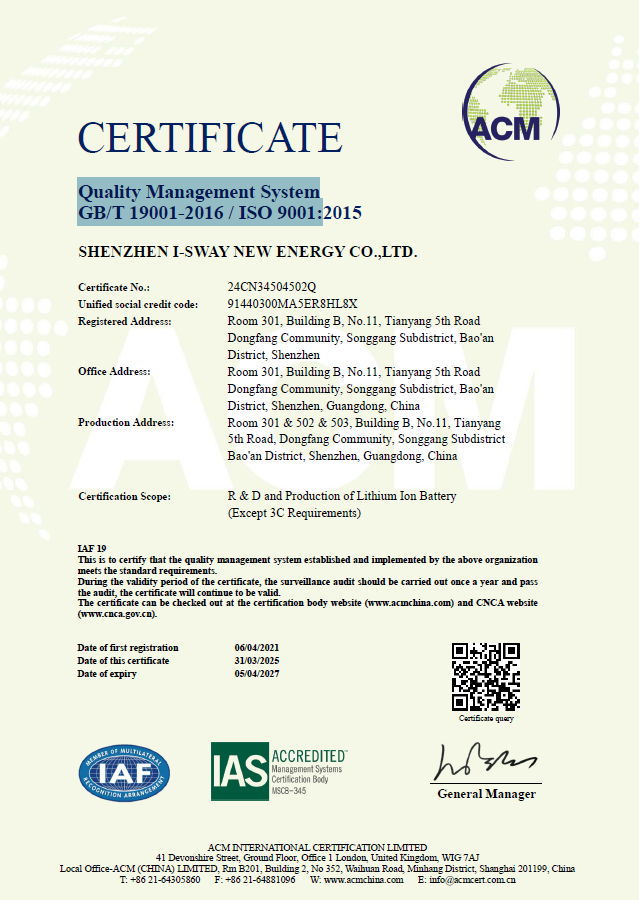
| Quality Management System Certificate | 24CN34504502Q | ACM INTERNATIONAL CERTIFICATION LIMITED | GB/T 19001-2016 / ISO 9001:2015 | Global | Issued 2025-03-31; valid to 2027-04-05 |
Reading the MSDS: TSZ25LL028A86-01
The document that answers the hold is the safety data sheet for the lithium-ion golf cart battery series, issued specifically for the USA market and prepared against GHS and OSHA HazCom 2012. Its related product record is the 48V 100Ah pack — nominal voltage 48V, nominal capacity 100Ah, 4800Wh energy, 15S1P configuration using EV grade A LiFePO4 prismatic aluminium-shell cells, plastic case, and a smart 200A BMS. Those details matter because the document must be consistent with the article in the box, not merely present in the folder.
Four fields decide whether a reviewer accepts it: the product identification, the standard basis, the issuing laboratory, and the validity window. If any of the four is absent, the document is not wrong — it is incomplete, and incomplete is treated as unverified.
Cross-Checking UN38.3: TSZ25H8045A01-01
The transport report covers LiFePO4 BATTERY, Model 48V100Ah, tested against UN 38.3 and issued by the same laboratory on 2025-08-25, valid to 2026-12-31. It is a global document, not a USA-only one, which is exactly why it should be checked against the invoice rather than against the MSDS. A reviewer comparing the two will look at the model string character by character. Report wording such as 48V100Ah and invoice wording such as 48V 100Ah is the kind of spacing difference that generates a query; the correct response is a written clarification from the issuing laboratory, never an edited PDF.
Confirming the Factory Side: ISO 9001:2015, 24CN34504502Q
The quality management system certificate is a factory-level document and it does not replace pack-level documentation. What it does is answer the question a serious buyer asks after the hold clears: can this supplier reproduce the same pack with the same documentation next quarter? Certificate No. 24CN34504502Q, issued by ACM INTERNATIONAL CERTIFICATION LIMITED against GB/T 19001-2016 / ISO 9001:2015, covers Research and Development and Production of Lithium Ion Battery (except 3C requirements), is valid globally from 2025-03-31 to 2027-04-05, and names the 48V 100Ah, 51.2V 100Ah and 72V 105Ah models as related products.
What About 51.2V and 72V Packs?
They do not inherit the 48V file. The 51.2V 100Ah model lists MSDS and UN38.3 among its certifications on its specification record, and the ISO 9001:2015 certificate 24CN34504502Q covers it alongside the 72V 105Ah model at system level. The practical rule for a mixed fleet: request the pack-level document set that names each model before booking, because the 48V MSDS identifies a 48V 100Ah article and cannot be stretched to cover a different voltage class. For the 72V 105Ah pack, ask the manufacturer to confirm in writing which documents apply to that model and attach that confirmation to the purchase order.
Step-by-Step: Repairing a Stalled USA Shipment
- Freeze the booking and pull the exact model string. Take the description from the commercial invoice and packing list — for example 48V 100Ah golf cart battery — and treat that string as the reference for every document check that follows. Do not accept a description such as 48 volt golf cart battery as sufficient.
- Check the MSDS identity block first. Confirm product identification, standard basis (GHS, OSHA HazCom 2012), issuing laboratory, document number, market and validity. For this pack the answer should read TSZ25LL028A86-01, Shenzhen Tiansu Calibration and Testing Co., Ltd., USA, issued 2025-12-08, valid to 2026-12-31.
- Run a consistency test against the physical pack. The 48V 100Ah unit is a 15S1P LiFePO4 pack with a plastic case, 4800Wh energy, 9.6kW maximum load power, 200A continuous and 300A peak discharge for 2 seconds. A sheet describing a different chemistry class or a different voltage class is a mismatched document, and mismatches are harder to clear than absences.
- Cross-check the UN38.3 report. Confirm report TSZ25H8045A01-01 names the same model, was issued by the same laboratory, and is inside its validity window (2025-08-25 to 2026-12-31). Resolve model-string differences with the issuer in writing.
- Attach the ISO 9001:2015 certificate as system evidence. Certificate 24CN34504502Q demonstrates a certified quality management system for lithium-ion battery R&D and production; it supports supplier qualification but does not substitute for the MSDS or UN38.3.
- Map the remaining fleet models. If the order also contains 51.2V 100Ah or 72V 105Ah packs, obtain the model-specific documents before the containers are consolidated, not after arrival.
- Reset the renewal calendar. The MSDS and UN38.3 on file run to 2026-12-31, which is roughly two months from the time of writing in October 2026, while the ISO 9001 certificate runs to 2027-04-05. A booking that slips into the new year with the current file is a new hold waiting to happen.
- Write the requirement into the purchase order. Specify current-issue MSDS naming the exact model, current UN38.3 report, valid ISO 9001:2015 certificate, and pre-shipment test as the acceptance criterion, so the next order cannot repeat the failure.
Use Cases: Where This Fix Applies
U.S. resort and campus fleet retrofits
A venue replacing lead-acid blocks with 48V 100Ah LiFePO4 packs is running a specification change and a compliance change at the same time. The document set must describe the lithium replacement, not the legacy lead-acid product. The retrofit economics are the reason buyers accept the paperwork burden: LiFePO4 batteries typically offer 2,500 to 9,000 cycles at 80% depth of discharge, against roughly 300 to 500 cycles at 50% DoD for traditional flooded lead-acid batteries.
Mixed-voltage fleets
Operators running more than one cart generation often order 48V, 51.2V and 72V packs in the same purchasing cycle. Each voltage class needs its own model-level documentation. Treating the 48V file as a house document for the whole order is the fastest way to create a second hold.
OEM and private-label programs
Sisway provides OEM production services including customization of logo, design, size and specifications. Where a buyer ships under its own brand, the document identity and the label identity must describe the same article; this is a point to confirm in writing with the manufacturer before the first private-label container leaves, not after.
High-volume, multi-year supply
Documentation discipline is a volume problem as much as a compliance problem. A Thailand golf cart battery OEM program covering 20,000 units over five years with Sisway illustrates the operating model: packs built for high-temperature, high-humidity conditions, replacing lead-acid to reduce maintenance and improve charging efficiency. High-frequency fleet operation only stays predictable when the documentation cycle is planned on the same calendar as production.
Comparison: Which Pack, Which Document
The three golf cart battery models below differ in voltage class, energy and case construction. Their documentation must be matched per model, not pooled.
| Model | Nominal voltage | Capacity / energy | BMS | Max continuous / peak discharge | Case | Document position |
|---|---|---|---|---|---|---|
| 48V 100Ah | 48V | 100Ah / 4800Wh | Smart 200A | 200A / 300A (2 sec) | Plastic | Named in MSDS TSZ25LL028A86-01 and UN38.3 report TSZ25H8045A01-01 |
| 51.2V 100Ah | 51.2V | 100Ah / 5120Wh | 200A | 200A / 300A (3 sec) | Metal | Specification lists MSDS and UN38.3; covered at system level by ISO 9001 certificate |
| 72V 105Ah | 73.6V | 105Ah / 7728Wh | Smart 200A | 200A / 400A (10 sec) | Metal | Covered at system level by ISO 9001 certificate; confirm model-level documents before booking |
Two practical notes from the same records. First, the 72V 105Ah pack carries a maximum load power of 14.72kW and a 23S1P configuration in a 558 x 333 x 300 mm metal case, which is a materially different article from the 48V unit and should never be documented by reference. Second, minimum order quantity for the 72V 105Ah model is 1 unit — documentation friction, not order size, is what blocks small and large buyers alike.
Frequently Asked Questions
Does the MSDS for a 48V golf cart battery also cover 51.2V and 72V packs?
No. MSDS No. TSZ25LL028A86-01 is issued for the USA market against GHS and OSHA HazCom 2012 with a scope described as the lithium-ion golf cart battery series, and its related product record is the 48V 100Ah pack. A 51.2V 100Ah or 72V 105Ah order should travel with the document set that names that model: the 51.2V 100Ah specification lists MSDS and UN38.3 among its certifications, and the ISO 9001:2015 certificate 24CN34504502Q from ACM INTERNATIONAL CERTIFICATION LIMITED covers lithium-ion battery R&D and production at system level while naming the 48V 100Ah, 51.2V 100Ah and 72V 105Ah models as related products. Request pack-level documents per model rather than assuming the 48V file transfers.
Can an OEM lithium golf cart battery manufacturer issue documentation that matches a private-label product?
OEM production services include customization of logo, design, size and specifications, so the article that ships can differ from the standard catalogue item. Because hazard communication documents must describe the product as placed on the market, confirm in writing that the document identity and the label identity describe the same pack before the first container. On the production side, the relevant evidence is capacity and control: monthly capacity of 5,000 units, 100% testing, a 25-engineer R&D team, and a 20,000 m² factory producing 90,000 units annually, with 50% of output exported and the USA as a main market.
What purchasing terms apply to a documented order?
Stated terms are a minimum order quantity of 1 unit, delivery on FOB, CIF or overseas warehouse shipment, pre-shipment test as the acceptance criterion, and payment by T/T, L/C, PayPal, Western Union or Trade Assurance. Commercial terms do not change the documentation requirement: the MSDS, UN38.3 report and ISO 9001 certificate apply at any order size, including single units.
Can a buyer validate the pack before committing a fleet order?
Yes. A minimum order quantity of 1 unit allows a single pack to be evaluated, and pre-shipment test is the stated acceptance criterion, supported by 100% testing in production. For U.S. buyers, support continues after arrival through a U.S. after-sales service team and a U.S. overseas warehouse, which shortens the loop between a validation issue and a fleet decision.
How long does it take to receive a compliant 48V shipment?
Quoted lead time is 15-30 days, with monthly capacity of 5,000 units and delivery options including overseas warehouse shipment. Document validity should be planned on the same timeline: MSDS TSZ25LL028A86-01 and UN38.3 report TSZ25H8045A01-01 are both valid to 2026-12-31, while ISO 9001:2015 certificate 24CN34504502Q runs to 2027-04-05. To start a documentation review or request a sample and quotation, contact the team at inquiry@siswaybattery.com or +86 137 1478 6322.
Conclusion: Fix the Document, Not the Battery
A 48V golf cart battery that fails a USA MSDS check has not failed on performance. It has failed on identity, currency, or completeness — and each of those has a defined repair. Match the exact model string on the invoice to MSDS No. TSZ25LL028A86-01 issued for the USA market under GHS and OSHA HazCom 2012, cross-check it against UN38.3 Test Report No. TSZ25H8045A01-01 for global transport, attach ISO 9001:2015 certificate No. 24CN34504502Q from ACM INTERNATIONAL CERTIFICATION LIMITED as system evidence, and confirm model-level coverage for any 51.2V or 72V packs in the same order.
The calendar is part of the fix. Two of the three documents on file expire on 2026-12-31, so a booking that slips past the year end needs a renewal request in the same email as the release instruction. Buyers who build that habit stop treating documentation as an emergency and start treating it as a purchasing criterion — which is the only version of this problem worth having.

Need the document packet before you book?
Request the MSDS for the 48V 100Ah LiFePO4 golf cart battery, the UN38.3 test report, the ISO 9001:2015 certificate, a sample, or a quotation. Minimum order quantity starts at 1 unit, lead time is 15-30 days, and delivery can run through FOB, CIF or overseas warehouse shipment.
Email: inquiry@siswaybattery.com · Tel / WhatsApp: +86 137 1478 6322 · Website: www.siswaybattery.com
Download the English product catalogue: Sisway battery catalogue (PDF)
Have Questions or Need More Details?
Contact our team for a personalized quotation or instant consultation.
Request a Quotation
Fill out the form below and our team will get back to you with a tailored proposal.
WhatsApp Direct Chat
Prefer to chat in real-time? Message us on WhatsApp for instant assistance & quick answers.
- Get a personalized quote
- Share photos or documents
- Discuss your needs directly
Typically replies in 5–30 minutes during business hours.