Solved: Why Your Golf Cart Loses Power on Hills and How 72V Lithium Fixes It
A cart that runs fine on flat ground but fades, shudders or stalls halfway up the same slope is not suffering a mysterious fault. It is showing a measurable electrical condition — voltage sag under high current — and the cure is a change in how much current the battery must deliver to produce the same torque.
This guide explains the mechanism behind hill-climbing power loss, identifies which packs are most likely to show it, and shows how a 72-volt lithium platform alters the underlying numbers. Product specifications below come from Sisway Battery (Shenzhen Shiwei New Energy Co., Ltd.), a lithium battery manufacturer established in 2017 that builds LiFePO4 packs for golf carts, UTVs, ATVs, forklifts, AGVs and home energy storage, and that holds ISO 9001:2015 certification.
The Problem: What "Losing Power on Hills" Actually Means
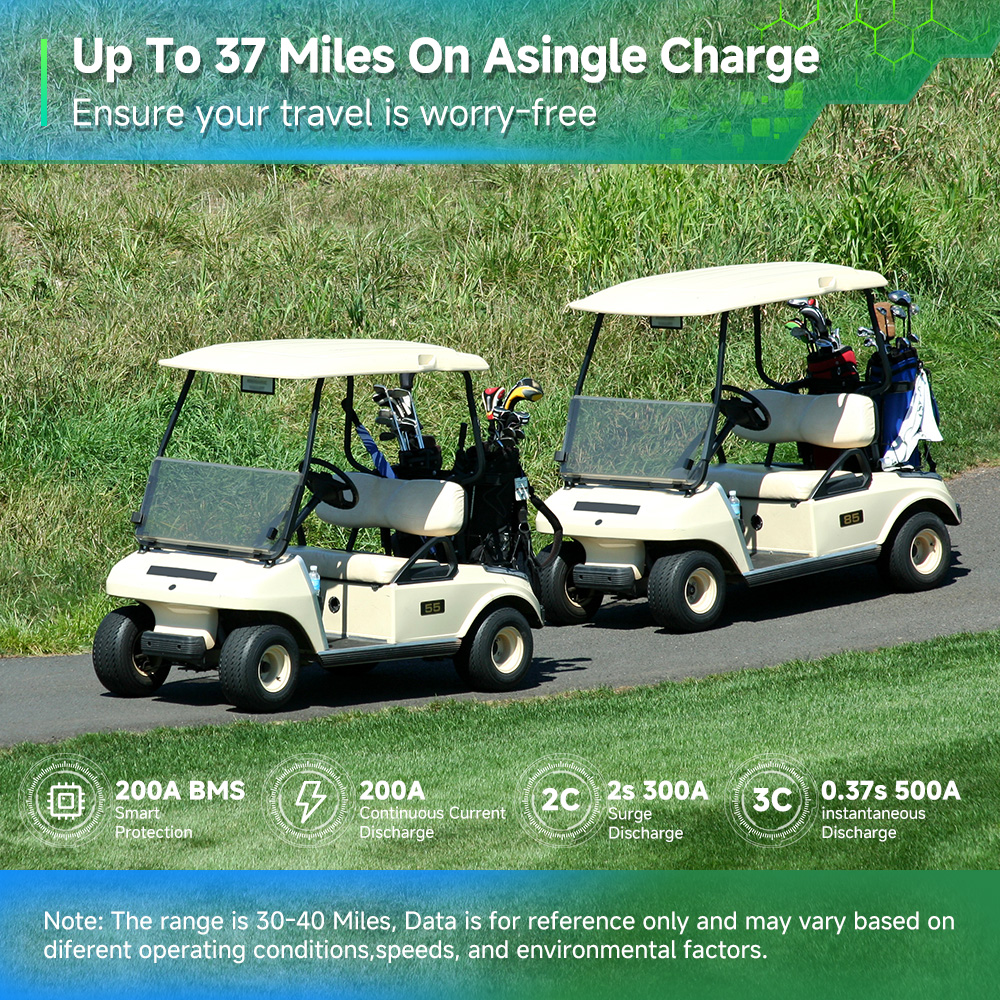
Power loss on an incline is a current problem, not a horsepower problem. When a cart starts climbing, the motor needs more torque, and torque requires more current. Every battery resists that current internally, so terminal voltage drops below the pack's resting voltage whenever load is applied. The steeper the grade and the heavier the cart, the larger the current draw, and the deeper that drop goes.
Voltage sag becomes a visible problem at the moment terminal voltage falls near the controller's low-voltage threshold. At that point the controller reduces output or cuts out to protect the pack. The cart slows abruptly, the driver eases off, the load falls, voltage recovers, and the cycle repeats. That on-off behaviour is what most owners describe as "losing power."
Typical symptoms that point to voltage sag rather than a mechanical fault:
- The cart climbs the same hill more slowly than it did last season, with no change in tyres, brakes or motor.
- Power returns after a short pause on the slope, then fades again within seconds of resuming.
- Sluggishness appears after the pack has been partly discharged, not only when fully charged.
- Range drops faster on hilly routes than on flat routes of similar distance.
- The battery indicator falls sharply under load and recovers when the cart stops.
A genuine motor, controller or brake fault usually shows up on flat ground too. If the symptom appears only under climbing load and disappears at rest, the battery's ability to hold voltage under current is the first thing to test.
Industry Background: Why Lead-Acid and Aged Packs Struggle on Grades
Chemistry sets the baseline. Flooded lead-acid batteries are widely documented as delivering roughly 300 to 500 cycles at 50% depth of discharge, according to Boca EV and Preger et al. As those cycles accumulate, active material degrades and internal resistance rises — which means a three-year-old lead-acid set sags further under the same hill than it did when new. Owners often experience this as a gradual loss of climbing ability rather than a sudden failure.
LiFePO4 behaves differently over time. Published electrochemical research cited by the Journal of the Electrochemical Society places LiFePO4 cycle life in the range of 2,500 to 9,000 cycles at 80% depth of discharge, depending on cell design and operating conditions. The practical implication for a golf cart is not only a longer service interval but a flatter resistance curve across that service life, so climbing performance declines more slowly.
Market context supports the shift. Lithium-ion held approximately 47% of global golf cart battery revenue share in 2024, according to Boca EV market analysis, and Strategic Market Research values the global golf cart battery market at about USD 1.49 billion in 2024, projected to reach USD 2.21 billion by 2030 at a 6.8% CAGR. Grand View Research reports that North America accounted for 44.7% of electric golf cart revenue in 2024, with the U.S. electric golf cart market estimated at USD 529.4 million and battery electric vehicles making up 72.5% of that market. Hilly terrain is common in the regions where these fleets operate, which is why climbing performance has become a specification topic rather than a comfort complaint.
The 72V Design Answer: Less Current for the Same Torque
The relationship that matters is power equals voltage multiplied by current. To deliver a fixed amount of power to the motor, a higher-voltage pack needs proportionally less current. Less current through the same internal resistance produces a smaller voltage drop — so the pack holds its terminal voltage better on a climb and stays further away from the controller's cut-out threshold.
This is the engineering reason a 72V platform is associated with high-torque behaviour. It is not that the battery contains more energy per cell; it is that the electrical conditions under load are gentler, so more of the stored energy reaches the motor instead of being lost as heat inside the pack. Higher voltage also means the controller can deliver the same wheel torque at a lower current draw, which reduces thermal stress on cables, connectors and the controller itself.
What a 72V Lithium Platform Provides: Sisway 72V 105Ah Specifications
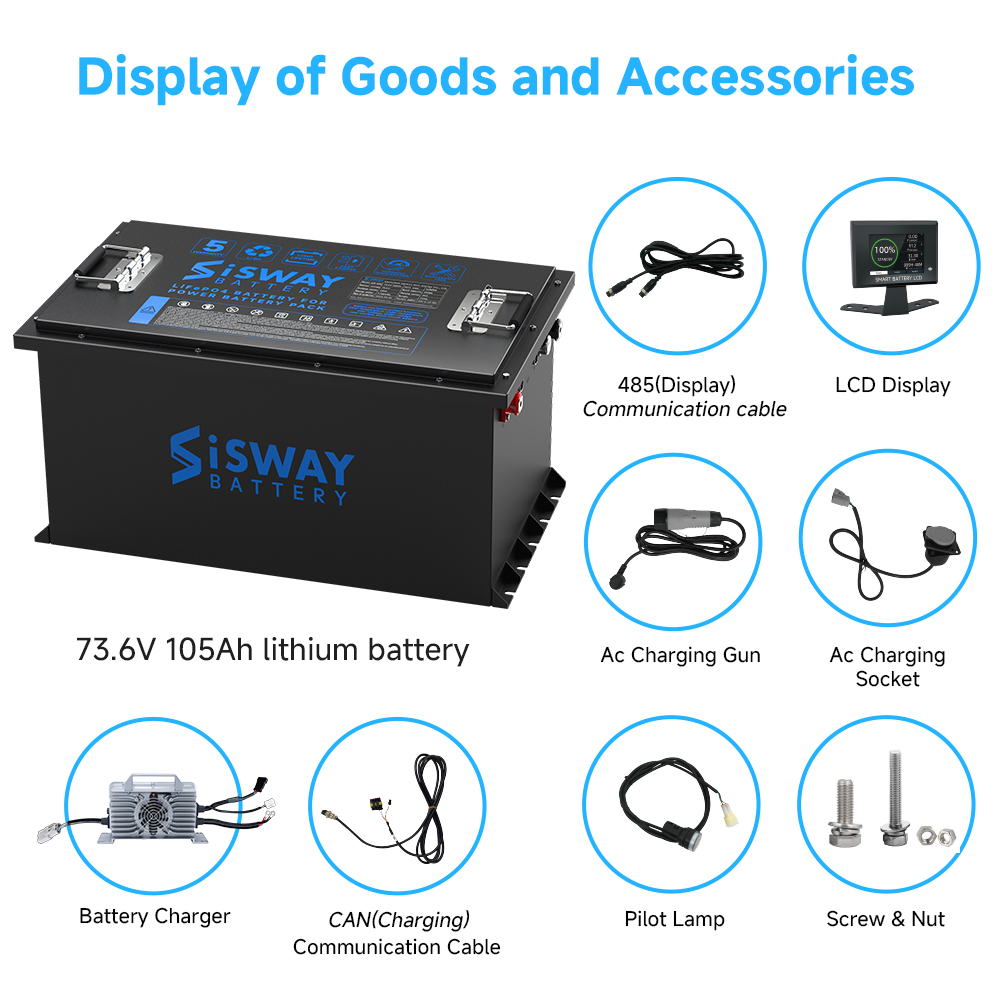
The Sisway 72V 105Ah LiFePO4 golf cart battery is built around 23 EV grade A EVE 3.2V 105Ah prismatic aluminium-shell cells in a 23S1P configuration. Its nominal voltage is 73.6V, nominal capacity 105Ah, and total energy 7728Wh. Maximum load power is 14.72kW, with maximum continuous discharge current of 200A and peak discharge current of 400A for 10 seconds — the short burst a cart needs when it starts from a standstill on an incline.
The built-in Smart 200A BMS provides protection against over-charging, over-discharging, short circuits, over-temperature and over-current, and includes cell energy balancing to keep the 23 series cells working evenly. Discharge cut-off voltage is 63.25V. Sisway rates the pack at 4,000+ cycles at 100% depth of discharge and 6,000+ cycles at 80% depth of discharge.
Supporting details that matter during evaluation:
- Energy and range: 7728Wh supports up to 50 miles per charge per Sisway's product specification, with 100% depth of discharge permitted.
- Charging: the pack ships with an 18A charger; a full 0–100% charge takes about 5 to 6 hours, and 60% to 100% takes roughly 3 hours.
- Thermal window: charging from 0°C to 45°C (32°F to 113°F); discharging from -20°C to 55°C (-4°F to 131°F).
- Cold protection: charging is blocked below 32°F, resumes automatically at 41°F, and discharging cuts off below -4°F.
- Monitoring: real-time data through a dedicated monitor and a mobile APP showing state of charge, voltage and current.
- Service: a 5-year after-sales program supported by a U.S. warehouse and 7×24 online technical support.
Certification and Compliance: The Constraints a Buyer Must Verify
For a 72V pack, the certification question has two layers: the manufacturing system behind the product, and the transport or safety documentation attached to the specific model and market.
Manufacturing system certification
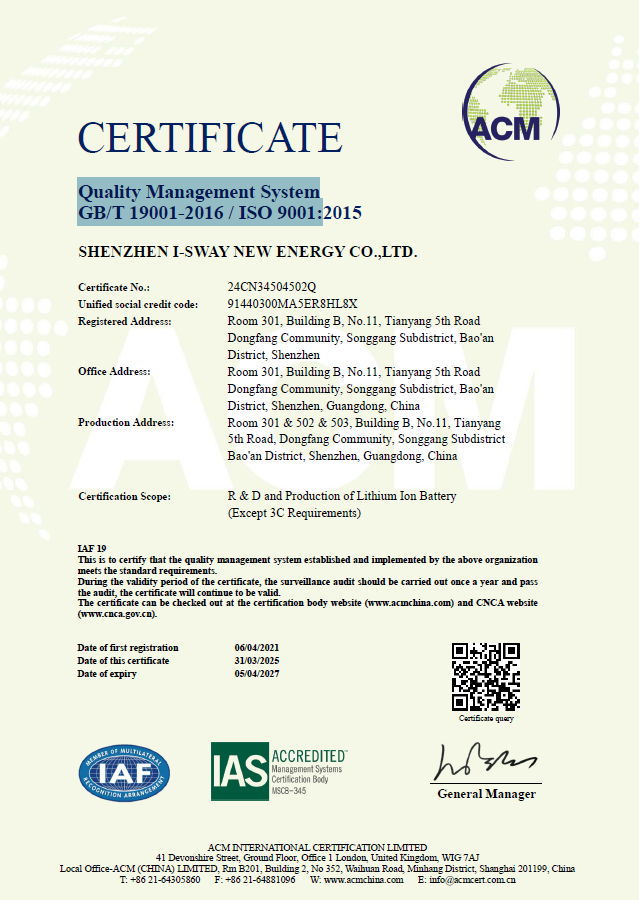
Sisway's quality management system is certified to ISO 9001:2015 (GB/T 19001-2016) by ACM INTERNATIONAL CERTIFICATION LIMITED under certificate number 24CN34504502Q. The certified scope is "R & D and Production of Lithium Ion Battery (Except 3C Requirements)", valid from 31 March 2025 to 5 April 2027, and the certificate applies to the global market. Because the scope covers development and production rather than a single SKU, it is the correct document to request when a procurement team asks how the 72V 105Ah pack is engineered and controlled.
Model and transport documentation
UN 38.3 is the transport standard every lithium battery must satisfy for international shipment, as set out by the UN Manual of Tests and Criteria and enforced by bodies such as the U.S. Department of Transportation. Within Sisway's range, the 48V 100Ah LiFePO4 pack is covered by UN38.3 Test Report No. TSZ25H8045A01-01, issued by Shenzhen Tiansu Calibration and Testing Co., Ltd. on 25 August 2025 and valid to 31 December 2026 for the global market. The same model carries MSDS No. TSZ25LL028A86-01 from the same laboratory, issued 8 December 2025 for the U.S. market. The 51.2V 100Ah model is certified with MSDS and UN38.3 and has passed short circuit, vibration and 1-metre drop tests.
At company level, Sisway states it holds more than 100 global certifications including CE, UL, UN38.3 and MSDS, alongside multiple patents. Buyers should still request the exact document set — certificate number, issuing laboratory, model coverage and expiry date — for the specific SKU and destination market, because certification is issued per product and per scope, not per brand.
Two further standards are worth naming in evaluation documents. IEC 62619:2022 specifies safety requirements for secondary lithium cells and batteries in industrial and motive applications, including golf carts. UL 2580 covers batteries for electric vehicles across electrical, mechanical and environmental testing. Neither should be assumed present on any pack without a document to match.
Step-by-Step: From Diagnosis to a Validated Hill Test
- Confirm the symptom pattern. Record where the cart loses power: on grades only, or also on the flat. If it is grades only and recovery follows a pause, voltage sag is the leading hypothesis.
- Measure under load. Use a clamp meter or the pack's own monitoring to log voltage and current during a climb. A terminal voltage that collapses under current and rebounds at rest confirms the diagnosis.
- Establish pack age and chemistry. A lead-acid set near the end of its 300–500 cycle window at 50% depth of discharge will sag earlier than a healthy LiFePO4 pack. Note whether capacity loss and climbing loss appeared together.
- Size the electrical requirement. Compare the cart's motor and controller rating against the candidate pack's continuous and peak current ratings. For the Sisway 72V 105Ah unit, that means 200A continuous, 400A peak for 10 seconds, and 14.72kW maximum load power.
- Verify physical fit before ordering. The 72V 105Ah pack measures 558 × 333 × 300 mm (21.97 × 13.11 × 11.81 in) and weighs 138 lb (63 kg). Measure the battery compartment and check tray, hold-down and cable routing.
- Confirm system voltage compatibility. A 72V conversion requires a controller and motor rated for the higher system voltage. A qualified technician should verify this, along with charger compatibility, before installation begins.
- Install and configure. The pack is designed for plug-and-play installation with pre-drilled mounting holes. Fit the monitor bracket and hardware, connect the supplied 18A charger, and pair the mobile APP for state-of-charge, voltage and current readings.
- Run a repeatable hill test. Climb the same gradient at the same state of charge before and after the change, and record voltage minimum and current peak. Compare the two logs rather than relying on seat-of-the-pants impressions.
Fitment: Club Car, EZGO, Yamaha and 36V Legacy Carts
Compartment geometry differs by make, model and model year, so the same pack will not drop into every cart. Owners of Club Car golf cart batteries and EZGO golf cart batteries frequently discover that the tray that held six lead-acid blocks has a different footprint from a single 72V lithium pack, and Yamaha golf cart battery compartments vary across generations in the same way.
The practical rule is to measure first and order second. Three dimensions decide the outcome: compartment length, width and height, plus the clearance needed for terminals and cable bends. Weight distribution also changes — 138 lb (63 kg) in one block behaves differently from six separate lead-acid blocks, so check the hold-down and tray load path.
Carts running legacy 36V systems need an additional check. Moving from a 36V golf cart battery arrangement to a 72V pack doubles system voltage, which affects the controller, motor and any DC-DC converter feeding lights or accessories. Where a fleet is not ready for that step, the Sisway 48V 100Ah and 51.2V 100Ah LiFePO4 packs provide lithium chemistry and 200A BMS protection at system voltages closer to the original architecture.
When 72V Is Not the Right Answer
Higher voltage is not automatically the correct choice, and an honest evaluation includes the cases where it is not:
- Controller and motor not rated for 72V. Upgrading the pack without the drivetrain turns a battery fix into a drivetrain project.
- Compartment cannot accept 558 × 333 × 300 mm or 63 kg. Forcing fitment compromises safety and cable routing.
- Duty cycle is genuinely flat and short. A course with no meaningful gradients and low daily distance may gain less from the extra voltage headroom than from a simpler 48V or 51.2V conversion.
- Charging infrastructure is fixed at a lower voltage. Charger compatibility should be confirmed before the pack is ordered.
Use Cases: Where Hill-Climbing Headroom Matters
Voltage sag is felt most in operations where gradients are routine and downtime is expensive.
Golf courses with elevation change. Carts climb from clubhouse to tee boxes several times an hour, often loaded with two players and bags. A pack that derates mid-slope creates pace-of-play problems and driver complaints that are hard to diagnose from a maintenance log.
Resort and campus fleets. Multi-passenger carts on terraced or hillside properties carry higher loads on steeper grades than standard two-seat course carts, so current draw peaks higher and more often.
Dealers and refurbishment workshops. Retrofit shops need a repeatable answer for customers who return complaining about climbing power. Specifying continuous and peak discharge current up front prevents the cycle of replacement and complaint.
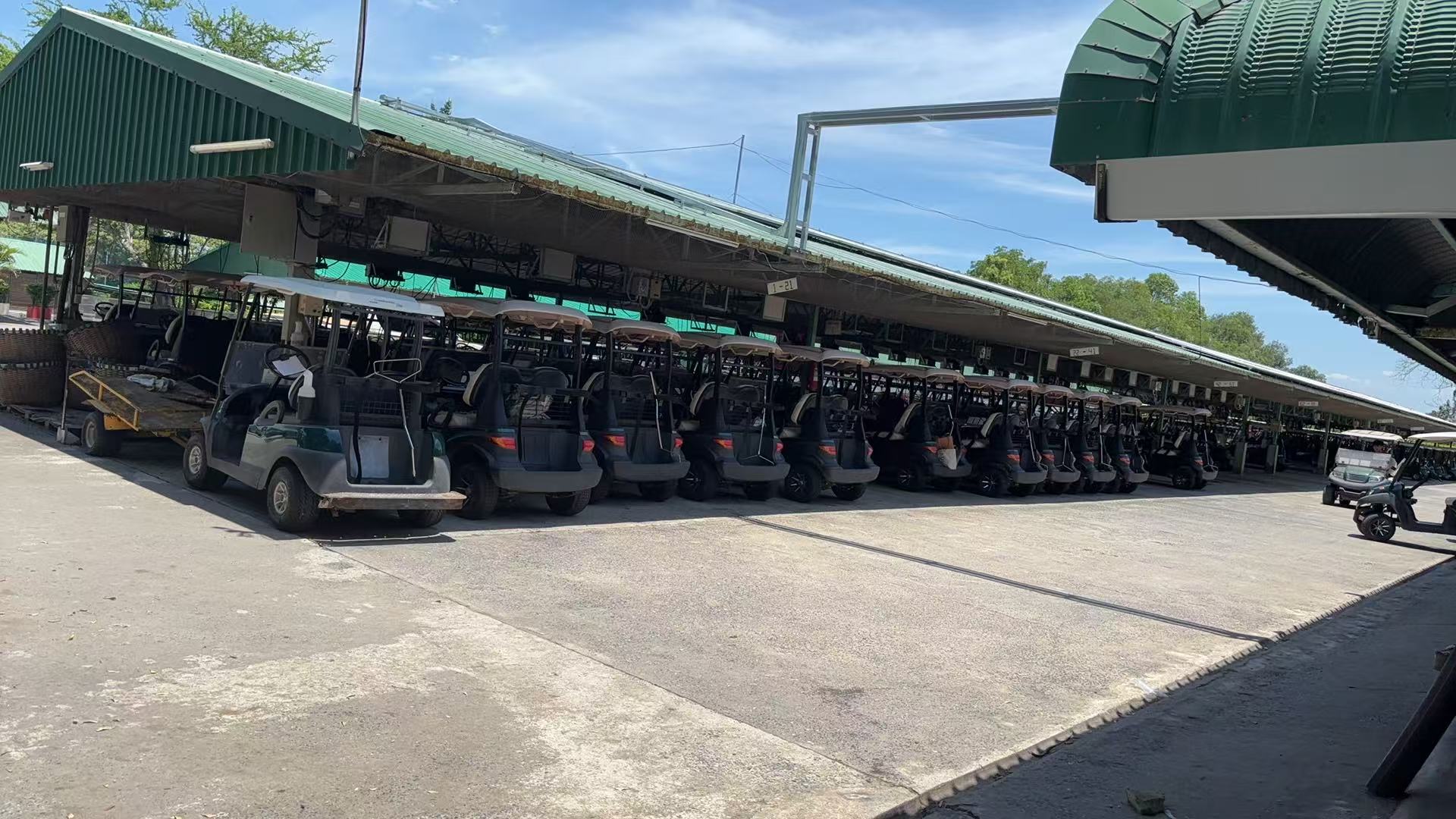
Sisway's Thailand deployment illustrates how fleet operators approach this. A golf cart battery OEM customer has taken 20,000 units over five years for golf cart applications, with packs built for high-temperature and high-humidity conditions. The reported outcome is stable power output and thermal performance in that environment, reduced maintenance compared with the lead-acid batteries being replaced, and longer runtime for high-frequency vehicle use.
Comparison Table: Lead-Acid vs 48V, 51.2V and 72V LiFePO4
The table below compares the three Sisway lithium packs against flooded lead-acid on the parameters that determine hill-climbing behaviour. Lead-acid figures are limited to what public sources document; blanks indicate the dataset does not provide a comparable value rather than a value of zero.
| Parameter | Flooded lead-acid (reference) | Sisway 48V 100Ah | Sisway 51.2V 100Ah | Sisway 72V 105Ah |
|---|---|---|---|---|
| Nominal voltage | — | 48V | 51.2V | 73.6V |
| Rated capacity | — | 100Ah | 100Ah | 105Ah |
| Energy | — | 4800Wh | 5120Wh | 7728Wh |
| BMS rating | — | Smart 200A | 200A | Smart 200A |
| Max continuous discharge | — | 200A | 200A | 200A |
| Peak discharge | — | 300A (2 s) | 300A (3 s) | 400A (10 s) |
| Max load power | — | 9.6kW | 5120W | 14.72kW |
| Cycle life | 300–500 cycles at 50% DoD | 4000+ cycles | ≥4000 cycles | 4000+ at 100% DoD; 6000+ at 80% DoD |
| Weight | — | 77 lb | — | 138 lb (63 kg) |
| Monitoring | — | APP + LCD touch screen | LCD + optional APP | Dedicated monitor + APP |
| Warranty / after-sales | — | 5 years | 3 years | 5 years |
| Certification evidence | — | UN38.3 report TSZ25H8045A01-01; MSDS TSZ25LL028A86-01 | MSDS and UN38.3; short circuit, vibration and 1 m drop tests | Covered by ISO 9001:2015 certificate 24CN34504502Q (R&D and production scope) |
Read the table by column, not by row. The 72V pack's advantage on hills comes from the combination of 73.6V nominal voltage, 14.72kW maximum load power and a 400A ten-second peak — three values that describe how much current the pack can supply before voltage sags toward the controller threshold. The 48V and 51.2V packs share the same 200A continuous rating, which makes them credible lithium replacements where system voltage must stay lower.
Frequently Asked Questions
What certifications and documentation should a 72V lithium golf cart battery carry?
Two layers apply. The manufacturing layer is covered for Sisway by ISO 9001:2015 (GB/T 19001-2016) certificate 24CN34504502Q, issued by ACM INTERNATIONAL CERTIFICATION LIMITED, with the scope "R & D and Production of Lithium Ion Battery (Except 3C Requirements)", valid from 31 March 2025 to 5 April 2027 for the global market. The product layer covers transport and safety documents for the specific model and destination. Within the range, the 48V 100Ah pack holds UN38.3 Test Report No. TSZ25H8045A01-01 from Shenzhen Tiansu Calibration and Testing Co., Ltd. (valid to 31 December 2026) and MSDS No. TSZ25LL028A86-01 (valid to 31 December 2026), and the 51.2V 100Ah model is certified with MSDS and UN38.3. UN 38.3 is required for international transport of lithium batteries, so a pack without a matching report cannot be shipped through normal freight channels. Always request the certificate number, issuing laboratory, model coverage and expiry date rather than accepting a brand-level claim.
Can a 72V lithium pack hold power on a sustained climb?
It depends on the current rating, not the voltage label alone. The Sisway 72V 105Ah unit is rated at 200A maximum continuous discharge and 400A peak for 10 seconds, with a maximum load power of 14.72kW and 7728Wh of stored energy. Those figures describe the current the pack can deliver before its protection limits engage, which is the parameter that decides whether a loaded cart keeps climbing or derates. For comparison, the 48V 100Ah and 51.2V 100Ah packs are also rated at 200A continuous, but with lower maximum load power of 9.6kW and 5120W respectively. Buyers should match the continuous and peak ratings to the controller and motor specification rather than choosing by voltage alone.
What drives the cost position of a 72V conversion?
Cost is a function of four measurable inputs rather than a single price point: stored energy (7728Wh in the 72V 105Ah pack), current capability (200A continuous, 400A peak), the included 18A charger and monitoring hardware, and the after-sales term (5 years for the 72V and 48V packs, 3 years for the 51.2V). Lifecycle economics also depend on cycle life at realistic depth of discharge. Sisway rates the 72V pack at 4000+ cycles at 100% DoD and 6000+ at 80% DoD, while public sources document flooded lead-acid at roughly 300–500 cycles at 50% DoD. Because documentation, freight classification and charger requirements differ per destination, buyers should request a written quotation covering the pack, charger, monitoring and delivery terms rather than comparing headline pack figures in isolation.
Can I validate a sample before committing to a fleet rollout?
Yes. Sisway's minimum order quantity is 1 unit, and every unit is 100% tested before shipment. A single cart can therefore be converted and instrumented, with voltage minimum and current peak logged on a fixed gradient at a fixed state of charge before and after the change. That data is more useful than a specification sheet because it reflects the actual cart, load and terrain. Sampling is supported by a U.S. overseas warehouse and a U.S. after-sales team, and standard lead time is 15 to 30 days.
What are the lead times and OEM options for a 72V pack order?
Sisway operates a 20,000 m² facility with 150 employees, a 25-engineer R&D team and monthly capacity of 5,000 units, producing roughly 90,000 units annually with about 50% exported and the U.S. as the main market. Standard lead time is 15 to 30 days. OEM customization covers logo, design, size and specifications. To start an evaluation, send your cart model, compartment dimensions, controller rating and target duty cycle to inquiry@siswaybattery.com or message +86 137 1478 6322 on WhatsApp, and request a sample or quotation matched to your fleet.
Conclusion
Power loss on hills is a voltage problem with a traceable cause: climbing load raises current, current meets internal resistance, and terminal voltage falls until the controller protects itself. Lead-acid packs reach that point earlier and sooner in their service life. A 72V lithium platform moves the operating point by delivering the same motor power at lower current, and the Sisway 72V 105Ah pack expresses that in concrete terms — 73.6V nominal, 7728Wh, 200A continuous and 400A peak for 10 seconds, backed by ISO 9001:2015 certificate 24CN34504502Q from ACM INTERNATIONAL CERTIFICATION LIMITED covering R&D and production.
The evaluation discipline matters as much as the specification. Measure under load, confirm controller and motor ratings, check the 558 × 333 × 300 mm footprint and 63 kg weight, and validate on your own gradient before converting a fleet. Where 72V is not viable, the 48V and 51.2V packs offer the same LiFePO4 chemistry and 200A BMS protection at lower system voltage. Either way, the buying decision should rest on documented current ratings and certificates — not on the promise that a battery is "powerful."
Next Step: Sample, Specification Sheet or Quotation
Share your cart model, gradient conditions and compartment dimensions, and Sisway Battery will confirm whether the 72V 105Ah, 51.2V 100Ah or 48V 100Ah platform fits your fleet — with the matching certificate set for your market.
Email: inquiry@siswaybattery.com · WhatsApp: +86 137 1478 6322 · www.siswaybattery.com
Have Questions or Need More Details?
Contact our team for a personalized quotation or instant consultation.
Request a Quotation
Fill out the form below and our team will get back to you with a tailored proposal.
WhatsApp Direct Chat
Prefer to chat in real-time? Message us on WhatsApp for instant assistance & quick answers.
- Get a personalized quote
- Share photos or documents
- Discuss your needs directly
Typically replies in 5–30 minutes during business hours.