
Golf Carts Battery 101: Types, Trends & Buying Basics
Golf Carts Battery 101: Types, Technology Trends & First-Time Buyer Basics
Golf cart batteries determine how far a cart can travel, how quickly it climbs, and how dependably it performs over multiple seasons. For golf course managers, cart dealers, and first-time owners, choosing the right golf carts battery is about more than matching a model number—it is about matching chemistry, voltage, physical fit, and supplier reliability. This guide explains the main golf cart battery types, the industry shift toward lithium, the differences between 48V, 51.2V, and 72V systems, and how to evaluate a golf cart battery manufacturer before making a purchase.
Whether you are looking for a 48v golf cart battery, a 72v golf cart battery, a 51.2v lithium golf cart battery, or a full golf cart battery replacement, the underlying technology is converging on lithium iron phosphate (LiFePO₄). Understanding what this chemistry change means for cycle life, weight, and total cost is the first step toward a confident buying decision.
Why Golf Cart Battery Selection Is More Complicated Than It Looks
The golf cart battery market has expanded rapidly, and so has the number of products and sellers. Buyers today must navigate three overlapping decisions: battery chemistry, system voltage, and physical fitment. Each dimension can invalidate an otherwise good purchase if ignored.
Lead-acid batteries remain common in older golf carts, but they require water maintenance, produce less usable energy per charge, and wear out after a few hundred cycles. Lithium batteries—especially LiFePO₄—are increasingly the default replacement because they are lighter, charge faster, and provide a much longer service life. According to market analysis, lithium-ion batteries already represent approximately 47% of the global golf cart battery market by revenue.
Voltage compatibility is the second common pitfall. Most electric golf carts operate on 48V systems, while newer high-performance carts and utility vehicles may use 72V. A lithium battery labeled 51.2V is actually a 16-cell LiFePO₄ pack designed to operate within a 48V system. Buyers who ignore the cart's existing system voltage risk purchasing a battery that cannot be integrated without additional modifications.
The third issue is physical fit. A battery can be electrically correct but still fail to install if the case dimensions exceed the cart's battery compartment. Reliable manufacturers publish full dimensional, weight, and terminal information precisely so buyers can check fit before ordering.
Finally, there is the supplier question. Because a golf cart battery is a long-term equipment investment, buyers are increasingly evaluating golf cart battery manufacturers on production capability, certifications, warranty policy, and after-sales support—not just product price.
Golf Cart Battery Market Overview: Size, Growth, and Regional Demand
Understanding the market context helps explain why battery technology has changed so quickly. According to Strategic Market Research, the global golf cart battery market was valued at approximately USD 1.49 billion in 2024 and is projected to reach USD 2.21 billion by 2030, growing at a CAGR of 6.8%. North America led the electric golf cart market with a 44.7% revenue share in 2024, and the U.S. electric golf cart market alone was estimated at USD 529.4 million.
China plays an outsized role in the global supply chain. China exported nearly USD 1 billion worth of golf carts and similar vehicles in 2024, with 81% of those exports going to the U.S. market. For golf cart battery buyers, this means Chinese manufacturers are now among the most relevant suppliers to evaluate. The same report notes that battery-electric vehicles accounted for 72.5% of the U.S. electric golf cart market, reinforcing the importance of reliable battery sourcing.
What Makes a Modern Golf Cart Battery Different
The most important difference between battery types is usable life. Traditional flooded lead-acid batteries deliver approximately 300 to 500 cycles at 50% depth of discharge (DoD). LiFePO₄ lithium batteries typically offer 2,500 to 9,000 cycles at 80% DoD, according to industry literature. A golf cart battery replacement with lithium therefore survives many times longer than a lead-acid equivalent, even when used more aggressively.
One company that has built its product line around this transition is Shenzhen Shiwei New Energy Co., Ltd., known by its brand Sisway Battery. Established in 2017, the company is a high-tech lithium battery manufacturer specializing in LiFePO₄ battery packs for golf carts, UTVs, ATVs, forklifts, AGVs, and home energy storage. Its main product line is golf cart batteries. The manufacturing facility covers 20,000 square meters, employs approximately 150 staff including an R&D team of 25 engineers, and has an annual production capacity of 90,000 units. Export business accounts for 50% of total sales, with the USA as a major market, and the company also partners with golf cart manufacturers in China.
Sisway Battery's product range is built around the three voltage classes most common in golf cart applications:
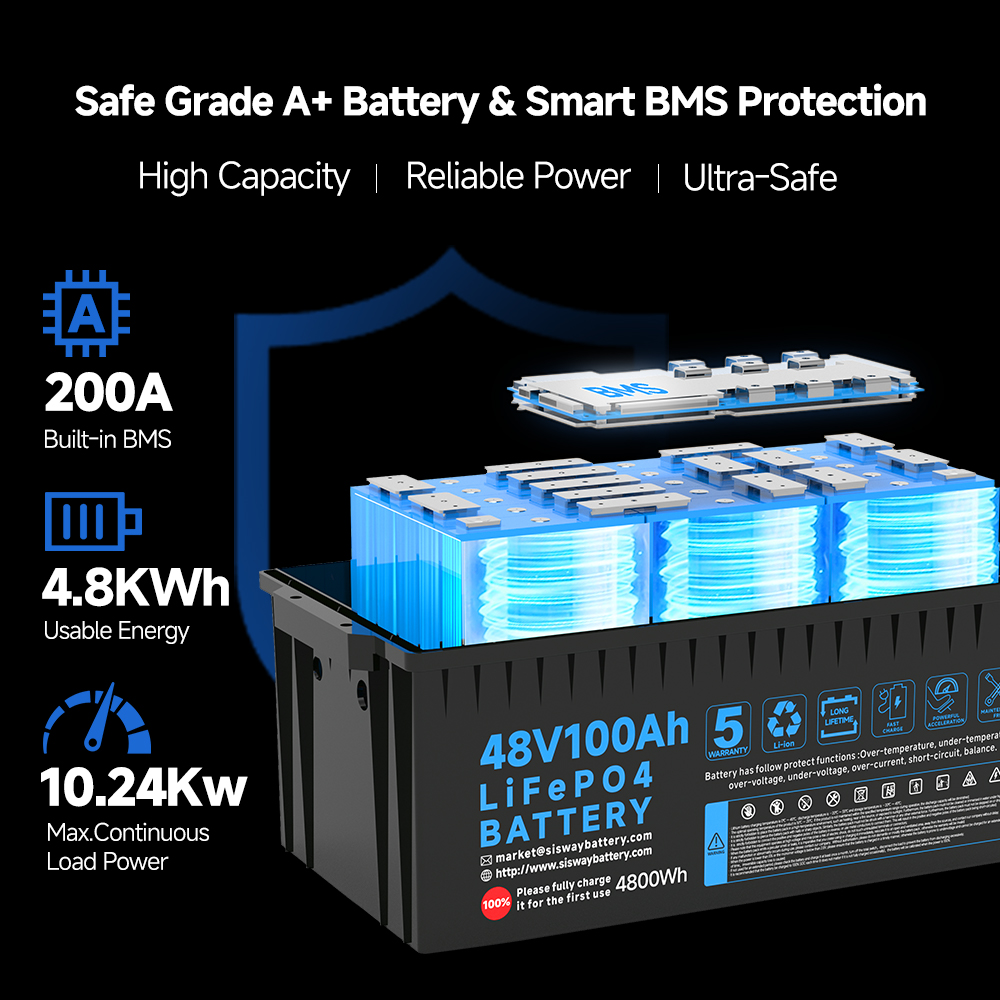
- 48V 100Ah — a 48V golf cart battery with a nominal capacity of 100Ah, designed as a drop-in replacement in a classic lead-acid case.
- 51.2V 100Ah — a 51.2V golf cart battery that belongs to the 48V golf cart battery category and is compatible with 48V systems.
- 72V 105Ah — a 72V golf cart battery with a nominal voltage of 73.6V and an energy capacity of 7,728Wh, suited for higher-power carts.
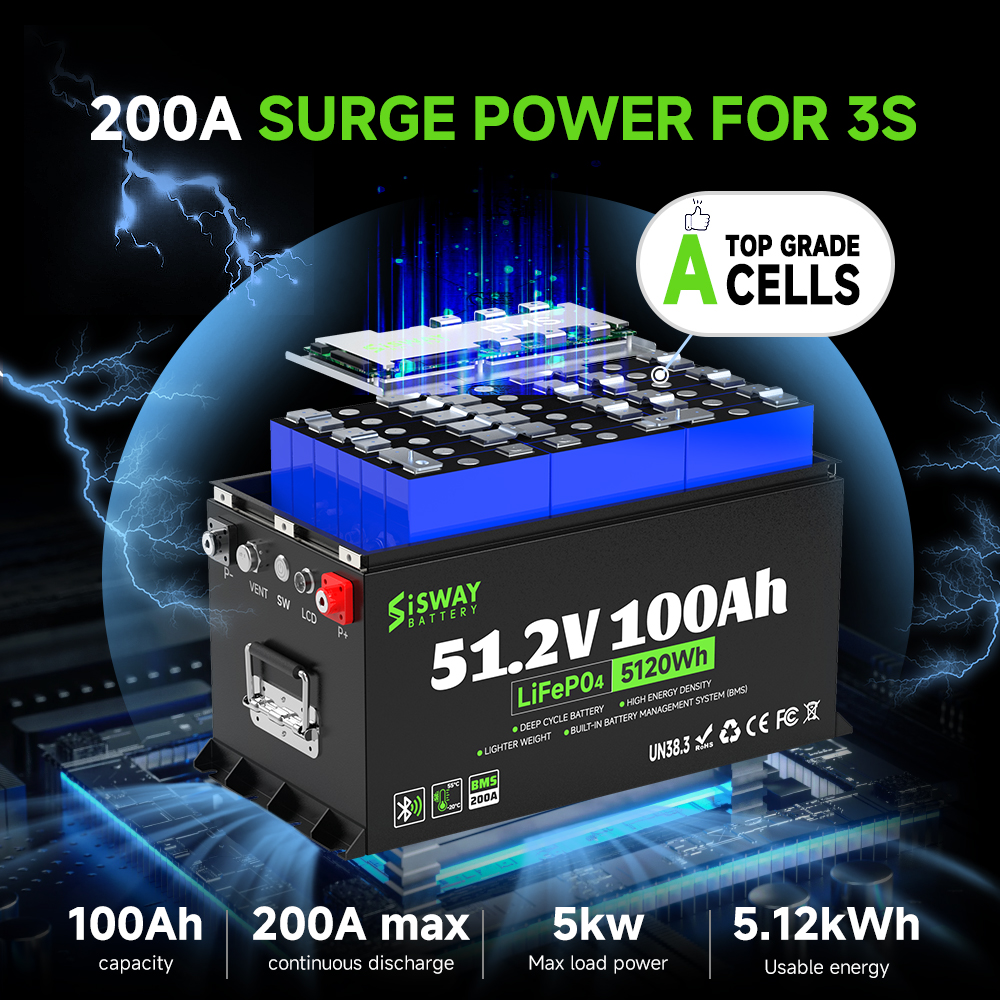
Inside each pack, the battery management system (BMS) is the component that most directly affects safety and lifespan. A good BMS protects cells against over-charge, over-discharge, over-temperature, over-current, and short circuits, while balancing cell voltages to maximize cycle life. Sisway lithium golf cart batteries use a smart 200A BMS. The 72V 105Ah model supports a maximum continuous discharge current of 200A and a peak discharge current of 400A for 10 seconds, which is sufficient for demanding acceleration and hill-climbing applications.
How to Evaluate Golf Cart Batteries in Six Steps
For buyers still in the research phase, a structured checklist is more reliable than a single brand recommendation. The following six steps apply to almost any golf cart battery purchase.
Step 1: Confirm the cart's existing system voltage. Check whether the cart operates on a 48V or 72V system. A 48v golf cart battery is not directly interchangeable with a 72v golf cart battery; the motor controller and charger must match the system voltage.
Step 2: Measure the battery compartment. Every lithium golf cart battery has a specific case size. The Sisway 48V 100Ah model measures 20.55" × 10.55" × 8.74" and uses a plastic case. The 51.2V 100Ah metal-case model measures 625 × 505 × 360 mm. The 72V 105Ah model measures 558 × 333 × 300 mm. Confirm available space before deciding which model can fit.
Step 3: Compare cycle life and total cost of ownership. A lithium battery costs more upfront than lead-acid but offers a much lower cost per cycle. LiFePO₄ batteries typically deliver 2,500 to 9,000 cycles at 80% DoD, whereas flooded lead-acid batteries deliver roughly 300 to 500 cycles at 50% DoD. Over the life of the cart, lithium generally requires fewer replacements.
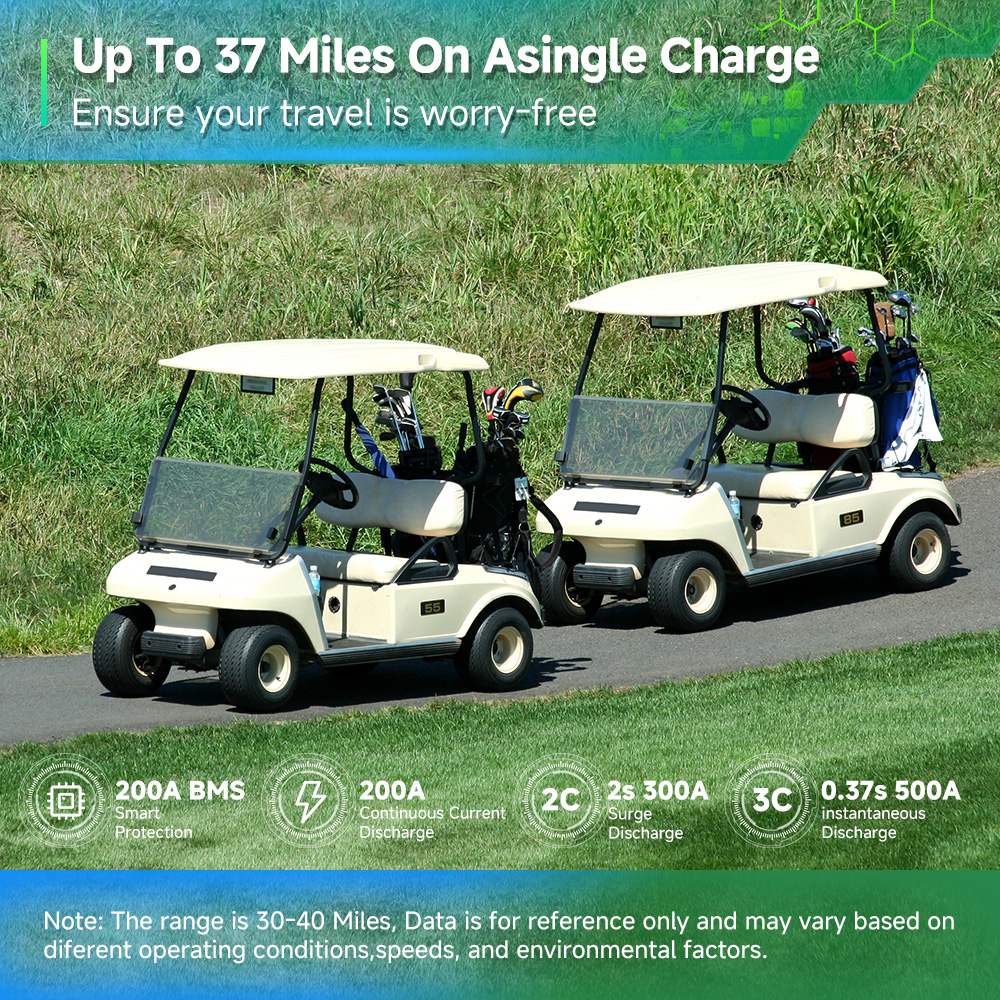
Step 4: Inspect the BMS and protection features. A high continuous discharge rating indicates the battery can maintain performance under load. The 200A BMS used across Sisway's models supports continuous discharge currents up to 200A, with peak capabilities varying by model. Check that over-charge, over-discharge, over-temperature, over-current, and short-circuit protection are all covered, plus cell balancing and low-temperature charge cutoff.
Step 5: Verify the manufacturer's credentials. Look for objective production evidence. Shenzhen Shiwei New Energy Co., Ltd. holds ISO9001 certification, over 100 global certifications including CE, UL, UN38.3, and MSDS, and multiple patents. These certifications support safe transport and reliable electrical performance. A factory with 20,000 square meters, an R&D team of 25 engineers, and an annual capacity of 90,000 units provides measurable evidence of production scale.
Step 6: Confirm warranty and post-sale support. Warranty coverage signals how much the manufacturer trusts its own product. Sisway Battery backs the 48V 100Ah and 72V 105Ah models with a 5-year warranty, and the 51.2V 100Ah model with a 3-year warranty. For buyers in North America, the company also operates a US-based warehouse to streamline repairs and replacements.
Common Use Cases for Lithium Golf Cart Batteries
Lithium golf cart batteries are used beyond private resort carts. Based on Sisway Battery's application documentation, the main project types are golf courses, golf cart dealers and resellers, and golf cart refurbishment and customization businesses.
Golf courses and golf venue equipment renovation projects require deep-cycle capability and dependable operation across many charge cycles. The working condition for these installations is, according to the product application notes, a 4000+ deep-cycle operation with an active BMS protection system. Because course carts cycle through multiple rounds each day, the battery must deliver consistent power at varying states of charge without premature shutdown.
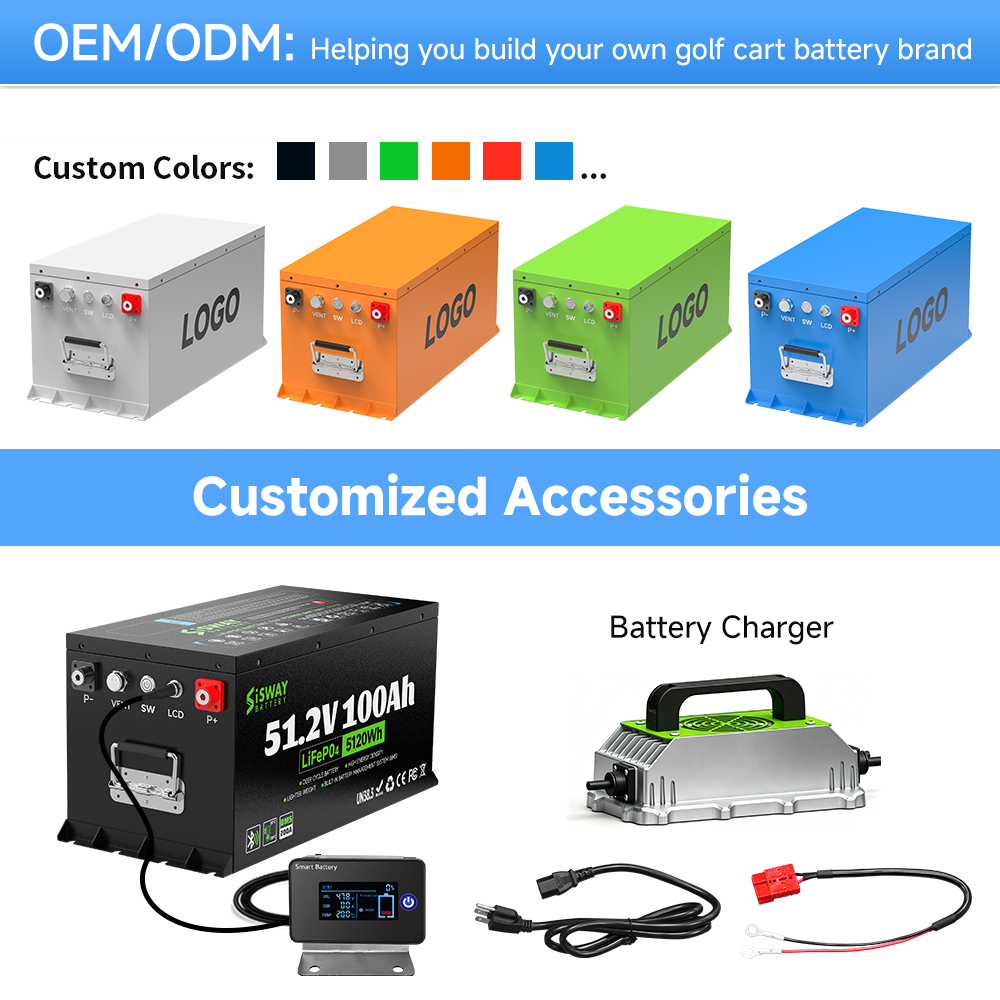
Dealers and resellers benefit from complete kits that reduce installation friction. Sisway golf cart battery packages include a display, charger, battery cable, wiring harness, and user manual, which simplifies the replacement process. The charging temperature range for these packs is 0°C to 45°C, and the discharge temperature range is -20°C to 55°C, covering typical outdoor course conditions.
Refurbishment and customization shops, meanwhile, depend on compatibility. The 51.2V 100Ah model was specifically designed as a 48V-compatible lithium replacement, making it a straightforward upgrade for older carts being rebuilt for resale.
Golf Cart Battery Comparison: 48V 100Ah vs. 51.2V 100Ah vs. 72V 105Ah
| Specification | 48V 100Ah | 51.2V 100Ah | 72V 105Ah |
|---|---|---|---|
| Nominal Voltage | 48V | 51.2V | 73.6V |
| Nominal Capacity | 100Ah | 100Ah | 105Ah |
| Battery Energy | 4,800Wh | 5,120Wh | 7,728Wh |
| BMS | Smart 200A | 200A | Smart 200A |
| Max Continuous Discharge | 200A | 200A | 200A |
| Peak Discharge Current | 300A (2 sec) | 300A (3 sec) | 400A (10 sec) |
| Max Output / Load Power | 9.6kW | 5,120W continuous | 14.72kW |
| Cycle Life | 4,000+ cycles | ≥4,000 cycles | 4,000+ cycles @100% DoD; 6,000+ cycles @80% DoD |
| Case Material | Plastic | Metal | Metal |
| Dimensions | 20.55" × 10.55" × 8.74" | 625 × 505 × 360 mm | 558 × 333 × 300 mm |
| Warranty | 5 years | 3 years | 5 years |
This comparison shows why model selection depends on the cart platform. Standard 48V carts that need a lightweight drop-in replacement fit best with the 48V 100Ah model. A 48V cart that needs more energy per charge can use the 51.2V 100Ah model, which provides more energy per charge while staying within the 48V system family. High-power carts and utility vehicles that demand the greatest acceleration reserve are better served by the 72V 105Ah model, which delivers considerably more energy than the 48V 100Ah.
Frequently Asked Questions About Golf Cart Battery Manufacturers
What certifications should golf cart battery manufacturers have?
Golf cart battery manufacturers should hold certifications that cover both electrical safety and transport safety. UN 38.3 is required for the safe global transport of lithium batteries. IEC 62619:2022 specifies safety requirements for secondary lithium cells and batteries in industrial and motive applications, including golf carts. UL 2580 is the corresponding North American EV battery standard covering electrical, mechanical, and environmental testing. Shenzhen Shiwei New Energy Co., Ltd. holds ISO9001 certification, over 100 global certifications including CE, UL, UN38.3, and MSDS, and multiple patents.
What should I look for in a golf cart battery manufacturer's production capability?
Production capability should be evaluated through measurable facts: factory area, staffing, R&D headcount, and annual output. Sisway Battery operates a 20,000-square-meter facility with approximately 150 employees, including 25 R&D engineers, and an annual production capacity of 90,000 units. Export data is another useful indicator: Sisway's export business accounts for 50% of total sales, with the USA as a major market.
Which golf cart battery voltages do manufacturers offer?
Most lithium golf cart battery manufacturers offer 48V and 72V options, and many also supply 51.2V models designed for 48V systems. Sisway Battery's main products are the 48V 100Ah, 51.2V 100Ah, and 72V 105Ah models. Buyers must match the battery voltage to the cart's existing system and verify compartment dimensions before ordering.
Are lithium golf cart batteries worth the higher upfront cost?
In terms of cost per cycle, lithium is generally the better investment. LiFePO₄ batteries typically offer 2,500 to 9,000 cycles at 80% depth of discharge, while flooded lead-acid batteries deliver approximately 300 to 500 cycles at 50% DoD. Longer service life, lower maintenance, and higher usable capacity explain why lithium-ion batteries held approximately 47% of the global golf cart battery market by revenue in 2024.
How can I request a quote or sample from a golf cart battery manufacturer?
Most manufacturers accept direct inquiries by email, phone, and WhatsApp. To request golf cart battery specifications, sample availability, or a quote, contact Sisway Battery at inquiry@siswaybattery.com or +86 137 1478 6322. The company also publishes a product brochure that can be downloaded for offline review.
Next Steps for Golf Cart Battery Buyers
The golf cart battery market is moving toward lithium for clear, measurable reasons. LiFePO₄ chemistry delivers thousands of cycles where lead-acid delivers hundreds, and lithium-ion batteries now account for nearly half of the global golf cart battery market by revenue. For buyers in the awareness and research stage, the most useful next step is to gather specifications from manufacturers and check them against your cart's actual requirements.
Start with the three data points that decide the purchase: the cart's system voltage, the battery compartment dimensions, and the cycle-life requirements of your usage pattern. Then compare suppliers on BMS specifications, certifications, production capability, warranty, and after-sales support. This framework works whether you are replacing batteries for a single cart or evaluating an entire fleet.
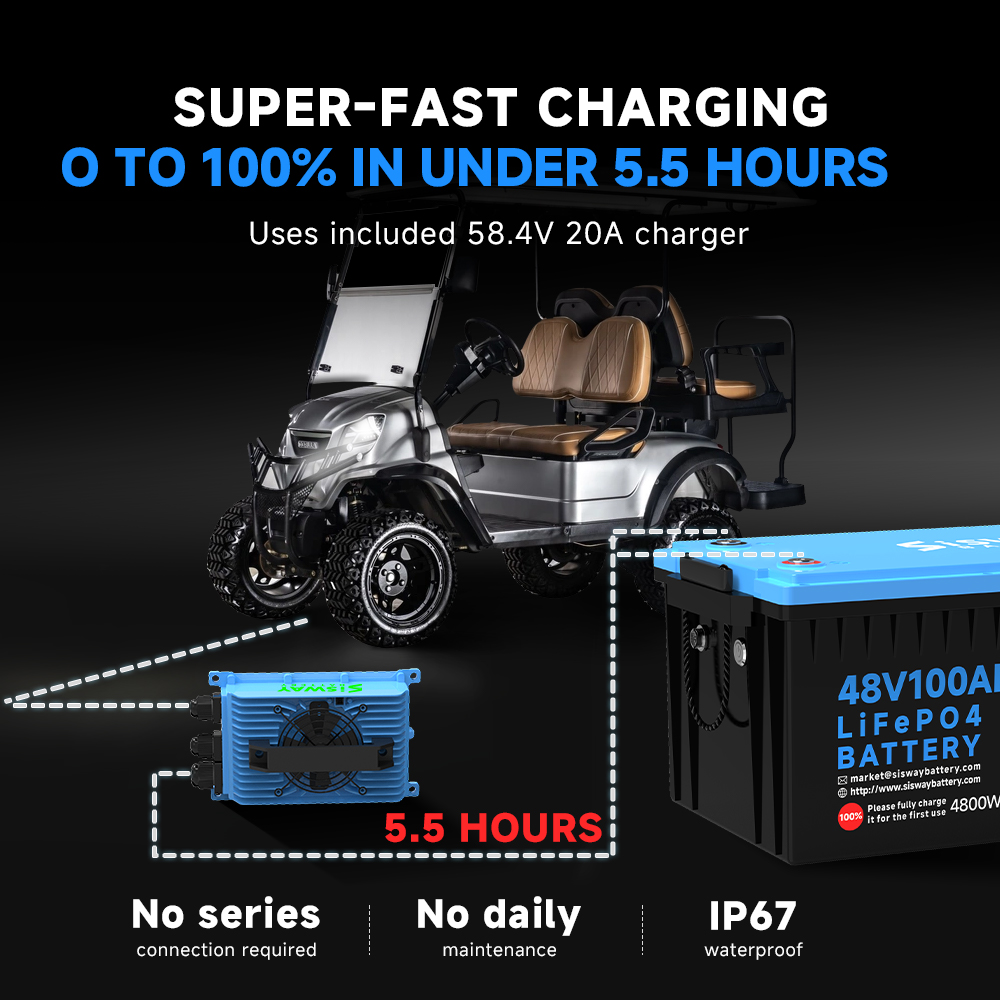
If you are planning a golf cart battery replacement, the next step is straightforward: confirm your cart's voltage, measure the compartment, and request a specification sheet from a manufacturer that can match your needs. You can download the Sisway Battery brochure to review the full golf cart battery product range: Sisway Battery Brochure (PDF).
Have Questions or Need More Details?
Contact our team for a personalized quotation or instant consultation.
Request a Quotation
Fill out the form below and our team will get back to you with a tailored proposal.
WhatsApp Direct Chat
Prefer to chat in real-time? Message us on WhatsApp for instant assistance & quick answers.
- Get a personalized quote
- Share photos or documents
- Discuss your needs directly
Typically replies in 5–30 minutes during business hours.