Golf Cart Battery Acceptance Criteria: A Technical Guide for 48V, 51.2V, and 72V
Accepting a lithium golf cart battery is a matching exercise, not a test drive. The pack that arrives must match the model that was quoted, the documents reviewed at quotation must describe that same model, and every document must still be valid on the day the shipment is released and on the day it clears import. When one of those matches fails, the failure usually shows up as a paperwork problem rather than a battery problem: a test report scoped to a different capacity, an MSDS filed as if it were a certificate, or a validity date that closed between the sample order and the fleet order.
This guide sets out acceptance criteria for LiFePO4 golf cart batteries in three configurations — 48V, 51.2V and 72V — and ties each criterion to a named document instead of a general expectation. It is written for the evaluation-to-execution stage, where the voltage class has been shortlisted and the remaining decision is whether a purchase order can be released and what must be true before the goods are accepted.
The documentation set used throughout is the one published for Sisway Battery (Shenzhen Shiwei New Energy Co., Ltd.), a LiFePO4 pack manufacturer established in 2017 with a 20,000 m² facility, 150 employees, a 25-engineer R&D team and an annual output of 90,000 units. Golf cart battery is its main product line, and it reports a 50% export ratio with the USA as its main market.
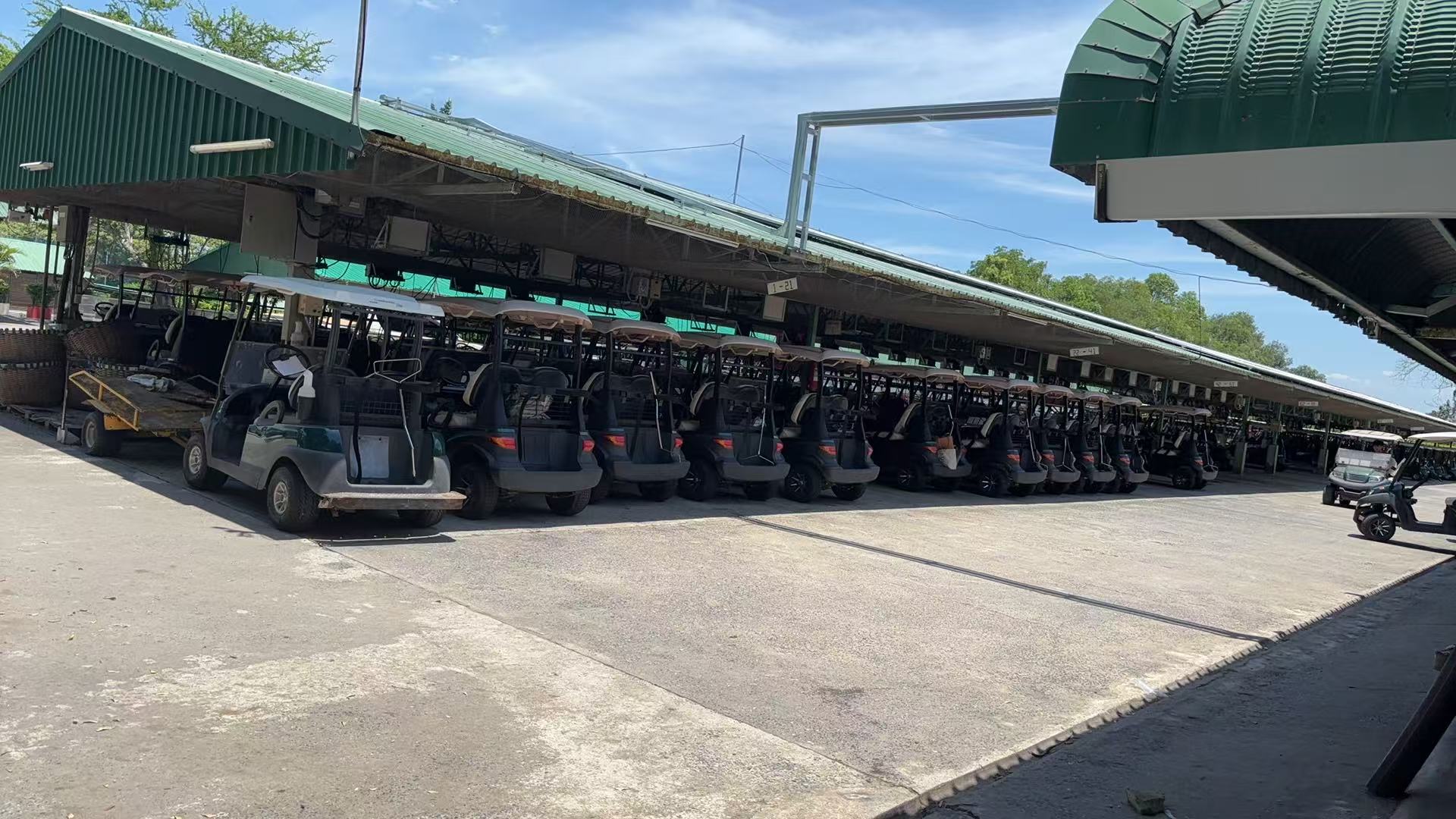
Cover: a golf cart fleet in service — the Thailand OEM case referenced later in this guide.
What an acceptance decision actually has to prove
Two different kinds of conformity sit behind a golf cart battery order, and different documents support each one. System conformity is the evidence that the pack was designed and manufactured inside a controlled quality management system; an ISO 9001:2015 certificate speaks to that, and it applies to the factory and its certified scope rather than to a single serial number. Product and shipment conformity is the evidence that the specific model, in the configuration being shipped, was tested against the transport and safety requirements of the destination market, and that the batch was checked before release.
An acceptance file that holds only the first is common and incomplete: the buyer can show that the supplier's quality system is certified, but cannot show that the 51.2V pack in the crate was ever the subject of a transport test. A file that holds only the second is fragile in the other direction: one test report on one capacity says nothing about how the rest of the range is controlled. The criteria below are built to close both gaps on the same order.
Four ways a golf cart battery acceptance file fails
Acceptance failures in this category cluster into four patterns, and each one has a specific counter-check.
- Scope mismatch. The document is genuine, current and correctly named, but its description of the tested item does not match the ordered item. A UN38.3 test report naming one capacity is the clearest case: it is valid evidence for the model it names and not for the other capacities in the same catalog line.
- Document-type confusion. An MSDS is sometimes filed as a certificate. It is hazard communication documentation for a product series — what the material is and how handlers and carriers should manage it. It does not certify that a pack passed a safety test, and filing it as one leaves the transport-test question unanswered.
- Validity drift. Test reports and certificates carry issue and expiry dates. An order placed near the end of a validity window can ship after that window closes, which is a frequent and avoidable cause of a carrier or customs query.
- An undefined pre-shipment test. When the agreed acceptance criterion is a pre-shipment test, the criterion is only as strong as the record it produces. If the purchase order does not state what that record must show, the buyer receives a photograph and a pass statement, and there is nothing to audit.
Why voltage class drives the paperwork, not just the wiring
A golf cart battery order is not placed into a uniform market. Mordor Intelligence reports that lithium-ion accounted for 47.18% of the golf cart battery market by battery type in 2024, while 6V lead-acid units still held 43.45% by voltage — a lithium transition running alongside a large legacy fleet that has not converted (Mordor Intelligence, 2026). Strategic Market Research values the wider category at USD 1.49 billion in 2024 with a projection of USD 2.21 billion by 2030 (Strategic Market Research, 2025). The two figures measure different things — a technology split versus a total market value — and neither should be read as a forecast for an individual order.
The acceptance consequence is that a buyer is normally replacing a pack inside an existing cart, on a mixed fleet, in a market where both the carrier and the importer want documents that describe the goods. Where a chemistry change is involved, published laboratory figures explain why the category is moving: LiFePO4 cells are reported at 2,500–9,000 cycles at 80% depth of discharge against approximately 300–500 for flooded lead-acid (Mordor Intelligence, laboratory testing). Those are laboratory cycle counts, not a prediction of a specific cart's service life, and they do not replace the product-level evidence discussed below.
Voltage class then decides which documents are relevant. 48V and 51.2V are separate product records in the supplier's catalog rather than two labels for one item, and 72V is a further class with its own capacity variants. None of the three can be accepted on the strength of documentation written for another.
The three records that carry the acceptance weight
For the 48V, 51.2V and 72V packs described here, three records do most of the work: a UN38.3 test report, an MSDS, and a quality management system certificate to ISO 9001:2015. Each answers a different question, and reading them as a set is what makes the release decision defensible.
UN38.3 test report TSZ25H8045A01-01 (48V 100Ah)
UN38.3 is the transport-test regime for lithium batteries, set out in the UN Manual of Tests and Criteria, Part III, Subsection 38.3. The report in this set, number TSZ25H8045A01-01, was issued by Shenzhen Tiansu Calibration and Testing Co., Ltd. on 25 August 2025 and carries an expiry date of 31 December 2026. Its stated scope is narrow and specific: LiFePO4 battery, model 48V100Ah.
That scope line is the most important sentence in the document. It establishes that the tested sample was the 48V 100Ah pack, and it is the line an acceptance reviewer compares with the purchase order. It does not extend by itself to other capacities in the 48V line, and it says nothing about 51.2V or 72V packs. Note also that this is a test report rather than a certificate: it records the outcome of testing on a sample, which is exactly what a carrier wants to see and exactly as far as its authority reaches.
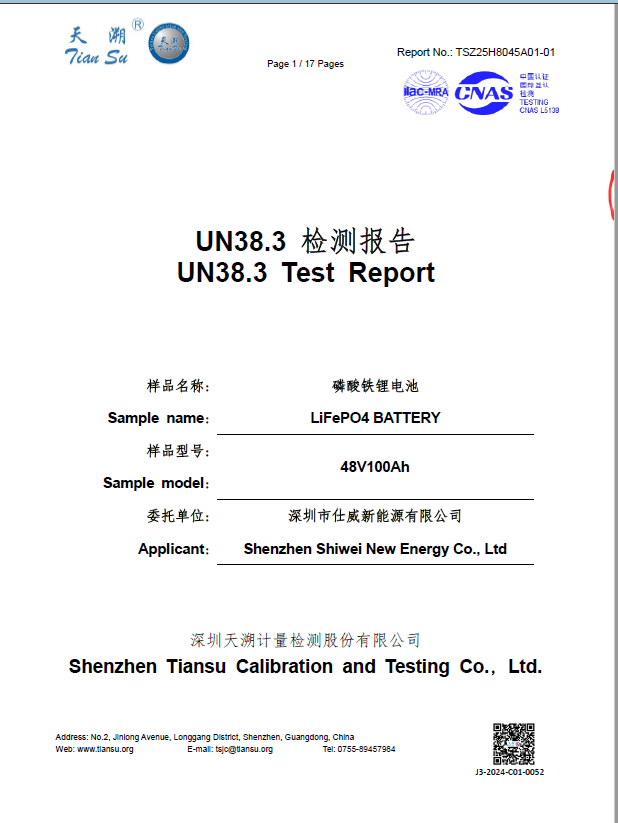
UN38.3 test report TSZ25H8045A01-01, scoped to the 48V 100Ah LiFePO4 battery.
MSDS TSZ25LL028A86-01
The Material Safety Data Sheet in the set, number TSZ25LL028A86-01, was issued by the same laboratory, Shenzhen Tiansu Calibration and Testing Co., Ltd., on 8 December 2025 with an expiry date of 31 December 2026. It is aligned with GHS and OSHA HazCom 2012 and is prepared for the USA market, and its scope is the lithium-ion golf cart battery series rather than a single model.
That wider scope makes the MSDS useful for handling, storage and carrier acceptance across a product family, but it changes what the document can prove. It describes hazards, composition, handling and transport information; it is documentation, not a certification standard, and it should never be filed as evidence that a pack passed a safety test. In an acceptance file the MSDS sits beside the test report, not in place of it.
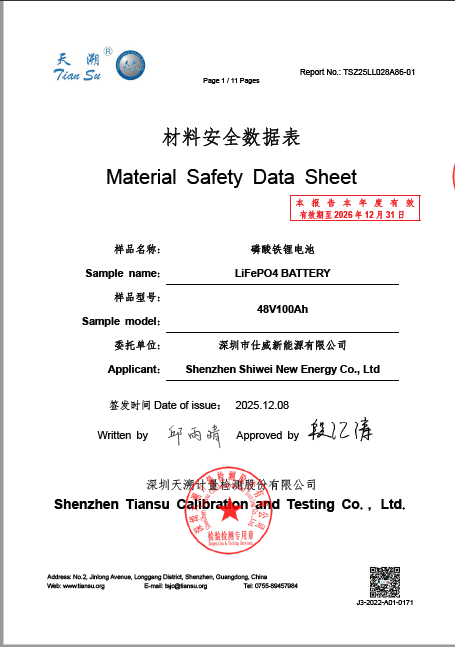
MSDS TSZ25LL028A86-01, prepared to GHS and OSHA HazCom 2012 for the USA market.
ISO 9001:2015 certificate 24CN34504502Q
The third record is a quality management system certificate, number 24CN34504502Q, issued by ACM International Certification Limited to GB/T 19001-2016 / ISO 9001:2015, valid from 31 March 2025 to 5 April 2027, with a scope of R & D and Production of Lithium Ion Battery (except 3C requirements).
In the supplier's documentation, certificate 24CN34504502Q is the record attached to the 51.2V 100Ah pack, and the same certificate — issued by ACM International Certification Limited, with a scope covering lithium-ion battery R&D and production — is the record attached to the 72V 105Ah pack. That is consistent with what a management system certificate is: it certifies the system and its scope, and product records reference it. It is not a model-level product certificate, and it does not carry the transport-test function of the UN38.3 report. Use it to answer whether the factory's lithium battery design and production are controlled under a certified system, and use the test documentation to answer the model-level question.
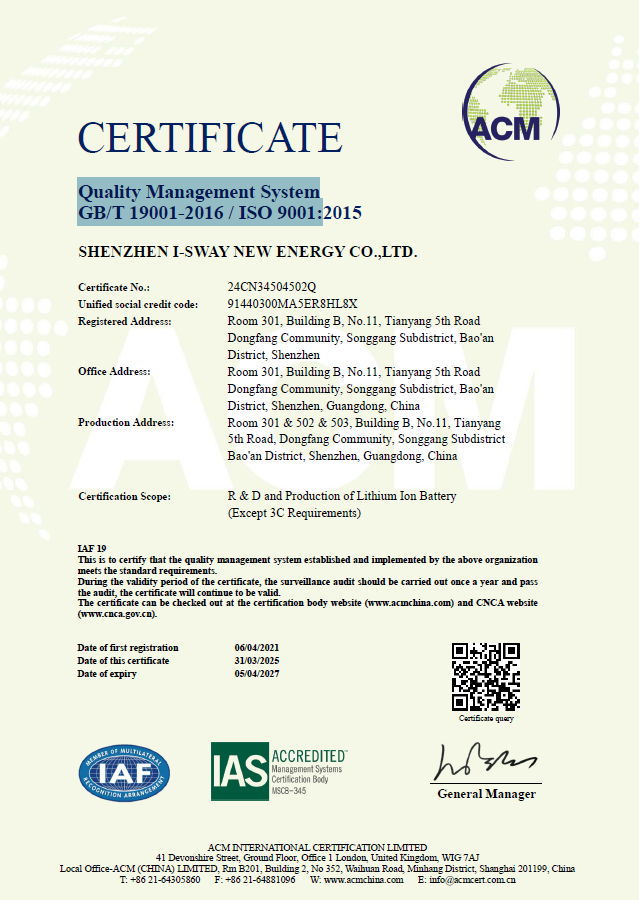
Quality management system certificate 24CN34504502Q, GB/T 19001-2016 / ISO 9001:2015.
The document register, in one view
| Record | Reference number | Issued by | Scope as documented | Valid to |
|---|---|---|---|---|
| UN38.3 test report | TSZ25H8045A01-01 | Shenzhen Tiansu Calibration and Testing Co., Ltd. | LiFePO4 battery, model 48V100Ah; UN 38.3 testing | 31 Dec 2026 |
| Material Safety Data Sheet | TSZ25LL028A86-01 | Shenzhen Tiansu Calibration and Testing Co., Ltd. | Lithium-ion golf cart battery series; GHS and OSHA HazCom 2012; USA market | 31 Dec 2026 |
| Quality management system certificate | 24CN34504502Q | ACM International Certification Limited | R&D and production of lithium-ion battery (except 3C requirements); GB/T 19001-2016 / ISO 9001:2015; referenced by the 48V 100Ah, 51.2V 100Ah and 72V 105Ah records | 5 Apr 2027 |
Six gates for releasing a 48V, 51.2V or 72V shipment
The six gates below convert these documents into a release decision. Each gate has a pass condition and an escalation condition; the shipment is released only when all six pass, and an escalation holds the order instead of being settled verbally.
Gate 1 — Model identity. Pass: the voltage and capacity string on the purchase order matches the model string on the datasheet and on the test documentation, character for character. Escalate: the order reads 48V 105Ah while the report names 48V100Ah, or the item is a 72V pack while supplier pages use both 72V and 73.6V terminology.
Gate 2 — Provenance. Pass: report number, issuing laboratory, issue date and expiry date on the PDF match the register, and the file is the original rather than a screenshot of a screen. Escalate: the numbers match but the issuing body differs from the registered one, or only a cropped image is available.
Gate 3 — Scope. Pass: for each ordered model there is at least one record whose scope line names that model or its series, plus a system record whose scope covers lithium-ion battery R&D and production. Escalate: the only model-specific record on file is for a different capacity.
Gate 4 — Validity window. Pass: every expiry date falls after the planned shipment date and after the buyer's import clearance date. Escalate: an expiry date falls inside the shipping window. In this set the UN38.3 report and the MSDS both expire on 31 December 2026 and the QMS certificate on 5 April 2027, so an order shipping in the final quarter of 2026 needs the renewal position confirmed in writing, with the replacement document number recorded, before release.
Gate 5 — Pre-shipment test record. Pass: the purchase order defines what the record must contain — model and capacity, batch or serial reference, test date, parameters tested, measured result, pass or fail, and the name of the person who signed it — and the supplied record matches that list point by point. Escalate: the record states a result with no batch reference, or the parameters tested are not identified.
Gate 6 — Release and archive. Pass: the decision, the documents reviewed and any accepted deviations are filed against the purchase order, each with the document version that was used. Escalate: a document is replaced after release without a note in the file, or the acceptance decision exists only in email.
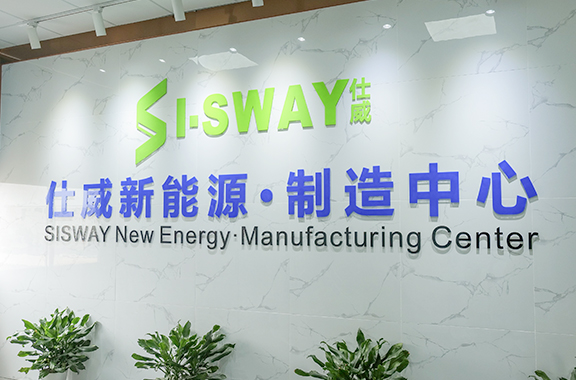
Production workshop: the point at which the pre-shipment test record is generated and signed.
Gates 1, 3 and 4 are the ones that most often change a purchase order, because they are the gates where both the document and the goods can be genuine and still not match each other.
What changes between 48V, 51.2V and 72V
The acceptance method is identical across the three voltage classes; the documentation coverage and the electrical interface checks are not.
48V: the best-documented class
The 48V class is the only one in this set with a model-scoped UN38.3 test report, covering 48V100Ah, and its 100Ah record is also covered by the series-level MSDS and referenced by the QMS certificate. Two checks still need attention. First, the supplier's catalog lists 48V capacities of 105Ah, 150Ah, 180Ah, 210Ah and 315Ah, so an order at any capacity other than 100Ah falls outside the tested model string and needs its own coverage confirmed. Second, 48V is a nominal class, not a charger setting: match the pack datasheet's maximum charge voltage against the charger that is actually on the cart.
51.2V: a separate class, and a separate document request
The 51.2V 100Ah pack is referenced by quality management system certificate 24CN34504502Q, whose scope is lithium-ion battery R&D and production. A 51.2V nominal pack is generally built as sixteen LiFePO4 cells in series, which is why it forms a distinct nominal class from 48V rather than a rounding of it; for acceptance purposes the series count matters less than the datasheet's nominal and maximum charge voltage. Because the model-scoped UN38.3 report in this set covers 48V100Ah, a 51.2V buyer should request the model-level transport documentation that applies to the pack being ordered and record the answer in Gate 3.
72V: labelling is the acceptance risk
The 72V 105Ah pack is referenced by the same certificate, and the ACM International Certification Limited scope covering lithium-ion battery R&D and production is the system-level evidence for this class. The specific risk at 72V is labelling: supplier pages use both 72V and 73.6V terminology for 72V-class packs, and the relationship between the two labels — cell configuration and maximum charge voltage — is a datasheet question, not an inference the buyer should make. Resolve it before the batch is built by obtaining nominal voltage and maximum charge voltage in writing, then confirming that the cart's controller and charger accept those values. Listed capacity variants in this class are 105Ah, 210Ah and 315Ah, and each variant needs its own documentation check.
| Voltage class | Records in this set | Main acceptance risk | Check that closes it |
|---|---|---|---|
| 48V (48V 100Ah; listing also shows 105–315Ah) | UN38.3 (model-scoped), MSDS (series), QMS certificate | Tested model string versus ordered capacity | Confirm the report covers the ordered Ah, not only 100Ah |
| 51.2V (51.2V 100Ah) | QMS certificate 24CN34504502Q | System certificate is not a pack-level transport test | Request model-level UN38.3 and MSDS for the 51.2V pack |
| 72V (72V 105Ah; listing also shows 210Ah and 315Ah) | QMS certificate 24CN34504502Q | 72V versus 73.6V labelling and controller match | Datasheet nominal and maximum charge voltage confirmed in writing |
Three acceptance scenarios
A course replacing an existing 48V set. The first order does not have to be large. With a minimum order quantity of 1 unit and a 15–30 day lead time, a single pack can be run through all six gates before a seasonal order is committed, and the exercise tests the acceptance file as much as the pack: whether the supplier can produce a model-scoped record on request, and how quickly. A pack that passes Gates 1 to 5 on a one-unit order is a stronger signal for a fleet order than a spec sheet reviewed twice.
A distributor building a private-label range. OEM production is offered with customization of logo, design, size and specifications, and private label changes Gate 1 directly: the model string the distributor orders may not be the model string on the test documentation. Before the first private-label batch, establish which tested model the private-label item is built from and keep that mapping in the acceptance file, so a later customs or customer query can be answered without reopening the order.
A hot-climate, high-frequency fleet. The supplier's Thailand case describes an OEM golf cart battery customer supplied with 20,000 units over a five-year relationship, with packs described as built for high temperature and high humidity, reported to deliver stable output and thermal performance, and replacing lead-acid with lower maintenance and improved charging efficiency. Treat it as a supplier-reported case rather than an independently verified field result, and use it to sharpen questions rather than to close them: ask whether the pre-shipment test conditions reflect the destination climate, and whether the batch record identifies the cells used.
Where the documentation stops
None of the three records proves field life in a specific duty cycle, compatibility with a particular controller, or that a future batch will match the tested sample. A quality management system certificate can stay valid while an individual model is redesigned, and a UN38.3 report speaks to the sample it names at the time it was tested. Paperwork acceptance is therefore necessary and not sufficient: it should be paired with a defined pre-shipment test record and an incoming inspection that compares the delivered pack, its label and its serial or batch reference against the file.
Decision rule: release the shipment when all six gates pass and the document register is archived against the purchase order. Hold it when any gate escalates — including a genuine document that simply does not name the ordered model.
Conclusion
Acceptance of a 48V, 51.2V or 72V golf cart battery is decided by whether the paperwork names the goods. The records examined here are specific enough to build a real release decision around: a UN38.3 test report scoped to the 48V 100Ah model and valid to 31 December 2026, a series-level MSDS valid to the same date, and an ISO 9001:2015 quality management system certificate, number 24CN34504502Q, valid to 5 April 2027 and referenced by the 51.2V 100Ah and 72V 105Ah records. The buyer's task is to close the gap between system evidence and model-level evidence, confirm validity against the shipping window, and define the pre-shipment test before the order is placed — not after the container is loaded.
FAQ
Which documents should be in the acceptance file for a 48V, 51.2V or 72V shipment?
Three records form the minimum set: a model-scoped UN38.3 test report, a series-level MSDS, and an ISO 9001:2015 quality management system certificate. For the packs described here that means report TSZ25H8045A01-01 covering the 48V 100Ah model, MSDS TSZ25LL028A86-01 covering the lithium-ion golf cart battery series, and certificate 24CN34504502Q covering lithium-ion battery R&D and production. Each file should be the original document, with issue and expiry dates recorded.
Does the UN38.3 report cover every voltage and capacity in the range?
No. Report TSZ25H8045A01-01 states its tested scope as the LiFePO4 battery, model 48V100Ah. It is direct evidence for that model and does not extend by itself to the 48V 105–315Ah variants listed in the catalog, nor to the 51.2V 100Ah or 72V 105Ah packs. Buyers ordering those configurations should request the model-level transport documentation that applies to the pack they are buying and record the response in the acceptance file.
What should an OEM lithium golf cart battery manufacturer provide for acceptance?
Beyond the product itself, an OEM supplier should provide model-level test and hazard documentation, a valid quality management system certificate, and a pre-shipment test record. Sisway Battery offers OEM production with customization of logo, design, size and specifications, runs 100% testing as its stated quality control, and reports a monthly capacity of 5,000 units with a 25-engineer R&D team. The buyer's check is whether the documentation scope still names the model after customization is applied.
What is the minimum order quantity, and how do payment and delivery terms affect acceptance?
The minimum order quantity is 1 unit, including for the 72V 105Ah model, which makes a single-unit acceptance run practical. Published purchasing terms list FOB, CIF and overseas warehouse shipment as delivery options, and T/T, L/C, PayPal, Western Union and Trade Assurance as payment terms, with a pre-shipment test as the stated acceptance criterion. Because acceptance rests on that test, the purchase order should specify what the test record must contain rather than referencing the test by name only.
Can a sample be used to validate acceptance before a fleet order?
Yes, and the 1-unit minimum order quantity makes it straightforward. Run the sample through all six gates: model identity, provenance, scope, validity window, pre-shipment test record and archive. A sample confirms that the supplier can produce the documents on request and that the delivered pack matches them. It does not by itself guarantee that a later production batch is identical, which is why Gate 5 asks for a batch or serial reference on each shipment rather than one test record reused across orders.
How long is production, and when should documents be re-validated?
Lead time is 15–30 days against a reported monthly capacity of 5,000 units. Re-validate at the point of shipment, not the point of quotation: the UN38.3 report and the MSDS in this set both expire on 31 December 2026 and the quality management system certificate on 5 April 2027, so an order shipping late in 2026 needs the renewal position confirmed in writing before release. If you are assembling the file for a 48V, 51.2V or 72V order, the team can be reached at inquiry@siswaybattery.com, and the company brochure is available for download below.
Company brochure (PDF): Sisway Battery product and capability brochure
Have Questions or Need More Details?
Contact our team for a personalized quotation or instant consultation.
Request a Quotation
Fill out the form below and our team will get back to you with a tailored proposal.
WhatsApp Direct Chat
Prefer to chat in real-time? Message us on WhatsApp for instant assistance & quick answers.
- Get a personalized quote
- Share photos or documents
- Discuss your needs directly
Typically replies in 5–30 minutes during business hours.