How to Vet a Golf Cart Battery Supplier: Capacity, Certification, Delivery Proof
A golf cart battery supplier evaluation is only finished when three things can be checked rather than believed: the plant can produce your volume, the specific model carries the documents your market requires, and the delivery date is backed by a schedule you can enforce. This guide runs those three gates in order and shows the exact evidence to request at each one, using Shenzhen Shiwei New Energy Co., Ltd. — the LiFePO4 golf cart battery manufacturer behind the SISWAY Battery brand — as a worked example.
Most evaluations stall at the same point. A buyer collects a folder of certificates and capability statements, approves the supplier, and then discovers three weeks before shipment that the transport report covers a different model, that a document expires before the vessel sails, or that “pre-shipment test” was never defined in the purchase order. The fix is structural: treat every capability claim as a hypothesis with a named document behind it, and refuse to move a claim forward until that document has been read.
The three gates below follow the order in which a wrong answer becomes expensive. Capacity errors surface as late or partial shipments. Certification errors surface at the port, at customs, or in a customer's insurance review. Delivery errors surface as a missed season. Each gate has a different evidence standard and a different person who has to sign it off.
What “capability” has to mean before you approve a supplier
Supplier capability arrives in three evidence classes, and they are not interchangeable.
- Company-stated facts. Facility size, headcount, annual output, R&D staffing, markets served. These describe the supplier's position and are useful for shortlisting, but they are self-reported.
- Third-party documents. Management-system certificates, transport test reports, safety data sheets, laboratory reports. These are issued by an identifiable body, carry a number and a validity date, and can be checked with the issuer.
- Commercial commitments. Lead time, delivery terms, payment terms, inspection rights and acceptance criteria written into the purchase order. This is the only class that gives you a remedy when something goes wrong.
A capability-first evaluation uses a four-column discipline for every claim: what the supplier asserts, which document proves it, what you will check on that document, and what happens if the check fails. The last column matters most. A claim that cannot fail is not being evaluated — it is being accepted.
For lithium golf cart battery sourcing, the evaluation has to cover customization as well as production. An OEM program may require a specific enclosure size, a logo, a BMS configuration or a different capacity class, and each of those changes which documents apply. A stated OEM scope tells you the service exists; the sample build and the model-specific document set tell you whether it works for your cart. SISWAY Battery, for example, documents OEM production with customization of logo, design, size and specifications — a scope you can then test against a real sample order.
Why the gate order matters in the current golf cart battery market
Lithium-ion batteries accounted for 47.18% of the golf cart battery market in 2024, according to Mordor Intelligence, while 6V units still held 43.45% on the strength of the legacy lead-acid installed base. That split explains a pattern buyers meet constantly: a supplier with excellent documentation for its highest-volume 48V pack may hold thinner, older or model-limited documentation for a 36V or 72V pack.
The practical consequence is that you evaluate a model, not a brand. Ask for the document set attached to the exact voltage and capacity class you intend to order, then check the model designation printed on the report against the model designation on the quotation.
The second market feature is replacement demand. Buyers converting Club Car, EZGO or Yamaha carts from lead-acid to lithium are matching a pack to an existing controller, charger and battery bay, so fitment evidence matters as much as cell chemistry. A supplier that cannot state the nominal voltage definition, the charge voltage limit and the physical dimensions of a specific model has not yet given you enough to approve a golf cart battery replacement program, whatever its certificate folder contains.
Gate 1 — Capacity: what scale proves and what it does not
Capacity evidence answers one question: can this plant deliver your quantity inside your window without borrowing capacity from someone else's order? The numbers are the starting point, not the answer.
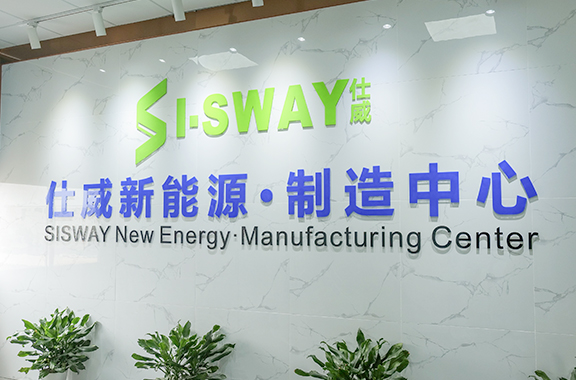
Shenzhen Shiwei New Energy Co., Ltd. was established in 2017 and reports a 20,000 m² facility, approximately 150 employees including 25 R&D engineers, an annual production capacity of 90,000 units, a stated monthly capacity of 5,000 units and a lead time of 15–30 days.
Read those figures as three different signals:
- Annual capacity describes the plant. 90,000 units a year is a statement about lines, floor space and workforce.
- Monthly capacity describes booking. A figure of 5,000 units per month is the number that governs whether your order fits into a given month, so ask what portion of that month is already committed before you accept a delivery date.
- The two figures are reported on different bases. Do not multiply one by twelve to “reconcile” them; ask the supplier which figure applies to slot allocation and put the answer in writing on the quotation.
R&D depth is the second capacity signal, and it is the one OEM buyers underuse. A team of 25 engineers inside a roughly 150-person company is the resource that determines whether a customization request becomes an engineering project or stays a sales promise. When you request a modified enclosure, a different terminal layout or a revised BMS setting, ask which engineer owns the change, what validation runs before the first shipment, and how the change is reflected in the model-level documents. Capacity without engineering hours produces samples that cannot be repeated at volume.
The third signal is the test regime. “100% test” is a claim about coverage, not a standard. Ask what is measured on every unit — open-circuit voltage, capacity check, insulation, BMS communication — what is recorded, and whether that record travels with the shipment. That answer is what makes a pre-shipment acceptance criterion enforceable later.
Gate 2 — Certification: model-level coverage, not a logo wall
Certification evidence has to be read in layers, because a management-system certificate, a transport test report and a safety data sheet prove three different things, and none of them proves product performance.
Layer 1 — Quality management system
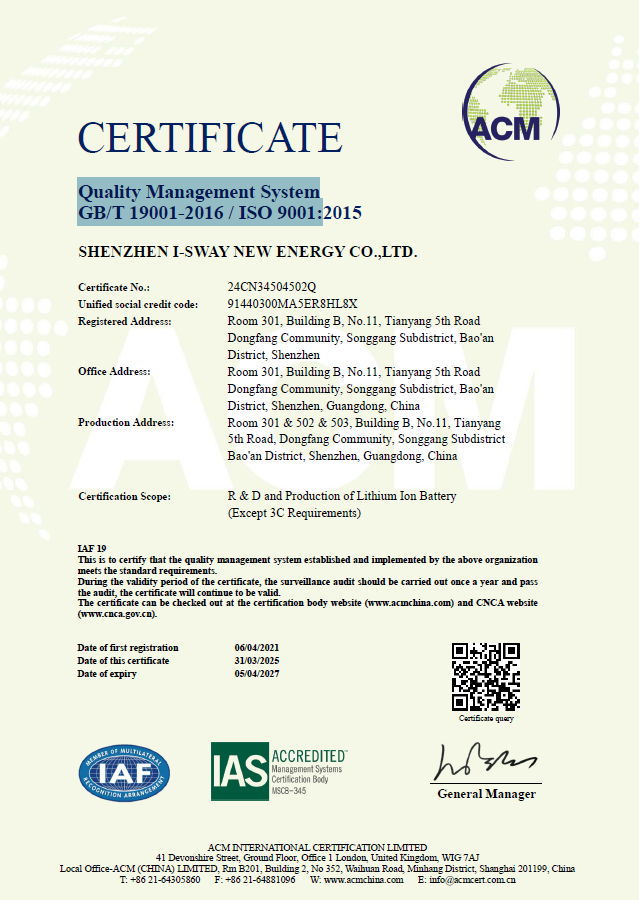
SISWAY Battery holds ISO 9001:2015 (GB/T 19001-2016) certificate number 24CN34504502Q, issued by ACM INTERNATIONAL CERTIFICATION LIMITED. The scope reads “R&D and Production of Lithium Ion Battery (Except 3C Requirements)”; the certificate was issued on 31 March 2025 and runs to 5 April 2027. Among the models associated with it are the 48V 100Ah, 51.2V 100Ah and 72V 105Ah packs — which is what allows a buyer to link the 48V and 51.2V products to a certified process rather than to a marketing page.
What it proves: the supplier operates a quality management system within a defined scope covering R&D and production. What it does not prove: capacity, cycle life, BMS behaviour, thermal performance, or market access in your country. A QMS certificate is a process claim, audited against process requirements rather than against a golf cart duty cycle.
Layer 2 — Transport testing
The UN38.3 test report on file is number TSZ25H8045A01-01, issued on 25 August 2025 by Shenzhen Tiansu Calibration and Testing Co., Ltd. Its scope is specific: LiFePO4 battery, model 48V100Ah, tested against UN 38.3 of the UN Manual of Tests and Criteria, Part III, Subsection 38.3. It is valid to 31 December 2026.
This is the document airlines, freight forwarders and many customs brokers actually ask for, and its limitation is built into its scope. It covers the 48V 100Ah model. It does not, on its face, cover a 72V pack, a 36V pack or a 51.2V pack. If your order is a 72V golf cart battery, request the corresponding report for that model before you book freight — not after.
Layer 3 — Hazard communication
The Material Safety Data Sheet is number TSZ25LL028A86-01, issued by Shenzhen Tiansu Calibration and Testing Co., Ltd., prepared to GHS and OSHA HazCom 2012 for the US market, covering the lithium-ion golf cart battery series, dated 8 December 2025 and valid to 31 December 2026.
An MSDS is a hazard-communication document, not a certification, and no supplier should describe itself as “MSDS certified”. Its buyer value is different: it is the document your safety officer, warehouse and carrier will read, and an outdated or generic sheet is a routine cause of receiving delays. Check that the sheet names your chemistry and application rather than a generic lithium-ion category.
Reading the wider certification claim
SISWAY Battery states that it holds more than 100 global certifications, listing CE, UL, UN38.3 and MSDS among them, alongside ISO 9001 and multiple patents. Treat a headline count as an invitation to request a matrix rather than a conclusion: one row per model you intend to buy, one column per document, with number, issuer, issue date, expiry date and scope.
Two date facts deserve attention at the time of writing. The UN38.3 report and the MSDS both expire on 31 December 2026, while the ISO 9001 certificate runs to 5 April 2027. If your production slot, vessel booking or import filing falls in 2027, ask in writing for the renewal schedule before you commit. A document that is valid today can be expired on the day your container is inspected, and that risk is managed at the evaluation stage, not at the port.
Gate 3 — Delivery proof: turning a date into a schedule
Delivery evidence is the weakest part of most supplier evaluations, because buyers accept a lead time as a fact. It is not a fact; it is a plan with conditions. The evaluation question is which conditions apply to your order and what happens when one slips.
The commercial baseline documented by SISWAY Battery is a 15–30 day lead time, delivery terms of FOB, CIF or overseas warehouse shipment, a minimum order quantity of 1 unit, and acceptance based on pre-shipment test, with payment through T/T, L/C, PayPal, Western Union or Trade Assurance. For US buyers there is an additional layer: a US after-sales service team and a US overseas warehouse.

Each element needs a follow-up question before it becomes delivery proof:
- Lead time. Does the 15–30 day figure start at PO confirmation, at deposit, or at document approval? Customization usually moves the start point, so ask which step begins the clock.
- Overseas warehouse. A warehouse is a location, not an inventory. Ask which models and capacities are stocked, who owns the stock, and how replenishment is scheduled for your region.
- Export record. The company exports to dozens of countries, reports a 50% export share and names the USA as a major market. That supports a conclusion about documentation habits and freight familiarity; it does not prove capacity for your specific order in your specific month.
- Acceptance. A pre-shipment test only protects you if the test method, the sampling rule, the pass criteria and the inspection window are written into the order.
A practical delivery-proof schedule names five milestones: document set confirmed, pre-shipment test completed with records shared, inspection window closed, freight booked, and estimated departure. Attach a named contact to each and a consequence for a missed date — re-inspection, revised delivery, or a defined remedy. That converts a lead time from a courtesy into a commitment.
The evaluation sequence, step by step
- Fix the model and voltage class first. 36V, 48V, 51.2V or 72V, with the capacity in Ah and the intended cart platform. Every later document request depends on this line.
- Request a document matrix, not a folder. One row per model, one column per document, with number, issuer, dates and scope.
- Check scope against your order. Certificate scope, report scope and MSDS scope must name or clearly cover the model you are buying.
- Check validity against your shipment window. Compare expiry dates with your booking and import dates, and request renewals in writing where the window overlaps.
- Confirm capacity booking. Ask which capacity figure governs your slot, how much of it is uncommitted, and where the lead-time clock starts.
- Define the pre-shipment test. Unit-level checks, sampling, pass criteria, record format and who signs the report.
- Lock the customization scope. Logo, design, size and specifications, with the engineering owner and the validation step for each change.
- Write acceptance into the purchase order. Documents, test records, milestones, delivery terms and the remedy for a miss. Evaluation ends here; everything before it is preparation.
Evidence table for the three gates
| Gate | Claim to verify | Document that proves it | What it still does not prove |
|---|---|---|---|
| Capacity | 20,000 m² facility, approx. 150 staff, 90,000 units per year | Company statement plus factory or audit evidence | That capacity is uncommitted in your month |
| Capacity | 5,000 units monthly capacity; 15–30 day lead time | Quotation and written booking confirmation | Actual departure date before freight is booked |
| Engineering | 25 R&D engineers; OEM customization of logo, design, size, specifications | Company statement plus customization record and sample validation | Performance of a custom design before it is tested |
| Quality system | ISO 9001:2015, certificate 24CN34504502Q | ACM INTERNATIONAL CERTIFICATION LIMITED certificate, valid to 5 April 2027, linked to 48V 100Ah, 51.2V 100Ah and 72V 105Ah | Capacity, cycle life or country-level market access |
| Transport | UN38.3 compliance for the ordered model | Report TSZ25H8045A01-01, LiFePO4 48V100Ah, valid to 31 December 2026 | Coverage of 36V, 51.2V or 72V models |
| Hazard | US-market hazard communication | MSDS TSZ25LL028A86-01, GHS and OSHA HazCom 2012, valid to 31 December 2026 | Certification status or product performance |
| Delivery | Pre-shipment test accepted as the acceptance criterion | Signed test report issued before shipment | Consistency across future batches unless repeated |
Use cases: what changes the emphasis
Golf course fleet, 48V replacement. This is the best-documented class in most supplier files, and it is where the 48V 100Ah model sits inside both the ISO 9001 scope and the UN38.3 report. The gate that usually decides the order is not certification but scheduling: a fleet conversion needs consistent batches across a short maintenance window, so ask for the pre-shipment test record and the milestone plan rather than another certificate.
Hilly resort or utility fleet, 72V. The 72V 105Ah model is listed among the ISO 9001 certificate's associated models, which supports the process claim. The transport document on file, however, covers 48V100Ah, so the 72V report must be requested separately. This is also where voltage definitions need pinning down: public listings may show 72V and 73.6V labels, so confirm nominal voltage and charge voltage limit in the model datasheet against your controller before approval.
OEM or distributor program. Here the evaluation shifts from production to engineering and repeatability. SISWAY Battery documents OEM production with customization of logo, design, size and specifications, a 25-engineer R&D team, and a minimum order quantity of 1 unit — including for the 72V 105Ah model. That combination allows a low-volume validation build before a volume commitment, which is the correct order for any custom golf cart battery program.
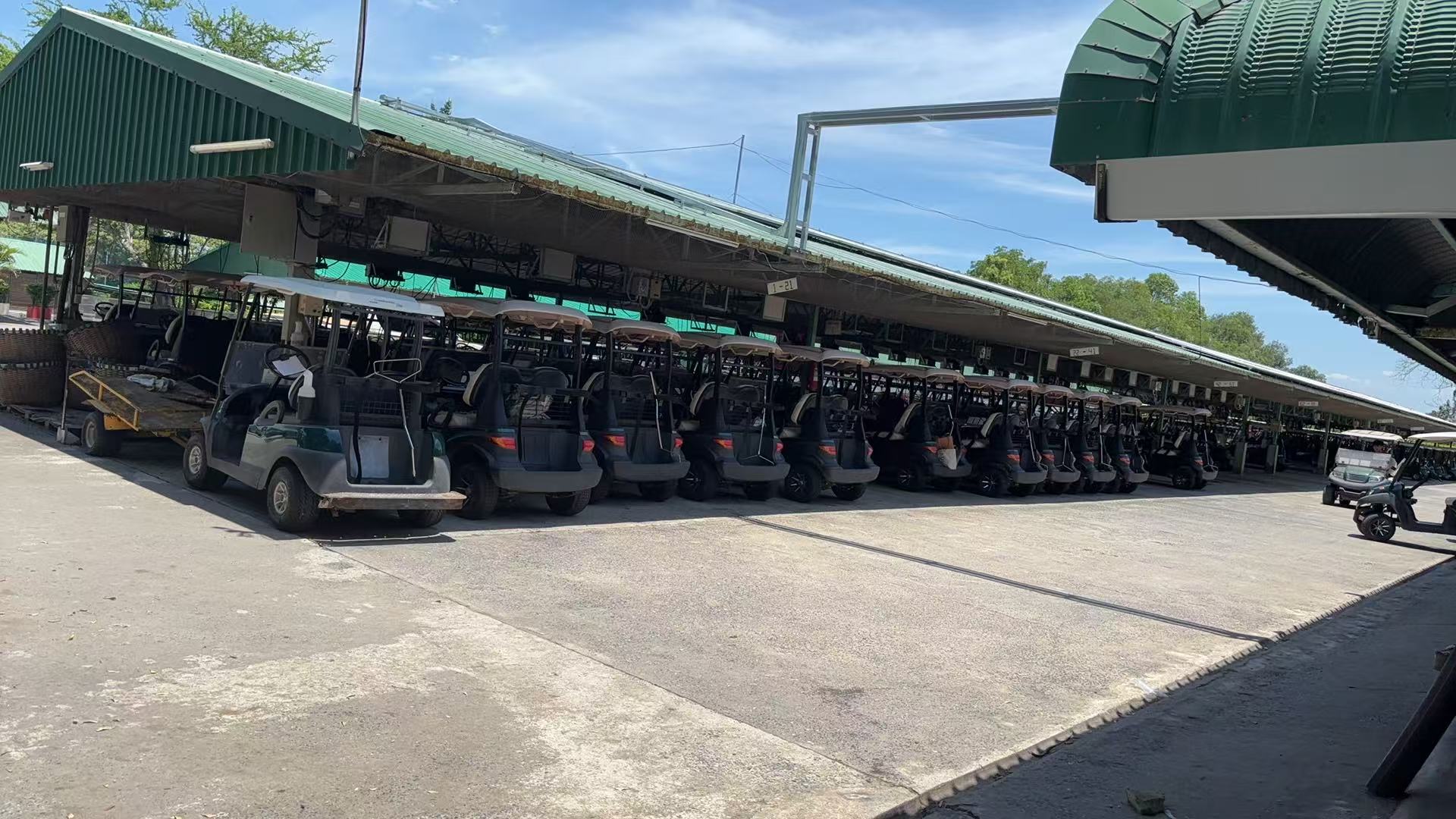
Documented case: Thailand OEM, 20,000 units over five years. The company reports a five-year OEM relationship supplying 20,000 units for golf carts in Thailand, designed for high-temperature and high-humidity conditions, replacing lead-acid with lithium. Read it for what it establishes — a long-running OEM supply relationship in a hot, humid market — and not for more. It does not establish performance on your duty cycle, with your controller, or under your warranty terms; those are sample-and-validate questions.
Where supplier evaluations usually break
- Certificate without scope. A valid ISO 9001 certificate is accepted as product approval, when it only describes a certified process scope.
- MSDS treated as certification. A hazard-communication sheet is filed as if it were a compliance certificate, and the real market-access question is never asked.
- Expiry ignored. Documents that were valid at evaluation expire before shipment, and the problem surfaces at the port.
- Annual capacity confused with available capacity. A plant-level output figure is used to justify a delivery date the booking calendar cannot support.
- No written acceptance criteria. The pre-shipment test is agreed verbally, so there is nothing to enforce when a batch arrives out of specification.
FAQ
Does an ISO 9001 certificate mean a golf cart battery is approved for my market?
No. ISO 9001:2015 certifies a quality management system within a stated scope — for SISWAY Battery, certificate 24CN34504502Q covers R&D and production of lithium-ion batteries excluding 3C requirements and is valid to 5 April 2027. Market access depends on separate requirements such as transport testing and destination-country rules, so the certificate supports a supplier qualification decision rather than a product approval.
What should I check in an OEM lithium golf cart battery manufacturer?
Check four things: a documented OEM scope that names the customization offered (logo, design, size, specifications), engineering capacity to support that customization, model-level certification for the voltage class you are ordering, and a validation path before volume. OEM production services alone prove the service exists; the sample build, the drawing approval and the pre-shipment test prove it works for your cart.
What is the minimum order quantity for a golf cart battery sample?
The documented minimum order quantity is 1 unit, including for the 72V 105Ah model. A single-unit order is best used as a validation step: confirm fitment, controller communication and charger compatibility against the datasheet before committing to a fleet or distribution quantity.
How long does production and delivery take?
The stated lead time is 15–30 days, with delivery terms of FOB, CIF or overseas warehouse shipment. Confirm in writing whether the clock starts at PO confirmation, deposit or document approval, and check that your transport documents remain valid across the shipment window — the UN38.3 report and MSDS on file both expire on 31 December 2026.
What after-sales support is available for US buyers?
SISWAY Battery documents a US after-sales service team and a US overseas warehouse, alongside payment options that include T/T, L/C, PayPal, Western Union and Trade Assurance. For a specific model, sample or quotation, contact the team at inquiry@siswaybattery.com or WhatsApp +86 137 1478 6322, and ask for the document matrix for the exact voltage and capacity you intend to order.
Conclusion
A capacity-first, certification-second, delivery-third evaluation is not bureaucracy; it is the cheapest way to avoid a battery order that cannot ship. Capacity numbers tell you whether the plant can make your volume, model-level documents tell you whether the pack can travel and be sold, and a milestone schedule tells you whether the date is real. The test of a finished evaluation is simple: every capability claim you relied on should trace to a document number, a scope and a validity date, and every acceptance criterion should already be inside the purchase order.
SISWAY Battery's published evidence makes the exercise concrete — a 20,000 m² facility and 90,000-unit annual capacity, ISO 9001 certificate 24CN34504502Q linked to its 48V, 51.2V and 72V models, a model-specific UN38.3 report and a US-market MSDS, and an OEM scope covering logo, design, size and specification customization. Read the dates, check the scopes, and confirm the booking before you sign.
Next step: request the model-specific document matrix and a validation sample before committing to volume.
Shenzhen Shiwei New Energy Co., Ltd. (SISWAY Battery) · Email: inquiry@siswaybattery.com · Tel / WhatsApp: +86 137 1478 6322 · No.11 Tianyang 5th Road, Songgang Street, Bao'an District, China
Download the English company catalog and product brochure: SISWAY product brochure (PDF). Product range and company profile: SISWAY Battery.
Have Questions or Need More Details?
Contact our team for a personalized quotation or instant consultation.
Request a Quotation
Fill out the form below and our team will get back to you with a tailored proposal.
WhatsApp Direct Chat
Prefer to chat in real-time? Message us on WhatsApp for instant assistance & quick answers.
- Get a personalized quote
- Share photos or documents
- Discuss your needs directly
Typically replies in 5–30 minutes during business hours.