Golf Cart Battery Application Guide: 48V, 51.2V & 72V for Course, Resort & Campus Fleets
Golf Cart Battery Application Guide: 48V, 51.2V & 72V for Course, Resort & Campus Fleets
Voltage should be chosen from the duty cycle, not from the badge on the cart. For golf course, resort and campus shuttle fleets, the 48V, 51.2V and 72V LiFePO4 golf cart battery classes serve three different route profiles. A 48V 100Ah pack covers short-loop course duty where carts return to the clubhouse frequently. A 51.2V 100Ah pack is classified inside the 48V golf cart battery category and suits 48V-class carts that need more stored energy in a different footprint. A 72V 105Ah pack carries the energy and power headroom required by longer shuttle loops with gradients and heavier passenger loads.
This guide is written for the people who actually sign the purchase order: fleet managers replacing a tired lead-acid set, resort operations teams specifying a new shuttle batch, campus facilities buyers adding carts to an existing route, and distributors quoting golf cart battery replacement work. It maps the three voltage classes supplied by Shenzhen Shiwei New Energy Co., Ltd. (Sisway Battery) to three fleet scenarios, then sets out the purchasing terms and acceptance criteria that should be agreed before delivery — including the certification documents to check: UN38.3 Test Report No. TSZ25H8045A01-01 for the 48V 100Ah LiFePO4 battery, MSDS No. TSZ25LL028A86-01 for the USA market, ISO 9001:2015 for the 48V battery, certification No. 24CN34504502Q for the 51.2V battery, and ACM International Certification Limited documentation for the 72V battery.
Shenzhen Shiwei New Energy Co., Ltd., trading as Sisway Battery, is a LiFePO4 battery pack manufacturer established in 2017 that builds golf cart batteries for golf carts, UTVs, ATVs, forklifts, AGVs and home energy storage, and exports to dozens of countries with the USA as a major market. The company's 20,000 m² facility, stated annual capacity of 90,000 units and 25-engineer R&D team are the supplier-side facts used in the capability section below.
Why Fleet Voltage Decisions Go Wrong
Most fleet battery mistakes are not caused by bad cells. They are caused by three specification shortcuts taken early in the project.
- Voltage copied from the old cart. A fleet standardises on 48V because the previous carts were 48V, then discovers that two new shuttle routes need more energy per shift than a 4,800Wh pack can deliver with a comfortable margin.
- Capacity chosen from the Ah label alone. Two packs can both read 100Ah and still differ in stored energy, continuous discharge current and peak current. A 48V 100Ah pack stores 4,800Wh; a 51.2V 100Ah pack stores 5,120Wh. The Ah number does not describe the route.
- Acceptance left verbal. Fitment, charger matching, BMS behaviour, document set and packaging are agreed by phone, then disputed at the loading dock.
The practical result is a fleet with mixed voltage classes, mixed chargers and mixed documentation — which is exactly the situation this guide is designed to prevent.
Industry Background: A Mixed-Voltage Installed Base
The global golf cart battery market was estimated at USD 1.49 billion in 2024 and is forecast to reach USD 2.21 billion by 2030 (Strategic Market Research, SRC-0001). Within that market, lithium-ion batteries accounted for a 47.18% share in 2024 (Mordor Intelligence, SRC-0002) — close to half, but still short of a lithium default.
The reason lithium has not yet replaced lead-acid outright is visible in the voltage mix. In 2024, 6V batteries still held a 43.45% share of the market by voltage type, driven by legacy systems (SRC-0002). Many of those 6V packs sit inside multi-unit strings that are later converted to a single higher-voltage pack — the classic 48V golf cart battery replacement project.
Chemistry performance explains the direction of travel. LiFePO4 cells are reported to deliver 2,500 to 9,000 cycles at 80% depth of discharge, while flooded lead-acid units typically deliver 300 to 500 cycles (SRC-0002, EV-0005). For a shuttle fleet cycling daily, that difference — not the sticker price — is the number that governs replacement intervals.
The practical consequence for a 2026 fleet specification is that 48V, 51.2V and 72V carts will coexist on the same property for years. A voltage guide is therefore a fleet-management document, not a shopping list.
Matching Each Voltage Class to a Fleet Duty Profile
Four duty inputs decide the voltage class: daily distance and number of stops, passenger or payload load, route gradient, and the recharge window between shifts. Ambient temperature is the fifth input, because all three classes share the same operating envelope — charge from 0°C to 45°C and discharge from −20°C to 55°C — so a route that must charge below freezing needs the low-temperature cut-off behaviour confirmed, not a different chemistry.
48V 100Ah: Short-Loop Course Duty
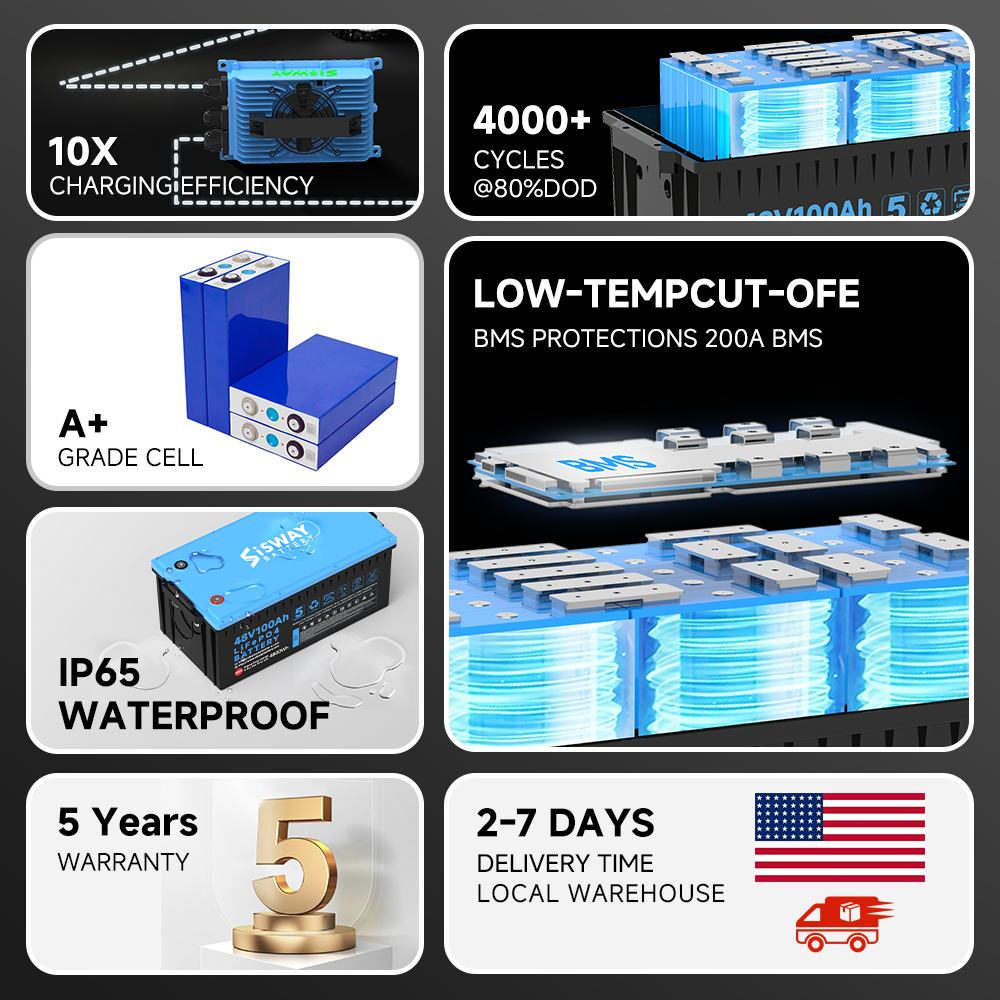
The 48V 100Ah model (product ID 6885) is a 48V golf cart battery with a nominal voltage of 48V, a nominal capacity of 100Ah and 4,800Wh of stored energy. It uses a 15S1P configuration of EV grade A LiFePO4 cells in a plastic case built to the classic lead-acid footprint, which is why the product is positioned as a drop-in replacement for lead-acid battery cases.
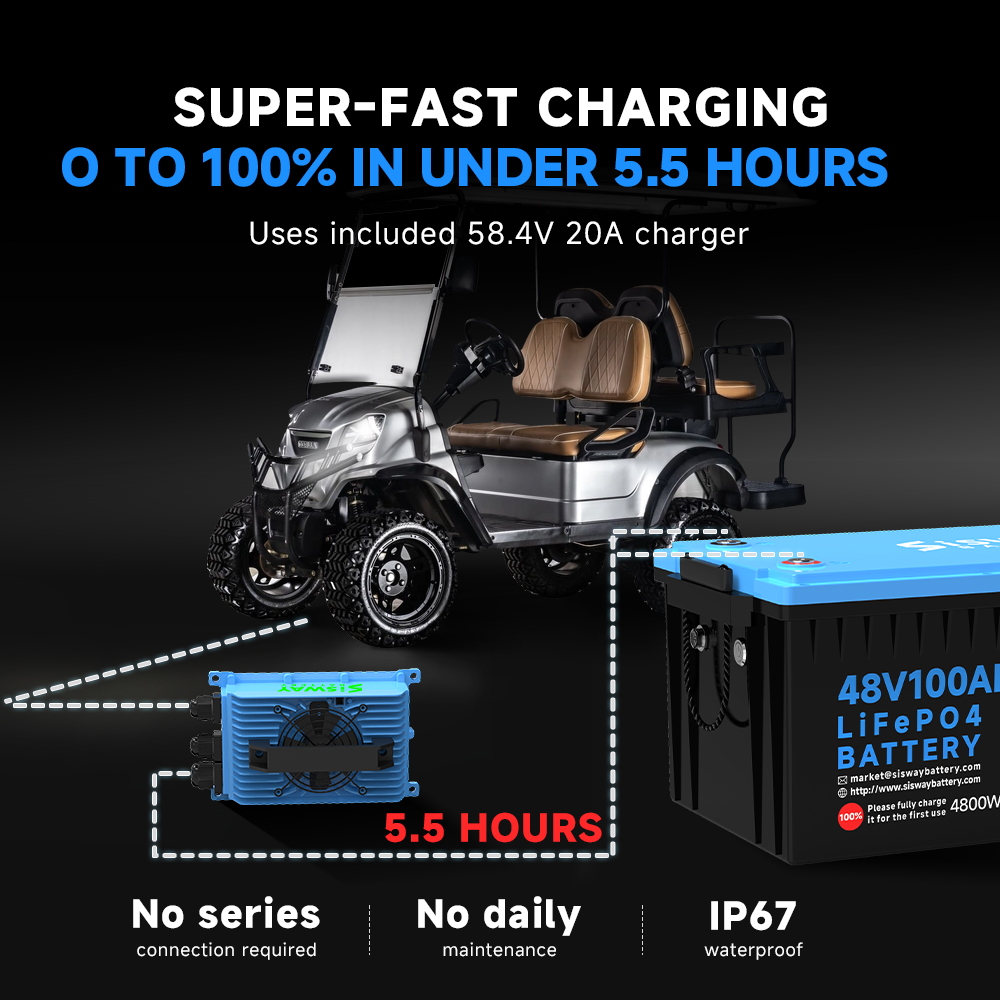
Key operating figures: a smart 200A BMS, 9.6kW maximum load power, 200A maximum continuous discharge, 300A peak discharge for 2 seconds, 41.25V discharge cut-off, a standard charge time of 6 hours and an included 18A charger. Weight is 77 lb with dimensions of 20.55"L × 10.55"W × 8.74"H. Cycle life is stated at 4,000+ cycles, and the pack carries a 5-year warranty plus a US-based warehouse for support. An LCD touch screen and mobile app provide dual monitoring of state of charge, voltage and current.
The matching duty profile is a short-loop course cart: repeated nine-hole or half-loop runs, frequent returns to the clubhouse, moderate gradients and a defined overnight charge window. The 20.55" × 10.55" × 8.74" envelope is also a fitment advantage where the compartment was designed around a lead-acid case.
51.2V 100Ah: 48V-Class Carts That Need More Energy
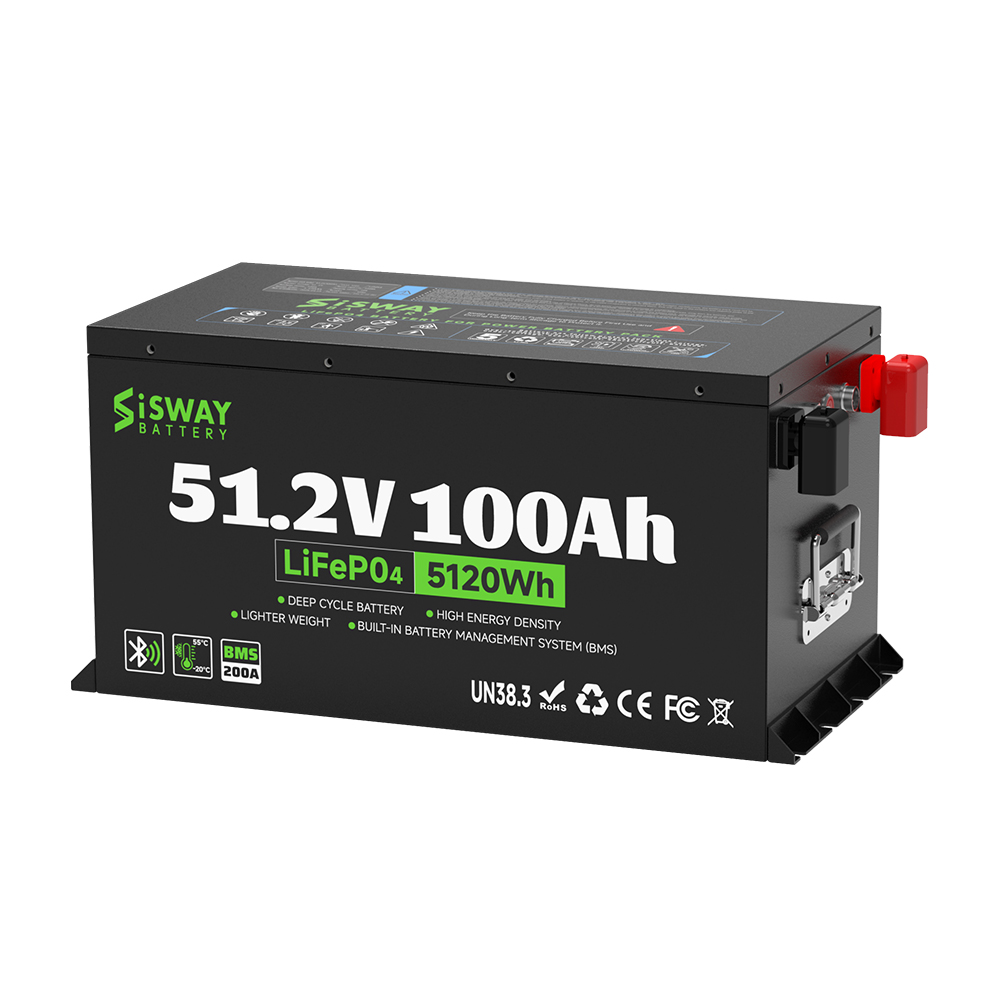
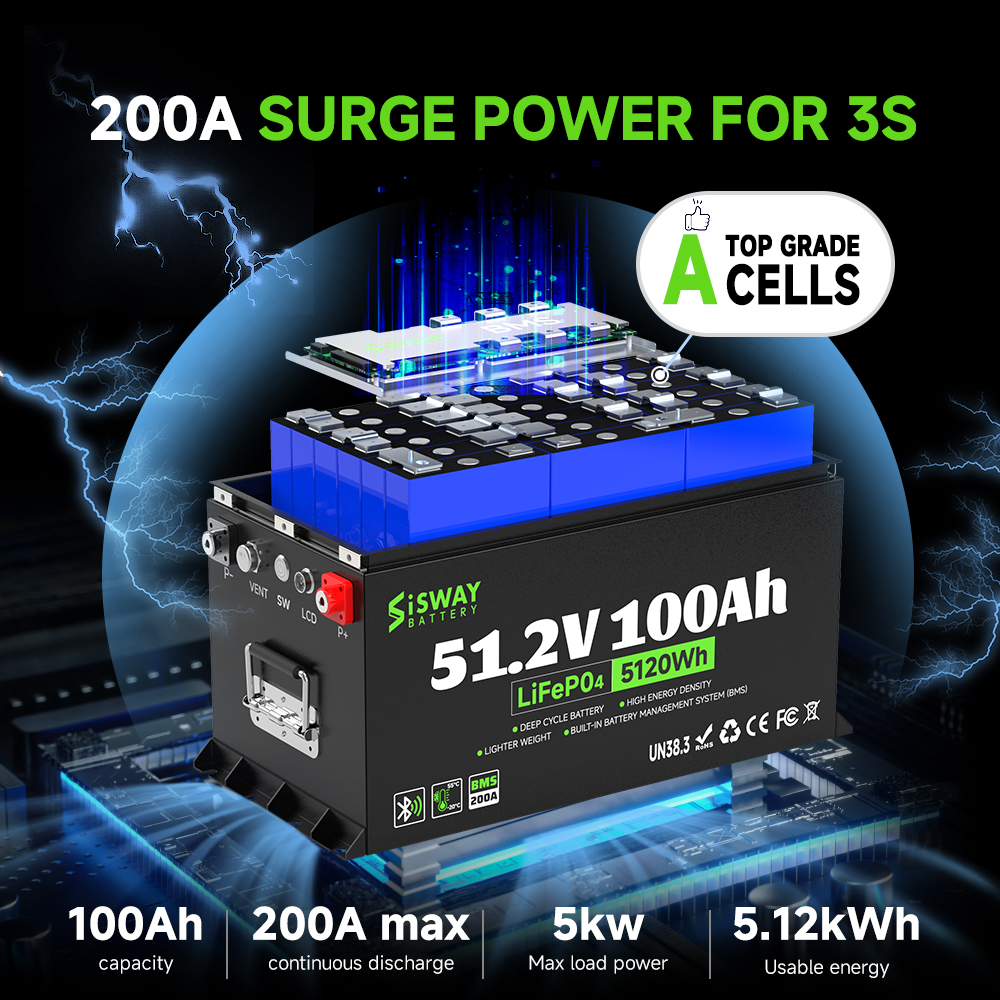
The 51.2V 100Ah model sits in an unusual but useful position: it is classified under the 48V golf cart battery category, is compatible with most 48V (58.4V) golf cart systems, and is labelled at 51.2V nominal with 5,120Wh of energy. In practice that means a cart whose controller already works in the 48V class can gain stored energy without moving to a 72V architecture.
Specified figures include a 200A BMS with seven protections (over/under voltage, over/under temperature, over-current, short circuit and cell balancing), 200A maximum continuous discharge, 300A peak for 3 seconds, 5,120W maximum continuous output power, 58.4V charge voltage and an 18A maximum continuous charge current. Low-temperature charge cut-off is set at 0°C ± 4°C, and the pack has passed short circuit, vibration and 1-metre drop tests according to the product documentation. Cycle life is ≥4,000 cycles, the casing is metal, dimensions are 625 × 505 × 360 mm, and the warranty term is 3 years. MSDS and UN38.3 are listed for this model.
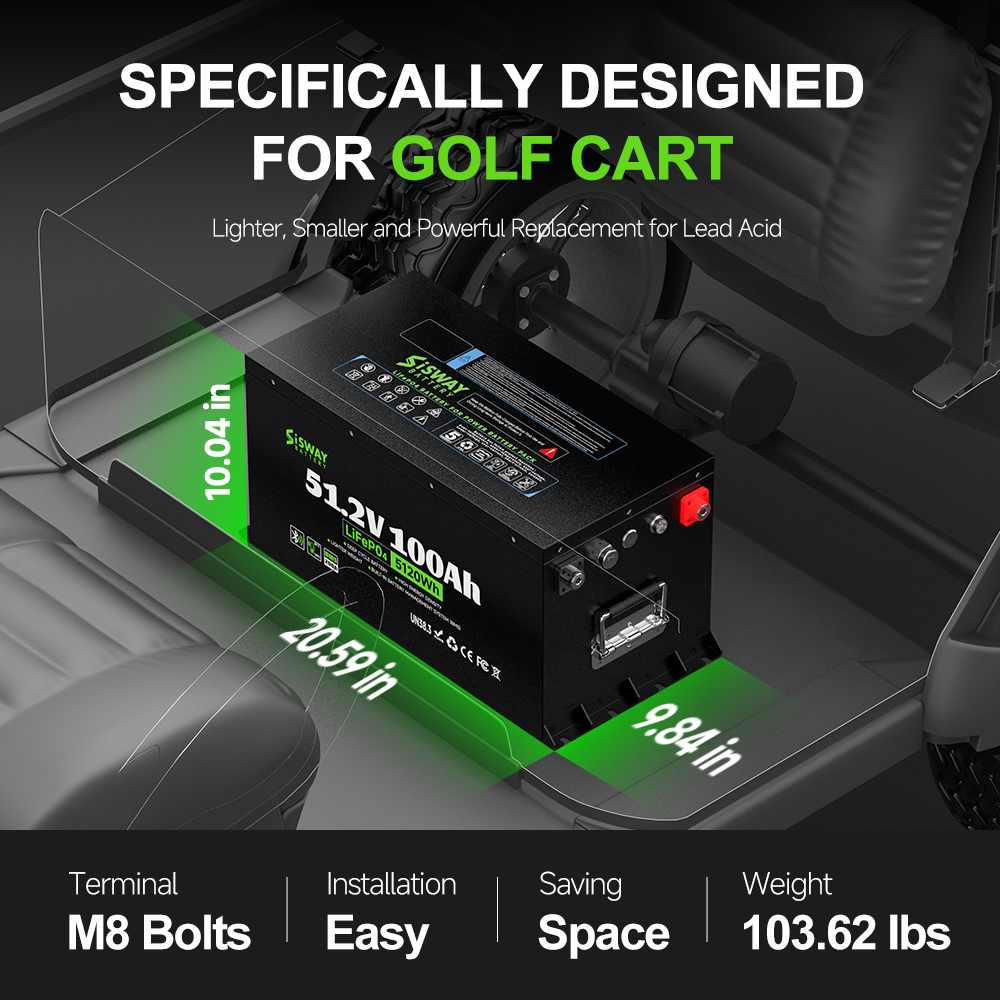
Because the form factor is a 625 × 505 × 360 mm metal case rather than a lead-acid shell, the 51.2V pack is not a blind drop-in. Measure the compartment before ordering — fitment varies by cart model, and this is the single most common specification error in 48V-class conversions.
72V 105Ah: Long Shuttle Loops and Gradients
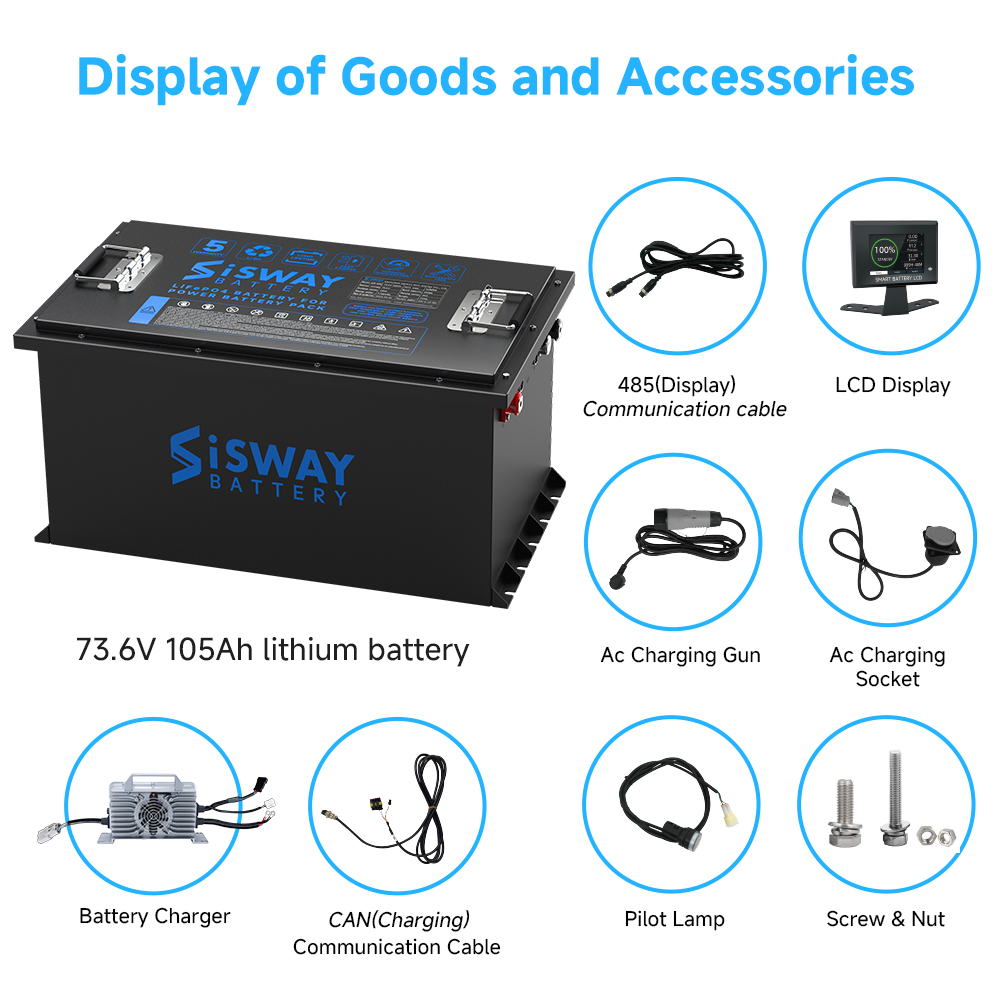
The 72V 105Ah model is a 72V golf cart battery designed as a replacement pack for golf cart applications, with a nominal voltage of 73.6V and a nominal capacity of 105Ah. Stored energy is 7,728Wh and maximum load power is 14.72kW — the highest of the three classes.
Electrical specifications include a smart 200A BMS, 200A maximum continuous discharge, 400A peak discharge for 10 seconds, a discharge cut-off voltage of 63.25V and a 23S1P configuration of EV grade A LiFePO4 cells with prismatic aluminium shells. An 18A charger is included and brings the pack from 0 to 100% in roughly 5 to 6 hours, or from 60% to 100% in about 3 hours. Cycle life is stated at 4,000+ cycles at 100% depth of discharge and 6,000+ cycles at 80% depth of discharge. The pack weighs 138 lb (63 kg) and measures 558 × 333 × 300 mm, with low-temperature cut-off protection and a 5-year after-sales service supported by a US warehouse.
A verification note for 72V projects: the supplier uses both 72V and 73.6V terminology for this class. Treat that as a compatibility checkpoint, not a marketing detail — confirm the controller's accepted voltage window and maximum charge voltage against the datasheet before approving the pack.
Step-by-Step: Selecting and Approving a Fleet Battery
- Audit the installed fleet first. Record the controller voltage class of every cart, not just the newest units. A fleet with 48V-class controllers cannot absorb a 72V pack without a drivetrain decision, and 36V carts sit outside this comparison entirely — they need a different voltage class.
- Measure the real duty cycle. Log daily distance, stop count, passenger load and gradient for a representative week. Two routes on the same property can require different classes.
- Size energy and power separately. Energy (Wh) sets how much work fits in one shift; continuous and peak current set climbing and acceleration. A 48V 100Ah pack offers 4,800Wh and 9.6kW; a 72V 105Ah pack offers 7,728Wh and 14.72kW. Match both numbers to the route.
- Confirm fitment and weight before quotation. Compartment dimensions and lifting capability should be checked against the actual model: 20.55" × 10.55" × 8.74" and 77 lb for the 48V 100Ah, 625 × 505 × 360 mm for the 51.2V 100Ah, and 558 × 333 × 300 mm and 63 kg for the 72V 105Ah.
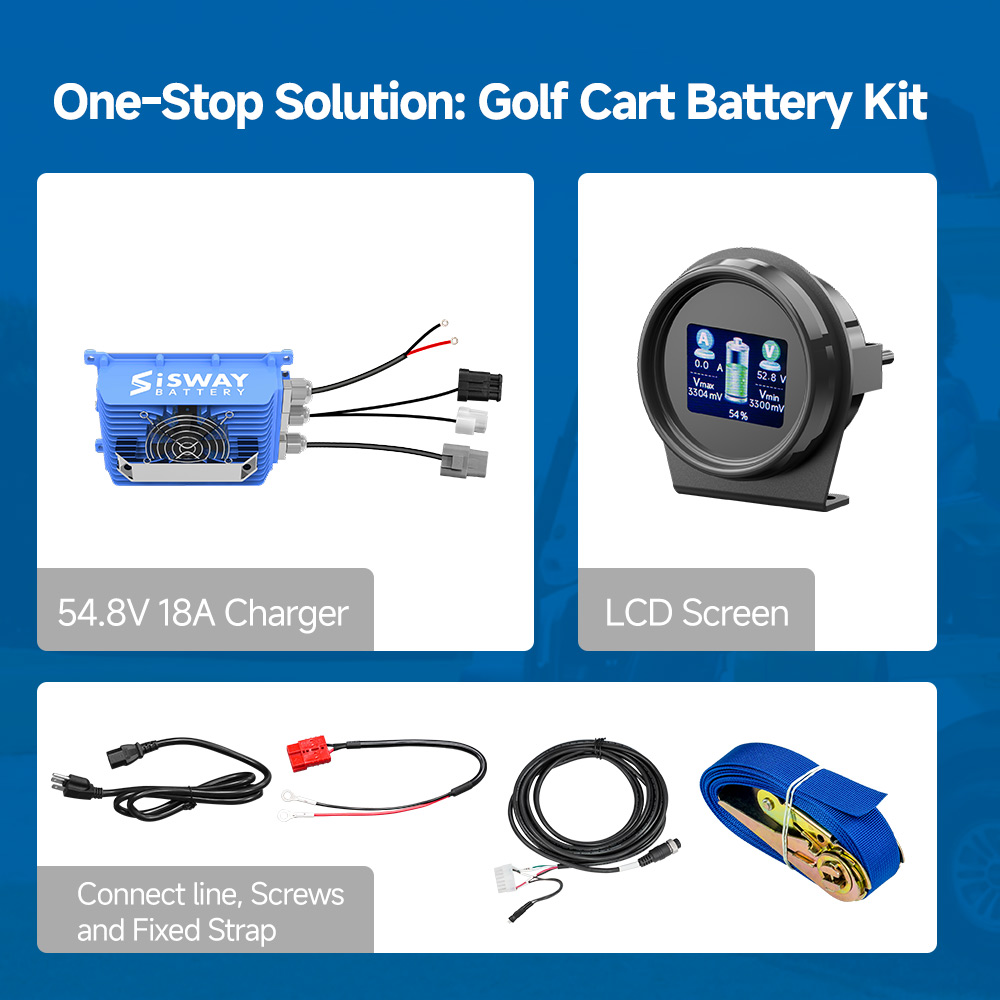
- Fix the charger in the same order. Each model is supplied with an 18A charger matched to its charge profile — 58.4V for the 51.2V pack. Mixing chargers across voltage classes is a warranty and safety problem, not a convenience.
- Write the purchasing terms into the PO. Model designation, nominal voltage, nominal capacity, BMS rating, charger inclusion, warranty term, packaging, spare parts and Incoterms should all appear as line items.
- Agree the acceptance criteria before the first shipment. Document review, visual inspection, charger verification and monitoring behaviour should be signed off as a checklist so that delivery is a confirmation step rather than a negotiation.
- Pilot, then scale. Run one route with one voltage class for a full cycle window before converting the rest of the fleet.
Purchasing Terms and Pre-Delivery Acceptance Criteria
The commercial section is where most fleet projects lose time. The following terms can be agreed in writing without any price discussion, and each one removes a common dispute.
Terms to fix in the purchase order
- Model designation and voltage label as written on the datasheet (for example 48V 100Ah, or 72V 105Ah at 73.6V nominal)
- Nominal capacity, stored energy and BMS current rating
- Charger inclusion, charger output current and charge voltage
- Warranty term per model — 5 years for the 48V and 72V packs, 3 years for the 51.2V pack
- Document set attached to the shipment (see the certification checklist below)
- Packaging, labelling and any distributor-specific marking
- Delivery schedule, Incoterms and destination port, stated in writing rather than assumed
- Spare parts and after-sales route, including the support channel used for claims
Certification Documents to Verify Before Delivery
Compliance is checked document by document against the exact model on the PO. Five documents matter for this range:
- UN38.3 Test Report No. TSZ25H8045A01-01 — the transport-safety test report for the 48V 100Ah LiFePO4 battery.
- MSDS No. TSZ25LL028A86-01 — the material safety data sheet issued for the USA market.
- ISO 9001:2015 — the quality management certification tied to the 48V battery supply.
- Certification No. 24CN34504502Q — the certification reference for the 51.2V battery.
- ACM International Certification Limited — the certification body documentation for the 72V battery.
Verification means three checks per document: the model and capacity on the document match the PO line, the certificate holder is the named supplier, and the document is current rather than superseded. A shipping file that contains a document for a different capacity class is not evidence of compliance for the pack in the crate.
Application Scenarios: Course, Resort and Campus
Golf Course Fleets
Course duty is repetitive and predictable: many short loops, frequent returns to the clubhouse, moderate gradients and a fixed overnight window. This is the natural home of the 48V 100Ah class, whose 4,800Wh and 9.6kW maximum load power match a route that never runs far from a charger. Where a course has one or two longer signature loops, the 51.2V 100Ah pack adds 320Wh of stored energy inside the same 48V-class architecture, provided the compartment accepts the 625 × 505 × 360 mm case.
Resort Fleets
Resort operations usually mix guest transfers, staff movement and back-of-house logistics in one fleet, which produces an irregular duty cycle — short trips on some days, continuous shuttle work on others. Two design choices matter here: stored energy headroom so that an unexpectedly busy day does not strand a cart, and live monitoring. All three models provide state-of-charge and voltage visibility through a monitor and app or LCD, which lets operations staff rotate carts by actual charge state instead of by assumption.
Campus Shuttle Fleets
Campus shuttle routes are the closest thing to a fixed bus timetable in golf cart operations: multi-stop loops, scheduled departures, higher ridership and, on many sites, gradients between building clusters. This profile suits the 72V 105Ah pack, which pairs 7,728Wh with 14.72kW maximum load power, 200A continuous and 400A peak discharge, and states a range of up to 50 miles per charge. The 5 to 6 hour full-charge time also allows a mid-day top-up when the timetable pauses.
Dealer and Refurbishment Channels
Dealers and refurbishment workshops rarely buy a single voltage class, because they rebuild whatever the local fleet already runs. For that channel, the useful approach is to hold all three classes on one specification sheet so that a 48V golf cart battery replacement, a 51.2V upgrade on a 48V-class cart, and a 72V shuttle build can be quoted from the same document set without re-verifying certification every time.
Comparison Table: 48V 100Ah vs 51.2V 100Ah vs 72V 105Ah
| Specification | 48V 100Ah | 51.2V 100Ah | 72V 105Ah |
|---|---|---|---|
| Category | 48V Golf Cart Battery | Classified under the 48V golf cart battery category | 72V golf cart battery |
| Nominal voltage | 48V | 51.2V (compatible with 48V / 58.4V systems) | 73.6V nominal, marketed as 72V |
| Nominal capacity | 100Ah | 100Ah | 105Ah |
| Stored energy | 4,800Wh | 5,120Wh | 7,728Wh |
| Max load / output power | 9.6kW | 5,120W continuous output | 14.72kW |
| BMS | Smart 200A | 200A with 7 protections and cell balancing | Smart 200A |
| Max continuous discharge | 200A | 200A | 200A |
| Peak discharge | 300A (2 sec) | 300A (3 sec) | 400A (10 sec) |
| Charger | 18A charger included; 6h standard charge | 58.4V, 18A charger included | 18A charger included; 5–6h 0–100% |
| Cell configuration | 15S1P, EV grade A LiFePO4 | Not stated in the supplied specification | 23S1P, EV grade A LiFePO4 |
| Case and dimensions | Plastic case, 20.55" × 10.55" × 8.74", 77 lb | Metal casing, 625 × 505 × 360 mm | Metal casing, 558 × 333 × 300 mm, 63 kg |
| Cycle life | 4,000+ cycles | ≥4,000 cycles | 4,000+ cycles at 100% DOD; 6,000+ at 80% DOD |
| Warranty | 5 years | 3 years | 5-year after-sales service |
| Key document to verify | UN38.3 Test Report No. TSZ25H8045A01-01; ISO 9001:2015 | Certification No. 24CN34504502Q; MSDS and UN38.3 listed | ACM International Certification Limited |
Read the table by route, not by row. The 48V column wins on fitment simplicity and warranty length, the 51.2V column adds stored energy inside a 48V-class system with a shorter warranty term, and the 72V column buys energy and peak current at the cost of weight and a controller voltage decision.
Frequently Asked Questions
Which certification documents should a fleet buyer verify before delivery?
Verify the documents against the exact model on the purchase order. For the 48V 100Ah LiFePO4 golf cart battery, check UN38.3 Test Report No. TSZ25H8045A01-01 and ISO 9001:2015. For shipments to the USA market, check MSDS No. TSZ25LL028A86-01. For the 51.2V 100Ah battery, check certification No. 24CN34504502Q; the product listing also references MSDS and UN38.3 for this model. For the 72V 105Ah battery, check ACM International Certification Limited documentation. In each case, confirm that the model, capacity and certificate holder on the document match the PO line, and that the document is current.
Can one golf cart battery manufacturer cover 48V, 51.2V and 72V fleets?
Shenzhen Shiwei New Energy Co., Ltd. (Sisway Battery) supplies all three classes: the 48V 100Ah pack, the 51.2V 100Ah pack classified under the 48V category, and the 72V 105Ah pack. The company was established in 2017, operates a 20,000 m² manufacturing facility with a stated annual production capacity of 90,000 units, employs approximately 150 staff including a 25-engineer R&D team, and exports to dozens of countries with the USA as a major market — export business accounts for 50% of total sales. Buyers should still confirm each voltage class against its own datasheet, because BMS rating, dimensions and warranty term differ by model.
How should budget be compared across 48V, 51.2V and 72V?
Compare cost per usable watt-hour and per cycle rather than per pack. The three classes store 4,800Wh, 5,120Wh and 7,728Wh respectively, and the warranty terms differ — 5 years for the 48V and 72V packs and 3 years for the 51.2V pack. Cycle life is stated at 4,000+ cycles for the 48V and 51.2V packs and 4,000+ cycles at 100% depth of discharge (6,000+ at 80%) for the 72V pack. All three include an 18A charger, so charger cost is not a differentiator within this range. Unit pricing is not published here, because a quotation depends on configuration, order volume and destination.
Can a fleet buyer test a sample before committing to a full order?
Yes. A sample or pilot unit can be requested before a fleet commitment, and it is worth running the pack on one real route for a full cycle window. Before requesting a sample, confirm the compartment dimensions against the specific model — 20.55" × 10.55" × 8.74" for the 48V 100Ah, 625 × 505 × 360 mm for the 51.2V 100Ah, and 558 × 333 × 300 mm for the 72V 105Ah — because fitment varies by cart model. The 48V and 72V models are supported by a US-based warehouse for after-sales service according to the product documentation.
What delivery terms and lead time should be fixed in the purchase order?
Ask for the delivery schedule, Incoterms, destination port and packaging terms in writing before the PO is issued, together with the document set that will travel with the shipment. Lead time is not fixed in this guide, because it depends on model, quantity and destination, and should be confirmed in the quotation itself. To obtain a written quotation with a confirmed delivery schedule, contact the Sisway Battery team at inquiry@siswaybattery.com or WhatsApp +86 137 1478 6322, or download the product catalog below and quote the model designations directly.
Next Step: Match a Voltage Class to Your Fleet Route
Share the route profile — daily distance, stop count, gradient, passenger load and recharge window — and the Sisway Battery team can map it to the 48V 100Ah, 51.2V 100Ah or 72V 105Ah pack, together with the matching certification document set for your destination market.
Sisway Battery Product RangeDownload the Catalog (PDF)
Email: inquiry@siswaybattery.com · Tel / WhatsApp: +86 137 1478 6322 · Address: No.11 Tianyang 5th Road, Songgang Street, Bao'an District, China
Conclusion
For course, resort and campus fleets, voltage is a route decision before it is a product decision. Short-loop course duty fits the 48V 100Ah pack with its 4,800Wh, 9.6kW and lead-acid footprint. 48V-class carts that need more stored energy fit the 51.2V 100Ah pack at 5,120Wh, provided the 625 × 505 × 360 mm compartment works. Long shuttle loops with gradients and higher ridership fit the 72V 105Ah pack at 7,728Wh and 14.72kW.
The second half of every fleet project is paperwork: purchasing terms agreed in writing, acceptance criteria signed off before delivery, and five specific certification references verified against the model on the PO. A committee that gets the voltage right and the documents right buys a battery. A committee that gets only one of the two buys a project.
Have Questions or Need More Details?
Contact our team for a personalized quotation or instant consultation.
Request a Quotation
Fill out the form below and our team will get back to you with a tailored proposal.
WhatsApp Direct Chat
Prefer to chat in real-time? Message us on WhatsApp for instant assistance & quick answers.
- Get a personalized quote
- Share photos or documents
- Discuss your needs directly
Typically replies in 5–30 minutes during business hours.