Golf Cart Battery Compliance Guide: Certifications Explained
A golf cart battery order is only as compliant as the documents that travel with it. Buyers sourcing 48V, 51.2V or 72V LiFePO4 packs are normally asked for three separate document layers, and each one answers a different question: can the battery be transported (UN38.3), is the factory's design and production system under control (ISO 9001:2015), and is the hazard information complete for the destination market (MSDS).
Sisway Battery, the brand of Shenzhen Shiwei New Energy Co., Ltd. (founded 2017, Bao'an District, Shenzhen, China), holds all three layers for its golf cart battery range. The documents currently referenced in this file are:
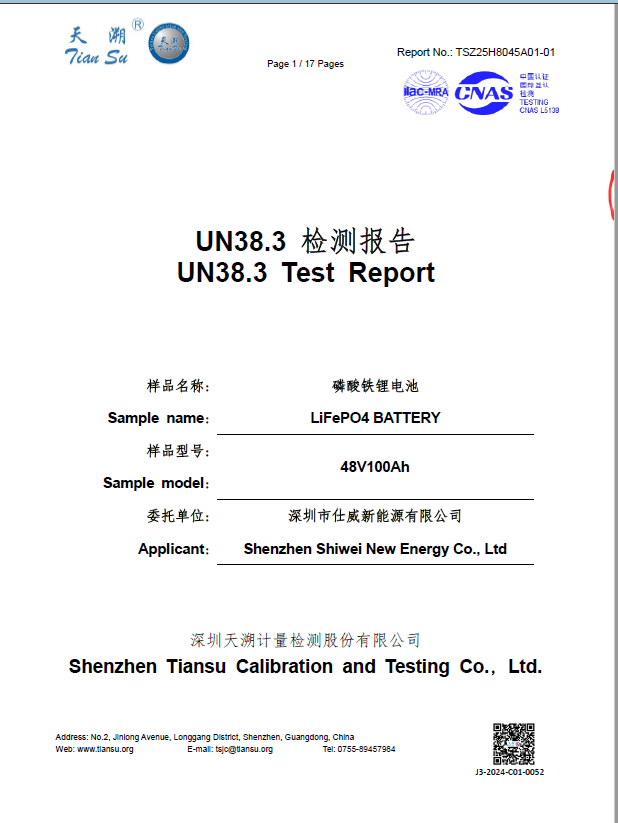
- UN38.3 Test Report No. TSZ25H8045A01-01 — scope: LiFePO4 battery, model 48V100Ah; global market; issued by Shenzhen Tiansu Calibration and Testing Co., Ltd. on 25 August 2025.
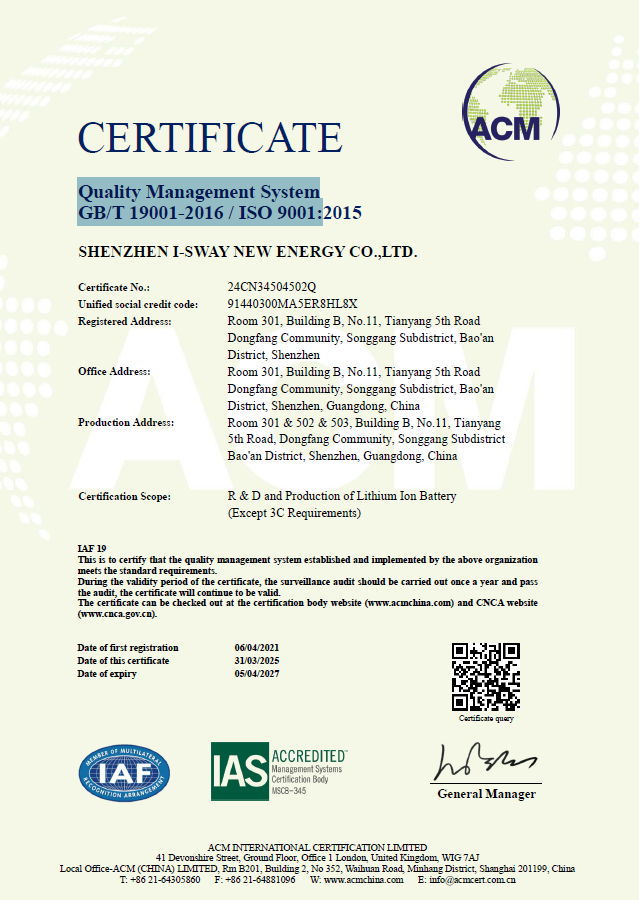
- ISO 9001:2015 Certificate No. 24CN34504502Q — issued by ACM INTERNATIONAL CERTIFICATION LIMITED under GB/T 19001-2016 / ISO 9001:2015; scope: R&D and Production of Lithium Ion Battery (Except 3C Requirements); valid 31 March 2025 to 5 April 2027; global market.
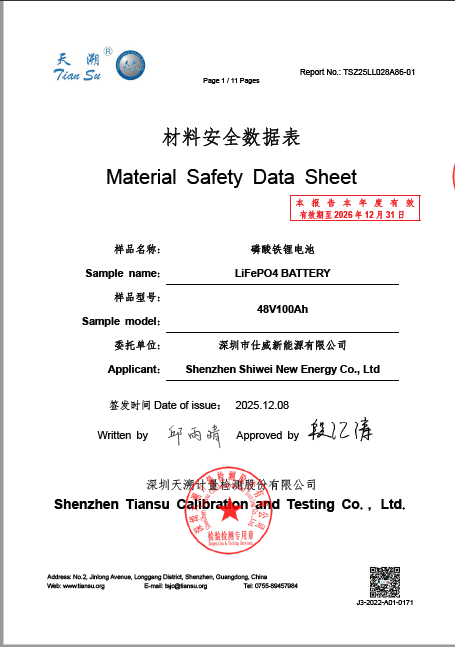
- MSDS No. TSZ25LL028A86-01 — USA market; aligned with GHS and OSHA HazCom 2012; issued by Shenzhen Tiansu Calibration and Testing Co., Ltd. on 8 December 2025.
This guide explains what each layer proves, where its coverage stops, how the 72V 105Ah model fits into the same file, and how to convert the paperwork into purchase-order acceptance criteria. Every number, date and document reference below is the one stated on the document itself.
Problem Definition: Why Compliance Files Break at the Order Stage
The failure mode that stops a golf cart battery shipment is rarely a dead battery on the test bench. It is a document that no longer matches the order. Four mismatches account for most of the friction between a quotation and a signed acceptance.
- Model mismatch. A transport report is written for one specific model. Report No. TSZ25H8045A01-01 names the model 48V100Ah. Quoting that report for a 51.2V or 72V pack creates a coverage gap that a reviewer will catch.
- Validity mismatch. Test documents carry end dates. Both the UN38.3 report and the MSDS listed above state 31 December 2026 as their validity end date, while the ISO 9001:2015 certificate runs to 5 April 2027. A purchase approved in one validity window can ship in another.
- Document-type mismatch. An MSDS is hazard communication documentation, not a certification, and ISO 9001:2015 certifies a management system, not a product's performance. Treating any of the three as a substitute for another is the most common filing error in procurement folders.
- Label mismatch. The 72V class is described with both 72V and 73.6V terminology. The nominal voltage on the datasheet (73.6V) and the marketing voltage (72V) must be reconciled against the vehicle controller before approval.
Each mismatch is cheap to fix before the purchase order and expensive to fix afterwards. The practical answer is to treat compliance as a per-model file rather than a per-supplier claim, and to attach that file to the order itself.
Industry Background: Why Documentation Became a Buying Gate
Lithium-ion batteries accounted for 47.18% of the golf cart battery market in 2024, according to Mordor Intelligence, and the same research house reports LiFePO4 cells delivering 2,500 to 9,000 cycles at 80% depth of discharge against 300 to 500 cycles for flooded lead-acid. Strategic Market Research values the global golf cart battery market at USD 1.49 billion in 2024, with USD 2.21 billion projected for 2030.
Market-size definitions differ between research houses, so the numbers above should be used from a single consistent source rather than blended. The structural point stands regardless of which figure a buyer cites: fleets are replacing modular lead-acid strings with larger single-pack lithium units, which raises both the unit value on a purchase order and the scrutiny applied to the paperwork behind it.
That shift changes what a supplier must be able to hand over. A lead-acid replacement cycle involved low-cost, locally available blocks. A lithium conversion involves a pack with an integrated battery management system, a defined charger voltage, a stated warranty term, and a transport classification. Procurement teams increasingly run a document review before they run a commercial negotiation, and the review is model-specific because the underlying test reports are model-specific.
Detailed Solution: The Three Compliance Layers That Matter
Layer 1 — UN38.3 Transport Testing
UN38.3 refers to the UN Manual of Tests and Criteria, Part III, Subsection 38.3. For Sisway's 48V 100Ah LiFePO4 golf cart battery, conformance is documented by Test Report No. TSZ25H8045A01-01, issued by Shenzhen Tiansu Calibration and Testing Co., Ltd., and stated to apply to the global market.
What this layer proves: the named model has been tested against the transport-safety criteria referenced in UN 38.3, and a report exists that a freight forwarder, carrier or customs reviewer can read. What it does not prove: that other capacities or voltages in the same product family were tested under the same report. The scope line — LiFePO4 battery, model 48V100Ah — is the boundary. When a buyer changes from 100Ah to another capacity, the correct action is to request the report that names the new model, not to re-use the existing number.
Layer 2 — ISO 9001:2015 Quality Management
ISO 9001:2015 certification covers the management system behind design and production, not a single unit's test outcome. Sisway's certificate No. 24CN34504502Q was issued by ACM INTERNATIONAL CERTIFICATION LIMITED against GB/T 19001-2016 / ISO 9001:2015, with a scope of “R&D and Production of Lithium Ion Battery (Except 3C Requirements)”, issued 31 March 2025 and valid to 5 April 2027, applying to the global market.
This is the layer that matters when a buyer asks a process question rather than a product question: is incoming material controlled, is production traceable, is testing documented, is non-conforming output segregated. The certificate itself does not state capacity, voltage or cycle life. It states that the organisation operates a certified quality system across R&D and manufacturing, and it is associated with the 48V 100Ah, 51.2V 100Ah and 72V 105Ah models.
How the 72V 105Ah Battery Fits Into the File
The 72V 105Ah pack does not have a separate product test report in this document set. Its position in the compliance file rests on the same ISO 9001:2015 certificate No. 24CN34504502Q issued by ACM INTERNATIONAL CERTIFICATION LIMITED, which is associated with the 72V 105Ah model and which covers how lithium-ion batteries are designed and produced. That is a manufacturing-system assurance, not a transport test result for that model.
Buyers of the 72V pack should therefore pair the certificate with model-level technical evidence. The documented figures for this unit are a 73.6V nominal voltage (marketed as 72V), 105Ah capacity, 7,728Wh energy, a 23S1P configuration using 23 EV-grade A LiFePO4 prismatic cells, a smart 200A BMS, 200A maximum continuous discharge, 400A peak discharge for 10 seconds, a 63.25V discharge cut-off, dimensions of 558 × 333 × 300 mm and a weight of 138 lb (63 kg). The BMS protects against over-charging, over-discharging, short circuits, over-temperature and over-current, and includes cell energy balancing. Low-temperature cut-off blocks charging below 32°F and resumes automatically at 41°F, with discharge cut-off below -4°F.
Practical reading
If the destination market, carrier or vehicle OEM requires a transport report that names the 72V model specifically, request it at RFQ stage by model and voltage. Report No. TSZ25H8045A01-01 is written for the 48V 100Ah model and should not be presented as covering the 72V pack.
Layer 3 — MSDS for the USA Market
The Material Safety Data Sheet listed in this file is No. TSZ25LL028A86-01, issued by Shenzhen Tiansu Calibration and Testing Co., Ltd., for the USA market, aligned with GHS and OSHA HazCom 2012, with a scope covering the lithium-ion golf cart battery series. It was issued on 8 December 2025 and carries a validity end date of 31 December 2026.
An MSDS is a hazard communication document: it tells a receiving facility, warehouse operator or safety officer what the product contains and how it should be handled, stored and responded to in an incident. It is not a certification and it does not replace a test report. Its practical value on a purchase order is that it unblocks the site-level safety review, which is often the last approval outstanding before a container can be received in the United States.
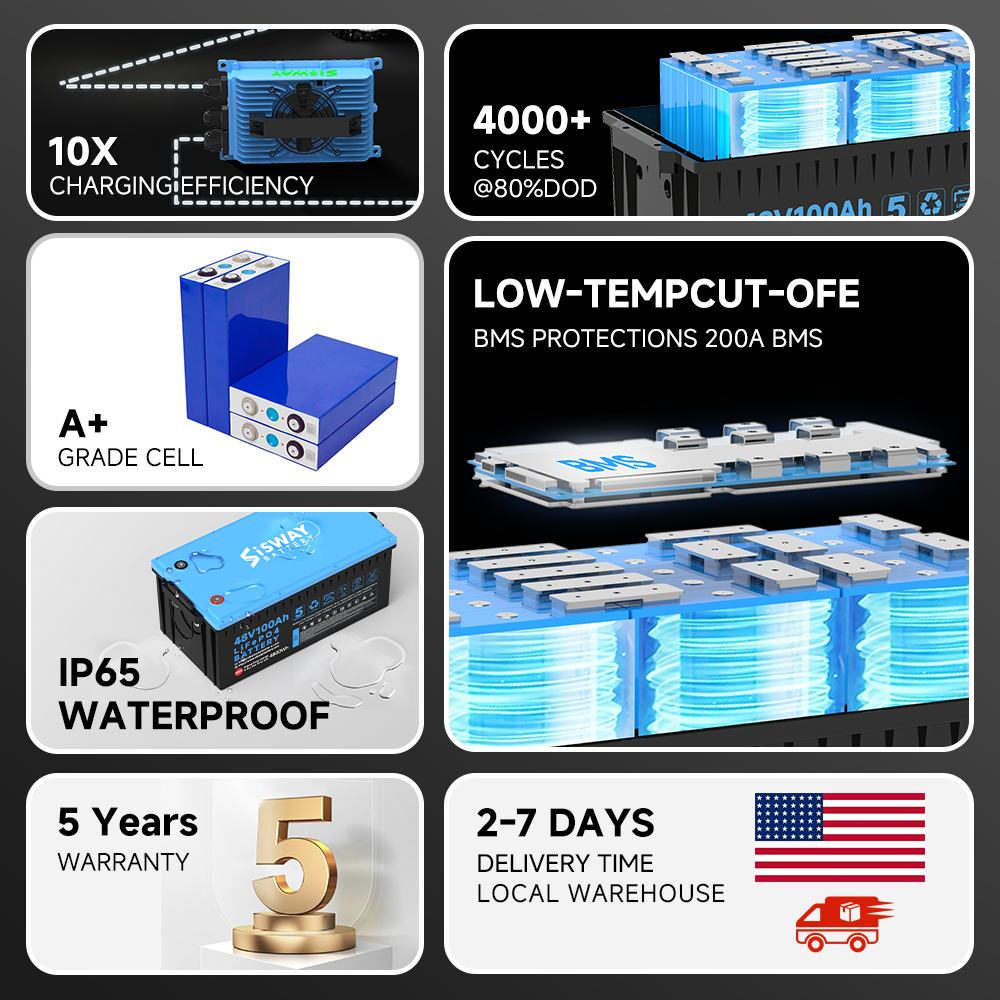
Product-level evidence complements it. The 51.2V 100Ah pack is documented as certified with MSDS and UN38.3 and as having passed short circuit, vibration and 1-meter drop tests, with a 200A BMS providing over/under-voltage, over/under-temperature, over-current and short-circuit protection, plus low-temperature charge cut-off at 0°C ± 4°C. The 48V 100Ah pack carries a 200A smart BMS with protection against over-charge, over-discharge, short circuit, over-temperature and over-current, app monitoring and an LCD touch screen, and a 5-year warranty.
What None of the Three Documents Covers
No single document above certifies drop-in fitment for a specific cart model, confirms controller compatibility, or approves a vehicle-level installation. Those remain engineering checks the buyer performs: compartment dimensions (625 × 505 × 360 mm for the 51.2V 100Ah unit; 20.55 × 10.55 × 8.74 in for the 48V 100Ah unit), charger voltage matching (58.4V charge voltage on the 51.2V pack), and discharge current against the controller's demand. Treating the compliance file as one input, and the technical datasheet as another, prevents the most expensive misreading of all — assuming a certificate guarantees fitment.
Step-by-Step: Building a Compliant Purchase File in Six Steps
The sequence below converts a supplier's document set into order-level acceptance criteria. It works for a single cart upgrade and for a fleet tender.
- Step 1 — Fix the SKU before requesting documents. Decide between the 48V 100Ah, the 51.2V 100Ah and the 72V 105Ah model, and record the exact voltage terminology. On the 72V class, write both the marketing label (72V) and the nominal figure (73.6V) into the specification so the datasheet and the purchase order cannot diverge later.
- Step 2 — Request documents by number, not by name. Ask for “UN38.3 Test Report No. TSZ25H8045A01-01”, “ISO 9001:2015 Certificate No. 24CN34504502Q issued by ACM INTERNATIONAL CERTIFICATION LIMITED” and “MSDS No. TSZ25LL028A86-01”. Named requests remove the ambiguity that lets a generic certificate be substituted for a model-specific one.
- Step 3 — Read the scope line against your SKU. Confirm that the report's model field matches the product you are buying. Where it does not, request the model-specific version before approving the price.
- Step 4 — Check validity against the shipping window. The UN38.3 report and the MSDS both state 31 December 2026; the ISO 9001:2015 certificate runs to 5 April 2027. With production lead time stated at 15–30 days, an order placed late in 2026 can cross the document expiry date before delivery, so renewal confirmation belongs in the order conditions.
- Step 5 — Write the documents into the purchase order. Add an acceptance clause naming each document number, the required model, the validity date that must be in force on the shipment date, and a statement that a mismatched document set is grounds for rejection.
- Step 6 — Re-verify at every repeat order. A document set is a snapshot. Before each reorder, re-check numbers, model coverage and validity — a habit that matters in fleet contracts running several years, such as the 20,000-unit, five-year golf cart OEM programme delivered into Thailand.
Use Cases: Where Each Document Layer Earns Its Place
Compliance documents are not abstract. Each layer unblocks a specific decision in a specific setting.
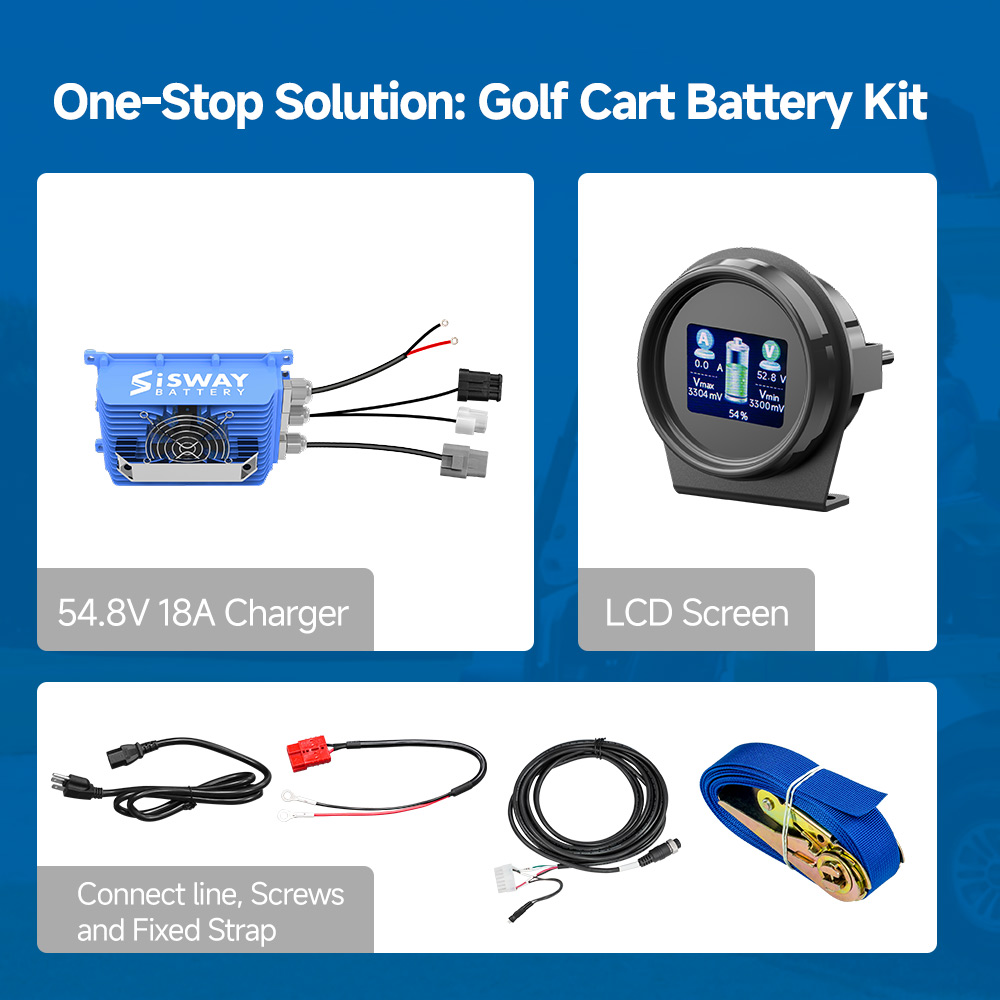
US venue, campus and resort fleets running 48V carts. The 48V 100Ah pack is the model whose file is written directly to the destination: UN38.3 Report No. TSZ25H8045A01-01 for global transport and MSDS No. TSZ25LL028A86-01 under GHS and OSHA HazCom 2012 for the USA market. With 4,800Wh of energy, 9.6kW maximum load power, 200A continuous and 300A peak discharge, a 77 lb drop-in case designed for lead-acid compartments, an 18A charger and a 5-year warranty, it is the unit most often specified where a fleet manager needs both a receiving-site safety file and an operational upgrade.
Resorts and campuses standardising on 51.2V. The 51.2V 100Ah pack provides 5,120Wh, 200A continuous discharge, a 58.4V charge voltage, 4,000+ cycles and a 3-year warranty, with LCD and optional app monitoring. Its file is documented as MSDS and UN38.3 certified plus short circuit, vibration and 1-meter drop testing. Buyers here should confirm the compartment envelope of 625 × 505 × 360 mm and request the model-specific transport report copy alongside the series-level MSDS.
High-power 72V conversions. The 72V 105Ah unit delivers 7,728Wh, 14.72kW maximum load power, 400A peak discharge for 10 seconds and 4,000+ cycles at 100% depth of discharge, with 6,000+ cycles at 80% depth of discharge, plug-and-play mounting holes, real-time monitor and app, and 5-year after-sales support backed by a US warehouse. Here the ISO 9001:2015 certificate carries the production-system argument, while the buyer negotiates a model-specific transport report as a separate line item.
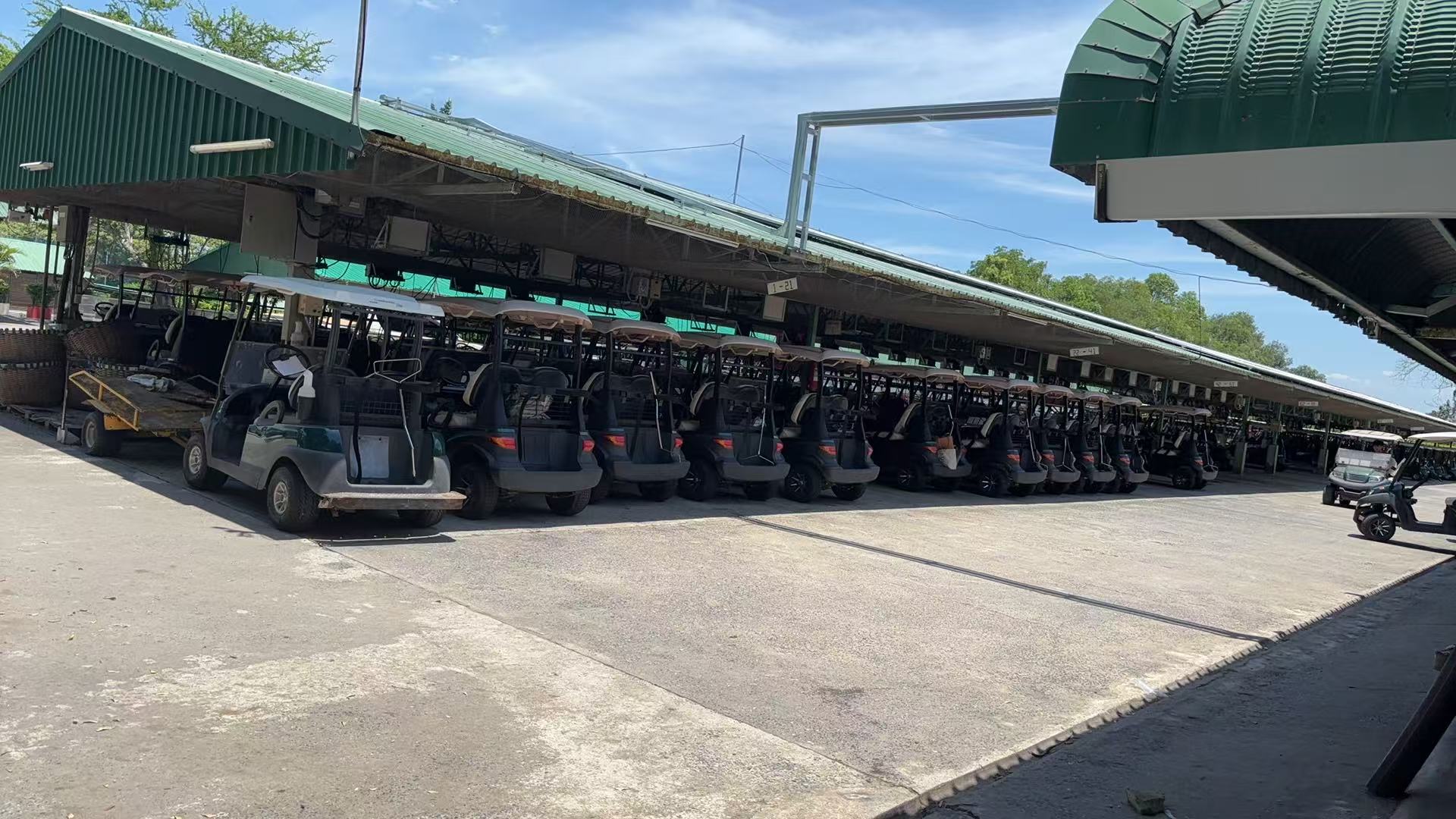
Dealers and refurbishment workshops. Mixed inventory is where document drift hurts most. A workshop holding 48V, 51.2V and 72V packs needs three distinct document references on file rather than one, because the 48V 100Ah UN38.3 report does not speak for the other two. Sisway's OEM programme supports this with logo, design, size and specification customisation, 100% testing, a stated monthly capacity of 5,000 units and a minimum order quantity of 1 unit.
Comparison Table: Document Coverage by Model
The table below maps the three document layers to the three product models, using only the document scopes and product specifications on file. Where coverage is at series level rather than model level, the appropriate action is to request a model-specific copy at RFQ.
| Model | UN38.3 Test Report | MSDS (USA) | ISO 9001:2015 | Documented warranty |
|---|---|---|---|---|
| 48V 100Ah 4,800Wh, 200A BMS | No. TSZ25H8045A01-01 names this model (48V100Ah); global market; validity to 31 Dec 2026 | Series-level MSDS No. TSZ25LL028A86-01; GHS / OSHA HazCom 2012; validity to 31 Dec 2026 | Certificate No. 24CN34504502Q; associated with this model | 5 years |
| 51.2V 100Ah 5,120Wh, 200A BMS | Product documented as certified with MSDS and UN38.3; report No. TSZ25H8045A01-01 is written for the 48V100Ah model — request model-specific copy | Series-level MSDS No. TSZ25LL028A86-01 applies to the lithium-ion golf cart battery series | Certificate No. 24CN34504502Q; associated with this model | 3 years |
| 72V 105Ah (73.6V nominal; 7,728Wh) | Not itemised in report No. TSZ25H8045A01-01; request by model and voltage if required by carrier or market | Series-level MSDS No. TSZ25LL028A86-01 for the lithium-ion golf cart battery series | Certificate No. 24CN34504502Q; associated with this model | 5-year after-sales service |
Sources: Sisway Battery certification and compliance records (UN38.3 Report No. TSZ25H8045A01-01; ISO 9001:2015 Certificate No. 24CN34504502Q issued by ACM INTERNATIONAL CERTIFICATION LIMITED; MSDS No. TSZ25LL028A86-01) and the corresponding product specifications.
FAQ
Which compliance documents should I request before approving a golf cart battery order?
Request three separate documents, each by its number. First, the UN38.3 Test Report No. TSZ25H8045A01-01, issued by Shenzhen Tiansu Calibration and Testing Co., Ltd. under UN 38.3 (UN Manual of Tests and Criteria Part III Subsection 38.3), which applies to the 48V 100Ah LiFePO4 battery and to the global market. Second, the ISO 9001:2015 Certificate No. 24CN34504502Q, issued by ACM INTERNATIONAL CERTIFICATION LIMITED under GB/T 19001-2016 / ISO 9001:2015, scoped to R&D and Production of Lithium Ion Battery (Except 3C Requirements), valid to 5 April 2027. Third, the MSDS No. TSZ25LL028A86-01 for the USA market, aligned with GHS and OSHA HazCom 2012. Confirm in each case that the model named in the document matches the model you are buying.
Can a customised OEM golf cart battery still be covered by this documentation?
Sisway offers OEM customisation of logo, design, size and specifications, with 100% testing and a stated monthly capacity of 5,000 units, and the ISO 9001:2015 certificate covers the R&D and production system that governs that work. Document coverage, however, is written per model: the UN38.3 report is scoped to the model 48V100Ah, so a customised pack with a different housing or specification should be matched to a document set that names the new configuration. Confirm the document position for the exact customised SKU at quotation stage rather than assuming the standard report transfers.
Which documented factors should drive budget planning for a compliant order?
Because quotations are issued per configuration, budget planning is better anchored on documented performance and service terms than on headline unit price. The relevant comparisons on file are energy per pack (4,800Wh for 48V 100Ah, 5,120Wh for 51.2V 100Ah, 7,728Wh for 72V 105Ah), cycle life (4,000+ cycles for the 48V and 51.2V packs; 4,000+ cycles at 100% depth of discharge and 6,000+ at 80% for the 72V pack), and warranty term (5 years on the 48V 100Ah and 5-year after-sales service on the 72V, 3 years on the 51.2V). For context on why cycle life matters commercially, LiFePO4 cells are reported at 2,500 to 9,000 cycles at 80% depth of discharge versus 300 to 500 for flooded lead-acid.
Can I evaluate a sample before placing a volume order?
Yes. The stated minimum order quantity is 1 unit, and production lead time is 15–30 days, so a single unit evaluation is operationally straightforward. Request the sample together with the document set for that model, so the unit you test and the paperwork you approve refer to the same configuration. Sample and document requests go to inquiry@siswaybattery.com or +86 137 1478 6322.
What is the delivery lead time, and can document validity affect it?
Stated production lead time is 15–30 days, with a monthly capacity of 5,000 units. Document validity can affect the shipping window: the UN38.3 report and the MSDS both carry a validity end date of 31 December 2026, so an order produced in that period but delivered after it should be confirmed against renewed documentation before dispatch. The simplest control is to state the required validity date in the purchase order and ask for the current document pack with the shipping documents.
Conclusion: Compliance Is a Per-Model File, Not a Claim
Three layers, three different jobs. UN38.3 Test Report No. TSZ25H8045A01-01 answers the transport question for the 48V 100Ah model. ISO 9001:2015 Certificate No. 24CN34504502Q, issued by ACM INTERNATIONAL CERTIFICATION LIMITED, answers the production-system question and extends across the 48V, 51.2V and 72V models. MSDS No. TSZ25LL028A86-01 answers the USA hazard-communication question for the lithium-ion golf cart battery series. The 72V 105Ah pack sits inside the ISO 9001:2015 system coverage, and its transport documentation should be requested by model where a carrier or market requires it.
The buying rule that follows is simple: name the document, match the model, check the date, and write all three into the purchase order. A supplier that can produce numbered, dated, model-specific documents is easier to audit, easier to renew and easier to keep as a long-term source — which is the actual purpose of the file.
Request the current compliance pack for your voltage class
Sisway Battery supplies LiFePO4 golf cart batteries in 48V 100Ah, 51.2V 100Ah and 72V 105Ah configurations, with OEM customisation, 100% testing, a stated monthly capacity of 5,000 units, MOQ of 1 unit and 15–30 day lead time. Ask for the document set that matches your model, or download the product catalogue first.
Download the Sisway Catalogue (PDF)
Shenzhen Shiwei New Energy Co., Ltd. (Sisway Battery) · No.11 Tianyang 5th Road, Songgang Street, Bao'an District, China · inquiry@siswaybattery.com · +86 137 1478 6322 · www.siswaybattery.com
Have Questions or Need More Details?
Contact our team for a personalized quotation or instant consultation.
Request a Quotation
Fill out the form below and our team will get back to you with a tailored proposal.
WhatsApp Direct Chat
Prefer to chat in real-time? Message us on WhatsApp for instant assistance & quick answers.
- Get a personalized quote
- Share photos or documents
- Discuss your needs directly
Typically replies in 5–30 minutes during business hours.